The rising cost of Renewable Identification Numbers (RINs) –– ethanol credits used by refineries to prove compliance with the federal Renewable Fuel Standard –– is putting added financial pressure on the refining sector, which already is squeezed by too-high inventories and thin crack spreads. In fact, for some refiners RIN expenditures may soon be their biggest single operating cost category. (Yes, you read that right.) The cost of ethanol credits is being driven up to record levels by several factors, chief among them the concern there may not be enough to go around this year and next. And things may only get worse from there. In today’s blog, we begin a two-part examination of the 2016-17 market for RINs, a regulatory must-do that rankles and vexes most refiners and gasoline importers.
The refining sector is not for the faint of heart or the foggy of mind –– the complexity of it all would challenge Job’s patience and Einstein’s cerebrum. Consider the hundreds of crude grades and incredible numbers of characteristics, including a continuum of qualities: from light to heavy, sweet to sour, and paraffinic to naphthenic, ad infinitum. We’re not talking checkers or even chess here; we’re talking three-dimensional chess. And each refinery is designed to process only a specific range of crude types. There’s the need to ratchet up toward summer-blend gasoline each spring and then gradually switching back to producing non-summer-blend at the end of driving season. And then there’s the need to schedule weeks-long “turnarounds” to do maintenance and other work, and deal with (heaven forbid) unscheduled maintenance/downtime. Not to mention the logistics of crude delivery and storage, refined-products production and delivery etc.
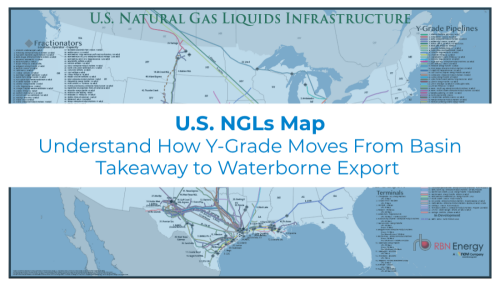
Visualize the infrastructure behind U.S. NGL movement.
The U.S. NGLs Map provides a comprehensive view of the transport, processing, and export networks moving NGLs across the U.S.
None of that, though, may be as hard to wrap your head around as Renewable Identification Numbers (RINs), a mechanism created by the Environmental Protection Agency (EPA) to help ensure that the provisions of the Renewable Fuel Standard (RFS) are being complied with. We took our first look at the RFS and RINs four years ago this week in A Market of Contradictions –– Ethanol Mandates, Motor Gasoline and the Blend Wall. A few weeks later we came back with more still more mind-numbing details in The RIN and Stimpy Show – Crushing Pain and Mandate Madness. In those blogs we explained the need to establish a mechanism to track the production of corn- or sugar-based ethanol (and biodiesel and other renewable fuels) and the blending of ethanol with gasoline; we also described how the whole RIN deal works.
About the song
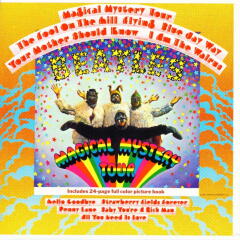
“Hello, Goodbye” was written by Paul McCartney and credited to Lennon/McCartney. It was recorded at EMI (Abbey Road) Studios in London in October-November 1967, with George Martin producing. The song was released as a single in November 1967, backed with John Lennon’s “I Am the Walrus” (also credited to Lennon/McCartney). It was the first non-album single released by the group since the death of their manager, Brian Epstein, and since the release of the phenomenally successful Sgt. Pepper’s Lonely Hearts Club Band album. Promotional films were made for “Hello, Goodbye” featuring The Beatles lip-syncing to the song, wearing their Sgt. Pepper’s uniforms. One of the “Hello, Goodbye” promotional films aired on The Ed Sullivan Show in the U.S. in 1967. The song went to #1 on the U.S. Billboard Hot 100 and has been certified Gold by the Recording Industry Association of America (RIAA). Both “Hello, Goodbye” and “I Am The Walrus” were included on the U.S. Magical Mystery Tour album, released in November 1967. Personnel on the record were: Paul McCartney (lead, backing vocals, bass, piano, bongos, conga), John Lennon (backing vocals, guitar, Hammond organ), George Harrison (backing vocals, lead guitar), Ringo Starr (drums, maracas, tambourine, backing vocals on coda), and Kenneth Essex and Leo Birnbaum (viola).
The Beatles were an English rock band formed in Liverpool in 1960. With the lineup of John Lennon, Paul McCartney, George Harrison and Ringo Starr, the group is the best-selling music act in history, with sales of over 800 million records worldwide. They have released 23 studio albums, five live albums, 53 compilation albums, 21 EPs and 63 singles. The band also released four full-length motion pictures. The group has won one Academy Award, one Billboard Award, four Brit Awards, 26 Grammy Awards, 15 Ivor Novello Awards, one MTV Video Music Award, and three World Music Awards. They are members of the Rock and Roll Hall of Fame, the UK Music Hall of Fame, and the Vocal Group Hall of Fame. They were awarded MBE's by the Queen in 1965. The Beatles have six Diamond albums, 20 multi-Platinum albums, 16 Platinum albums and six Gold Albums, as certified by the RIAA. The Beatles officially broke up in 1970. John Lennon was murdered in 1980. George Harrison passed away in 2001. Paul McCartney and Ringo Starr still record and perform as solo artists.