Mont Belvieu may be the epicenter of NGL storage, fractionation and distribution along the Gulf Coast, but the rest of Texas offers almost half as much fractionation capacity — about 1 MMb/d of it — and a good bit of storage and pipeline connectivity too. These are particularly important facts in the summer of 2018, when demand for fractionation services in Mont Belvieu is at or near an all-time high and increasing volumes of NGLs are headed toward the hub. So what else has the Lone Star State got on the fractionation and NGL storage front? And are these assets experiencing the same strong demand as their counterparts in Mont Belvieu? Today, we continue our review of fractionators and key NGL-related infrastructure.
With 2.1 MMb/d of existing fractionation capacity, more than 250 MMbbl of salt-cavern storage, a spaghetti bowl of incoming and outgoing pipelines, and ethane and LPG export terminals nearby, Mont Belvieu is to NGLs what the Beatles — the group behind this blog series’ title song — are to the era of rock and roll bands: the undisputed king. And like Sir Paul McCartney’s bank account (he’s rock’s only billionaire), Mont Belvieu keeps growing; another 465 Mb/d of fractionators are under development and scheduled to come online over the next couple of years. But NGL production has been rising fast, and so has the need for more fractionation capacity — the mixed NGLs that come out of gas processing plants aren’t of use to anyone until they are fractionated into purity products (ethane, propane, normal butane, isobutane and natural gasoline). The problem is, new fractionators in Mont Belvieu haven’t been coming online as quickly as the need for them. Until recently, producers had been reluctant to commit to building new fractionation capacity, so existing plants have been running flat out to keep pace.
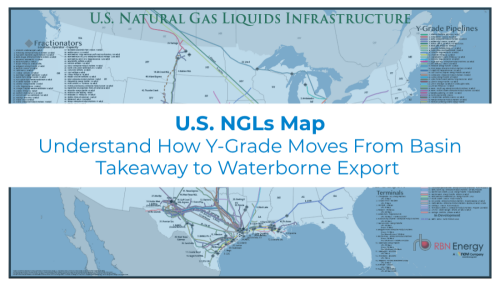
Visualize the infrastructure behind U.S. NGL movement.
The U.S. NGLs Map provides a comprehensive view of the transport, processing, and export networks moving NGLs across the U.S.
In Part 1 of this series, we looked at rising NGL production in the Permian, the SCOOP/STACK and other key basins; potential U.S. NGL production — including ethane that is rejected into natural gas — is now approaching 5 MMb/d. We also noted that a number of new, ethane-consuming steam crackers are coming online along the Texas and Louisiana Gulf Coast, conveniently close to the NGL storage and fractionation hub in Mont Belvieu. And we talked about the strong export market for liquefied petroleum gas (LPG) — propane and normal butane — which has averaged more than 1 MMb/d in the first half of 2018 (almost all of it being shipped out of Gulf Coast ports), and for ethane exports too. In Part 2, we started a company-by-company review of the Big Five fractionation players in Mont Belvieu, with a look at Enterprise Products Partners, which has more fractionators (nine) and more fractionation capacity (755 Mb/d) than anyone else there. We also discussed the Enterprise-owned NGL pipelines that transport y-grade to Mont Belvieu, its NGL and purity-product storage, and its Houston-area export terminals for LPG and ethane. Next, we turned our attention to fractionation capacity owned by Targa Resources as well as Energy Transfer Partners. Then, in Part 3, we looked at the fractionation assets of Cedar Bayou Fractionators (CBF) and Lone Star NGL. CBF, a joint venture (JV) that is 88% owned by Targa Resources, owns five fractionation plants in Mont Belvieu (combined capacity 453 Mb/d) and is building another 100-Mb/d fractionator that is scheduled to begin commercial operation in the first quarter of 2019. Lone Star NGL, a subsidiary of Energy Transfer Partners, owns 420 Mb/d of existing fractionation capacity at four plants in Mont Belvieu and has two new 120-Mb/d fractionators under development — one scheduled to come online the third quarter of 2018 and the other set to follow in the second quarter of 2019. And in Part 4, we discussed the fractionation plants owned by ONEOK (three plants; 340 Mb/d of existing capacity; a 125-Mb/d plant on the way) and Gulf Coast Fractionators, a joint venture of Targa, Devon Energy and Phillips 66 with two plants and 145 Mb/d of capacity.

About the song
“Magical Mystery Tour" is the song that kicks off the Beatles’ album of the same name. As the lyrics state, it's "an invitation to make a reservation to roll up for the Mystery Tour." The Beatles recorded the tracks that would become the soundtrack to the film, "Magical Mystery Tour," in the spring, summer and fall of 1967 at EMI Studios, Olympic Sound Studios, and Chappell Sound Studios in London, with George Martin producing. It was initially released in the UK as a double EP, and in the U.S. as a full-length album, with the addition of songs that were singles for the band in 1967.
After the Beatles finished their groundbreaking Sergeant Pepper's Lonely Hearts Club Band LP, Paul McCartney wanted to make an unscripted film that captured the psychedelic experience of Ken Kesey's Merry Pranksters with new music by The Beatles providing the soundtrack to the film. Reviewers hated the movie, giving The Beatles their first critical failure, but the Magical Mystery Tour LP went to #1 on Billboard's Top 200 Albums chart, where it stayed for eight weeks at the start of 1968. The song "Magical Mystery Tour” was never released as a single. The Beatles were formed in Liverpool, England, in 1960. They went on to change the face of modern music and have influenced art, fashion, style and politics to this day.