Renewable Identification Numbers (RINs) have grabbed the attention of refiners this spring and summer, and for good reason. The price of RINs –– ethanol credits used by refineries to prove compliance with the federal Renewable Fuel Standard –– have soared, and the credits are having an outsized negative effect on some refiners’ costs and profitability. Part of the RIN price spike can be attributed to concerns that there may not be enough to go around this year, and that the situation in 2017 may be far worse. But the rocketing cost of the credits is also raising questions about whether the largely unregulated and opaque RINs market is being manipulated or even cornered by those hoping for a quick, Powerball-size profit. Today, we continue our review of the RINs market with a look at which types of refiners are hit hardest by high RIN prices, and at whether we might be heading off a RIN-availability cliff.
Imagine for a moment that your biggest monthly bills weren’t your mortgage, your car payment, and maybe child-care or private-school tuition but, say, the cost of shampoo or pet food or paper towels. You would know something was seriously out of whack, yes? Well, consider the fact that for a number of U.S. refineries, their biggest operating cost in the second quarter of 2016 was not for labor or natural gas or electricity, but for RINs – paper credits created by the Environmental Protection Agency (EPA) to help ensure that the provisions of the Renewable Fuel Standard (RFS) are being complied with. Few guessed we’d end up here, with RIN prices approaching $1/credit, and no one can say with certainty what 2017 will bring. Still-higher RIN prices? More merchant refiners getting into the fuel-blending business or even the retail gasoline biz to mitigate their RIN risk exposure? A complete reworking of the RFS and the RIN program by EPA or Congress? In the land of government mandates, it seems like anything could happen.
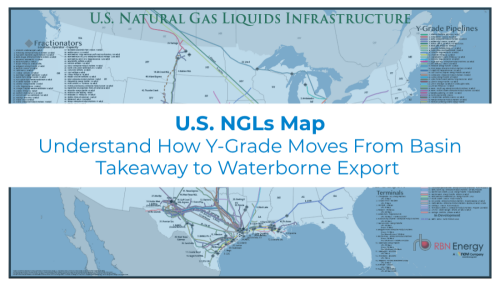
Visualize the infrastructure behind U.S. NGL movement.
The U.S. NGLs Map provides a comprehensive view of the transport, processing, and export networks moving NGLs across the U.S.
We took our first look at the “magical mystery” of the RFS and RINs four years in A Market of Contradictions –– Ethanol Mandates, Motor Gasoline and the Blend Wall, and followed that up with more details in The RIN and Stimpy Show – Crushing Pain and Mandate Madness. In those blogs we explained the need to establish a mechanism to track the production of corn- or sugar-based ethanol (and biodiesel and other renewable fuels) and the blending of ethanol with gasoline. We also discussed an earlier instance of “RIN-sanity” the market for ethanol credits experienced in 2013. As we said in Part 1 of this 2016 blog series, the RFS was created under the Energy Policy Act of 2005 and expanded under the Energy Independence and Security Act (EISA) of 2007; the program is overseen by the EPA. Under the RFS, as it stands today, refiners and gasoline importers (but not blenders or gasoline retailers) are required to sell specific volumetric target quantities (known as Renewable Volume Obligations, or RVOs) of renewable fuel each year through 2022, as laid out in EISA. (Note that in this series, we’re focusing solely on “conventional” biofuel for the motor gasoline market –– namely ethanol –– and not on “advanced” biofuels like cellulosic biofuel and biomass-based diesel, which get still more complicated.) EISA called for ratcheting up the national RVO for ethanol to 15 billion gallons (or Bgal) in 2015, and keeping it at that level through 2022. RINs are ethanol credits that were intended to help smooth out any bumps in the renewable fuels market but, as we will get to today, they have become something very different. “Obligated parties” (refiners and gasoline importers) need to present EPA with a sufficient number of RINs to prove they’re meeting their RVO requirements. RINs are generated when ethanol (for fuel blending) is produced and are initially “attached” to the ethanol. When blenders mix the ethanol with gasoline (typically in a 90% gasoline/10% ethanol combination called E10; see blender load racks in photo below), the RINs are “separated” from the ethanol. If the blender is also a refiner (who needs to accumulate RINs to prove its RFS compliance), it would typically hold onto its RINs. But, as is often the case, if the blender is not also a refiner or a gasoline importer (and therefore has no ultimate need for RINs), the blender can either sell its RINs directly to a refiner or into the RIN market. (More on that market in a moment.)