



One of the biggest stories in the energy world right now is the rise of data centers and the massive amounts of electricity they require. It’s happening everywhere, but the Northeast stands out because big data center projects are clustering near existing high‑voltage lines, major substations, natural gas-fired generation and pipeline corridors. Some states already have large, mature hubs, while others are just starting to show up on the map. In today’s RBN blog, we zero in on the part of the Northeast with the heaviest concentration of these power‑hungry campuses, while also previewing our latest Drill Down Report on the changing dynamics in the Northeast gas market.
After being in virtual limbo for the past couple of years, the Northeast gas market is reawakening. Pipeline projects to expand connectivity between Appalachia and demand centers are moving forward for the first time in years, including into the previously off-limits New York/New Jersey and New England market areas. Regional flow dynamics are poised to shift as expansions debottleneck production and pathways out of the Appalachia producing region, deepening seasonal patterns. At the same time, structural changes, such as coal retirements and new data centers, are driving additional gas demand, and we’re already seeing more gas-related projects in areas where data centers are planned or under construction. In today’s blog, we’re calling out the heavy hitters among the 14 Northeast states, the places where big data center clusters already exist and more are planned.
As we detailed in Sweet Virginia, the center of the data center universe is Virginia. The state was the pioneer for data centers and has been home to them since the 1990s — long before most people even knew what a data center was. Virginia has more than 550 data centers, with some estimates at well over 600. Northern Virginia already hosts the world’s largest concentration of data centers, anchored by Loudoun (orange-shaded county on top of Figure 1 below) and neighboring counties, and industry estimates suggest the state’s installed and committed capacity runs into the multi‑gigawatt range, far beyond any other state, with the potential to significantly alter the region’s supply/demand picture, a topic examined in our new report. There are many thousands of megawatts already online, mostly serving hyperscalers like Amazon, Digital Realty, Equinix, Google, Microsoft and QTS. Meta’s 500‑MW Henrico facility near Richmond gives a sense of the scale of individual sites.
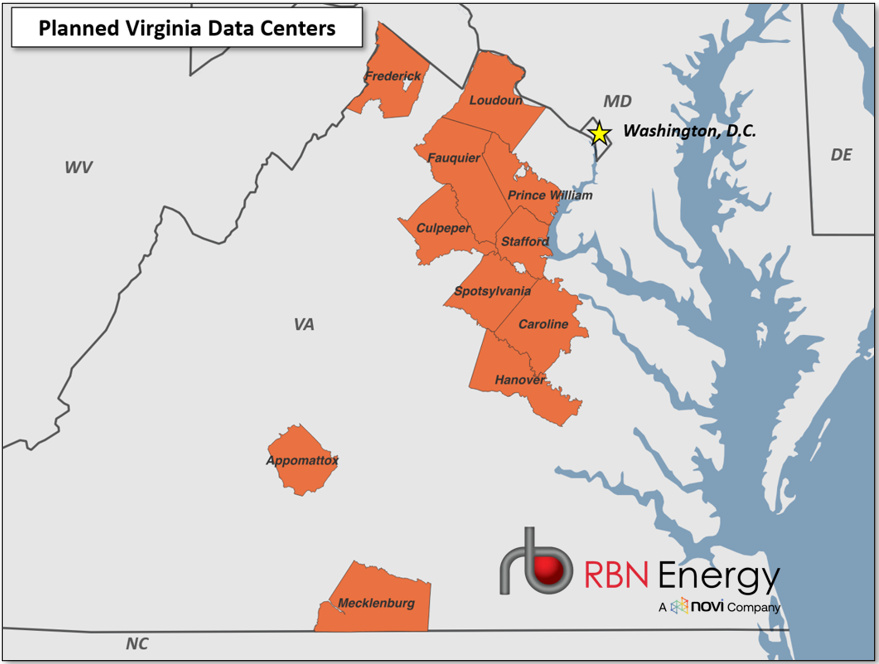
Figure 1. Planned Virginia Data Centers. Source: Novi Labs
U.S. Rig Count Up Ten to 573; Largest Weekly Gain Since June 2022
U.S. oil and gas rig count gained ten rigs to 573 for the week ending June 26 according to Baker Hughes data, as Anadarko (+2), Permian (+2), Gulf of Mexico (+1), Haynesville (+1), the Niobrara (+1) and All Other (+3) all posted gains with no basin reporting a decline.

About the song
“I Want More” was written by KALEO’s lead vocalist and guitarist, JJ Julius Son, and appears as the first song on Side C of KALEO’s third studio album, the double-LP, Surface Songs. The song is about yearning for something more meaningful and reaching a deeper level of commitment. Released as a single in Iceland in January 2020, it reached #4 on the Icelandic singles chart. Personnel on the record were: JJ Julius Son (lead vocals, guitar), Daniel Kristjansson (bass), Rubin Pollock (lead guitar, backing vocals), Davio Antonsson (drums, percussion, backing vocals) and Gaukur Daviosson (harmonica, various instruments).
Surface Sounds is a double LP and the third studio album of KALEO. It was recorded at a variety of studios in North America, South America and Europe and produced by Julius Son and Dave Cobb. Son spent two years globe-hopping to write songs about trouble and redemption for the album, hoping that each new locale he recorded at would bring a fresh flavor to the record. The album was released in April 2021 and went to #102 on the Billboard 200 Albums chart. Five singles were released from the LP.
KALEO is a blues-rock band formed in Mosfellsbaer, Iceland, in 2012 by Julius Son, Dan Kristjansson, Davio Antonsson, Rubin Pollock and Gaukur Daviosson. (“KALEO” means “the voice” in Hawaiian.) In 2013, the band signed with Icelandic record label Sena and released their debut album. After successful performances at SXSW, the band relocated to Austin, TX, in 2015, and signed with Elektra Records in the U.S. They have released four studio albums and 17 singles. They have sold more than 1 million records worldwide. They released their latest album, Mixed Emotions, in May 2025. They continue to record and tour and are currently on their Way Down We Go/Mixed Emotions Tour in North America.
"About the Song" -- written by Mickey McMahan , RBN Director of Musicology







Comments
Thank you for this analysis, Lisa. I'm glad the dogma driving the focus on unreliable, expensive, and intermittent solar, wind, and batteries for the past two decades is being challenged. I've been involved in data centers for more than a quarter of a century. The big driver for data center growth in northern Virginia has been the federal government's growing information processing needs
If New York state had not given into their ideologically-based opposition to nuclear power, the Indian Point.Energy Center in northwest Westchester County would still be on line. Indian Point's over 2,000MW of always-on generation would ease the growing power needs of the greater New York City region.
The northeast's policy-driven natural gas transmission constraints will require many years to resolve, stifling load growth in the region. Another region where this is problematic is California. (If California were a separate nation, its economy would be the fourth largest in the world - about $4.25 trillion in 2025. California's Silicon Valley is the home of many of the nation's first data centers.) The same policy-driven constraints on the use of natural gas also apply to California. 95% of California's natural gas is imported via an aging system of large-diameter natural gas pipelines. California faces the unique geographical challenge that many of those lines cross the San Andreas Fault. In the 2008 USGS "Shakeout Scenario," an overdue rupture of the southern section of the San Andreas Fault is projected to result in horizontal displacements greater than 40 feet. That rupture will tear up many of those transmission pipelines. Aftershocks spanning a decade will continue to challenge the repaired pipelines. Like New York state, California gave into ideologically-driven oppositon to nuclear power. As a consequence, the over 2,000 MW San Onofre Nuclear Generation Station (SONGS) was closed instead of being repaired after a tiny steam generator leak was detected at the end of January, 2012. The independent nonprofit Californians for Green Nuclear Power (CGNP) continues to advocate for extended operations to at least 2045 of California's remaining nuclear power plant, the 2,270 MW Diablo Canyon Power Plant near San Luis Obispo, California. You may learn about recent developments via CGNP's GreenNUKE Substack. We look forward to your analysis of California.
In reply to Thank you for this analysis,… by Gene Nelson, Ph.D.
Couldn't have said it better myself, Gene. Though, credit where credit is due, this article is from Lisa Shidler. We'll talk about doing a California update too.
In reply to Couldn't have said it better… by David Braziel
Thank you, David. Please contact CGNP for additional details. During the past decade, CGNP has submitted thousands of pages of written testimony to the CPUC regarding the importance of Diablo Canyon operations to maintain California's grid reliability. CGNP worked with legislators to obtain a historical first that a nuclear power plant's operation was extended instead of being needlessly shut down in 2025. CGNP representatives recently met in Sacramento with California Governor Newsom's Senior Advisor on Energy regarding California legislation to extend Diablo Canyon's operations to 2045. The NRC already granted Diablo Canyon an extended operating license to 2045.
I asked ChatGPT how much natural gas was going to be consumed at our power plants to meet the need of all these AI Data Centers over the next 10 to 15 years. Trillions of cu.ft.
And how energy efficient are our natural gas power plants? How much of this natural gas is being combusted and is then being wasted ~ blown up chimneys across the country as wasted hot exhaust into the atmosphere? Power Plants are +- 50% energy efficient
This means that for all the effort and costs it takes to drill and pull all this energy out of the ground, and then pipeline this energy to the refinery where it then gets treated and brought into America's quality. From the refinery it again gets pipelined all over the country until it goes through a gas meter and then enters the vessel where it is combusted to perform it's work. But since we don't yet have appliances that combust to those high efficiencies ~ a portion of the energy performs the "work" needed and the balance of this combusted energy is pushed to a chimney where it is then vented into the atmosphere.
So what is in that exhaust? Combusted Btu's that have the capability to perform more work, and CO2, and water. A Lot Of Wasted Energy ! So why is it wasted? Is there no purpose left for all this combusted natural gas energy? Yes, of coarse there is.
So why isn't it being done? Power plants in the past had a purpose. Make electricity so when the light switch was flicked - the lights came on. When an industrial appliance was wired up - it would perform the work required. This part was good, and "we the people" were happy with how this energy was being consumed. The wasted energy was not really any big concern.
This is now 2026 and America and the world is recognizing waste. DOGE. We believe DOGE should put natural gas on it's list. Why waste this energy when it can so easily be captured and utilized to near 100%? The residential market and a lot of other businesses have realized they can use their natural gas to well over 90% energy efficiency - greatly reducing their natural gas bills, and at the same time reduce CO2 emissions and even conserve water.
Waste is Not Waste if it has a Purpose! Such a simple concept. America needs to become Energy Wise. It's also has an Energy Security purpose. Imagine if all the power plants that are being constructed directly feeding all these AI Data Centers were to operate at over 90% energy efficiency. If these power plants were to Host the combusted exhaust to a 3rd party, these combusted exhausts could be creating hundreds of full time good paying jobs and money for the community. These Data Centers and their power sources could claim to the community they are putting into the atmosphere zero or only minimal emissions.
We believe it's time for America to wake up, and smell the roses and truly produce clean energy.