



For several years now, no single topic has caused more angst in refiners’ quarterly earnings calls than the seemingly arcane topic of renewable identification numbers, or RINs, which can have a big impact on a refiner’s financial performance. RINs are a feature of the federal Renewable Fuel Standard (RFS), which requires renewable fuels like ethanol and bio-based diesel to be blended into fuels sold in the U.S. And depending on your point of view — farmer, refiner, blender, consumer, politician — you may have a very different perspective regarding RINs’ role as a tax and a subsidy. In today’s RBN blog, we dig into the fundamental aspects of RINs at the root of this long-running controversy and examine the role of RINs as a mechanism for forcing renewables into fuels.

To truly understand Cushing — what it does and how it works — you need to know the hub’s assets and how they fit together. RBN’s Cushing Crude Oil Playbook provides the first one-stop, comprehensive guide to the hub’s assets.
In the first blog in this series, we explained that RINs are used to monitor compliance with the federal RFS, which was created by the Energy Policy Act of 2005 and expanded and extended by the Energy Independence and Security Act of 2007. In essence, the system works like this. A refiner or importer of “blendstock for oxygenated blending” (BOB) — the non-renewable gasoline mixed with ethanol to produce the E10 that most of us use to fuel our cars, SUVs and pickups — is obligated to acquire and retire an annual quota of RINs to fulfill its Renewable Volume Obligation, or RVO. A 38-digit RIN is created for and “attached” to each gallon of ethanol produced to blend with BOB, “separated” from the ethanol gallon when the gallon is blended with BOB, and “retired” to fulfill the BOB refiner or importer’s RVO. (Again, see Part 1 for a more detailed explanation.)
The cost to acquire RINs is what’s considered the “RIN tax.” How the RIN tax affects a refiner’s profit is the key point of contention. One camp, which we call Camp A, says it hurts a refiner’s profit and the other side, Camp B, says it doesn’t. Their disagreement hinges on one key question: Is the RIN tax passed through in a higher price for the non-renewable BOB the refiner sells to the downstream blender (displayed by the gray line in the yellow-outlined rectangle in Figure 1)? That disagreement about the RIN tax is one root of the controversy. But there’s another angle to the disagreement: RINs’ role as a subsidy (green-outlined rectangle), which we’ll consider today.
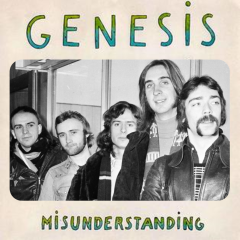
About the song
“Misunderstanding” was written by Phil Collins and appears as the fifth song on side one of Genesis’ 10th studio album, Duke. Released as a single in May 1980, the song went to #14 on the Billboard Hot 100 Singles chart. According to Collins, the song was influenced by The Beach Boys’ “Sail on Sailor,” Sly and the Family Stone’s “Hot Fun in the Summertime,” and Toto’s “Hold the Line.” Personnel on the record were: Phil Collins (lead vocals, drums, drum machine, percussion), Tony Banks (keyboards, twelve-string guitar, backing vocals), and Mike Rutherford (guitars, bass, bass pedals, backing vocals).
Duke was recorded in November and December of 1979 at Polar Studios in Stockholm, with Genesis and David Hentschel producing. Released in March 1980, the album went to #11 on the Billboard 200 Albums chart. It has been certified Platinum by the Recording Industry Association of America. Three singles were released from the LP.
Genesis is a British rock band formed in Godalming, Surrey, England, in 1967. The band was a pioneer of what was to be labeled progressive rock. Its most successful lineup consisted of Collins, Banks and Rutherford. Original lead singer Peter Gabriel left the band in 1975 to pursue a successful solo career. Genesis has released 15 studio albums, six live albums, four compilation albums, two EPs and 43 singles and have sold over 100 million records worldwide. The band was inducted into the Rock and Roll Hall of Fame in 2010. Eleven people have passed through its ranks since its inception. The band played their last concert together in March 2022, with Collins saying it would be his last Genesis tour due to health issues.




Comments
The U.S. transportation fuels market is not an homogenous, unsegmented whole. The RIN tax, RIN subsidy, RIN cost pass-through and wholesale RIN discount all depend on what segment we're considering. For diesel, for example, refiners probably are able to pass through their RIN costs in most or all geographic markets. Bio-diesel has a higher price than the blended product. That price difference represents the cost of the D4 RIN to the blender that then recovers the cost by selling D4 RINs to refiners. D4 RINs are a real cost to the blender recovered by selling the D4 RIN.
For E10, it depends on whether we are talking about New York Harbor or nearly everywhere else. Ethanol's price is lower than the price of E10. Even without the D6 RIN, blending ethanol is a gain for the blender. So, for blenders, D6 RINs are free. In NYH, however, imports are the marginal supply, and non-blending importers have no access to free RINs. These importers will not bring their BOB ashore until the bulk price of BOB covers their D6 RIN costs. Thus, in NYH, D6 RIN costs for importers and refiners alike are passed through to blenders.
Outside of NYH, the market is often or generally long on BOB. Few or no imports are purchased, imports are not the marginal supply, and importers' RIN costs have no effect on bulk BOB prices. In an exporting market, the lowest cost domestic producers, not importers, are the marginal suppliers and pricing power. Vertically integrated companies, blending and selling at the wholesale rack far more BOB as E10 than their refineries can supply and separating far more free D6 RINs than their refineries need, control this situation. The vertically integrated refinery manager knows its D6 RIN needs will be met at no cost to the company before surplus RINs are sold. For the vertically integrated refiner, there is no D6 RIN cost to pass through.
Likewise, using the D6 RIN for compliance rather than selling it is not an opportunity cost for the vertically integrated refiner. Selling a D6 RIN needed for compliance will generally require cutting runs or otherwise changing refinery operations to suboptimal levels. The cost of doing so far exceeds any gain to be had from selling a D6 compliance RIN. So, the vertically integrated refiners are sitting fat, dumb and happy. Their compliance D6 RINs are free making them the lowest cost BOB producers and giving them pricing power in a market generally long on BOB. And, selling D6 compliance RINs is not economic. The very real and significant D6 RIN costs of merchant refiners are not passed through when vertically integrated refiners with free RINs, i.e., the low cost producers, have pricing power.
Unfortunately, EPA has totally ignored RIN markets outside NYH. Knittel, et al, in Figure 8 does show no pass through for LA RBOB, but this, too, has been ignored and discounted by both the paper's authors and EPA.
In reply to It depends . . . . by Bob Neufeld
Thanks a lot for reading and commenting on our current RIN series. I have entered below my thoughts on the points you raised:
D4 RINS - I agree with your take on D4 RINs.
New Your Harbor D6 RINs - I agree the New York Harbor BOB market price must include the importer's cost for purchasing D6 RINs. A question for you -- do you think refiners who might sell BOB into that market, like PBF Delaware City/Paulsboro would receive a market price that includes the D6 RIN value? The reason I ask is PBF is among those who strongly deny the pass-through theory, they say the market price does not include RIN value, and I think you have made a very good argument why, in that market, it should.
Empirical studies on RIN pass-through in markets other than New York - The published pass-through studies are actually more comprehensive than just New York Harbor, including other geographical markets and multiple steps in fuels supply chains. Here is a link to a good paper reviewing them. Also, in the comment period for the recent denial of small refiner exemptions, refiners submitted price data from their local markets which those refiners said disprove the pass-through theory and EPA concluded that data actually supports the pass-through theory. Unfortunately that data was not published because it was claimed to be confidential business information, but EPA did send confidential responses to those refiners.
Advantages for vertically-integrated refiner in markets without BOB imports - The refining business unit of an integrated refining-blending company could choose to sell its BOB to independent blenders at the market price for BOB, for those gallons he would need to purchase RINs and for this to be profitable, he and other merchant refiners in his market would have to receive a market price for BOB that includes the cost of the D6 RIN. In that situation the integrated refiner is acting as a merchant refiner and his cost for RINs is zero because his cash cost for buying the RIN is offset by the higher market price he receives for BOB which includes the cost of the RIN. Or he could transfer BOB to his sister blending business unit who would acquire a RIN via ethanol purchase, separate and keep it for compliance by its sister refining business unit. Either way, the net RIN cost is zero. I don't see how the RIN system confers an advantage on the integrated refiner-blender versus a combination of a merchant refiner and an independent blender. When you say the integrated refiner has control of this situation and has pricing power, what do you see him controlling? The price of BOB? The price of D6 RINs? Or the price of E10? And is he controlling the price to be higher or lower than the price that would otherwise occur?
Opportunity cost: The opportunity cost for the integrated refiner using RINs for compliance is, when he doesn’t sell a gallon into the BOB market, he foregoes the opportunity to realize the RIN value embedded in the market price of BOB; but in that case he needs to buy a RIN for that gallon, so it nets out to zero which is no different than what I described above, i.e. he is acting as a merchant refiner. So viewing the situation in terms of opportunity cost is just another way to say the same thing.
Selling RINs needed for compliance and refinery run rate: If a refiner wants to sell RINs needed for compliance, wouldn’t he have another option which is to sell uncovered gallons of BOB to a blender, instead of cutting refinery run rate?
RIN wholesale discount: This topic will be addressed in the upcoming Part 3 of the series.
Thanks again for sharing your thoughts on this! If you would like to continue the discussion please do so here and/or contact me directly any time [email protected] +1 630 330-8159