The competition to develop the one or possibly two new offshore crude oil export terminals that the U.S. will likely need by the mid-2020s has been under way for more than a year now, and the field of contestants continues to expand. Within the past few weeks, both Phillips 66 and Sentinel Midstream filed applications with the U.S. Maritime Administration (MARAD) — Phillips 66’s project would be located off the coast of Corpus Christi and Sentinel’s in the waters off Freeport. And who knows, maybe another deepwater project or two capable of fully loading Very Large Crude Carriers (VLCCs) might still be in the offing. Today, we update our series on prospective offshore crude export terminals with a look at the P66 and Sentinel project details revealed by their applications to MARAD.
One of the more interesting questions in the U.S. energy business today is which of the seven individual companies and joint ventures planning to build new deepwater terminals for exporting crude off the Texas and Louisiana coasts will be the first to reach a final investment decision (FID) on their project. The query regarding who crosses the FID line first is particularly important because, as we said a couple of weeks ago in Where the Boat Leaves From, the Gulf Coast — with an estimated 5.1 MMb/d of crude export capacity in place — will likely need at least another 1 MMb/d of capacity by 2024 or so as production keeps rising in the Permian and other major shale plays. While still more export capacity may be required in the mid-2020, the palpable fear of a capacity overbuild suggests that only a few of the proposed offshore terminals (and onshore-terminal expansion projects) will be able to secure the necessary throughput commitments to advance their plans to construction.
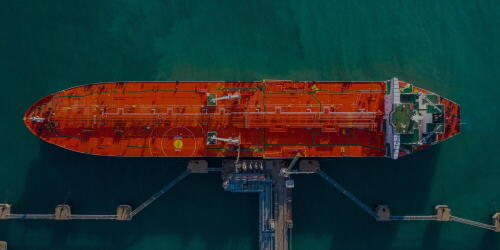
The Crude Voyager is a weekly analysis of U.S. Gulf Coast loading activity that explains the ebbs and flows of crude loadings, destinations, and geopolitical issues impacting U.S. exports. It outlines the major paths for laden tankers hauling U.S. crude all over the world and reflects the change in tanker departures to the main regions that consume U.S. crude.
While expansion projects at onshore terminals allow their developers to build off of existing infrastructure, what they cannot do — at least so far — is enable their docks to fully load deep-draft, 2-MMbbl VLCCs, which (as we said in Working on a Dream) are the most cost-efficient waterborne means for transporting crude long distances (like from the Gulf Coast to Asia). To fill a VLCC to the gills, you need more than 72 feet of draft, and to get that along most of the Texas and Louisiana coast, you typically have to go out at least several miles. Hence, the growing importance of deepwater offshore terminals like the Louisiana Offshore Oil Port (LOOP; green triangle in Figure 1), which since the early 1980s has been receiving VLCCs fully laden with foreign crude — and since early 2018 has been sending out a small but growing number of VLCCs filled to the brim with U.S.-sourced oil. LOOP is still the only Gulf Coast facility capable of fully loading VLCCs. Otherwise, VLCCs exporting crude are generally reverse lightered in specified deepwater lightering areas in the Gulf — a couple of onshore terminals (Moda Midstream’s Ingleside facility near Corpus Christi, and Seaway’s Texas City terminal) can load VLCCs about halfway at their docks, then top them off via reverse lightering.

About the song
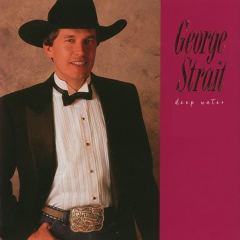
“Deep Water” is a track off country singer George Strait’s 1986 album, 7. "Deep Water" was written by Fred Rose and was first recorded and released by Bob Wills and his Texas Playboys in 1948. George Strait’s 7 LP — his seventh album — reached #1 on the Billboard Top Country Albums chart and #27 on the Billboard Top 200 Albums chart. It produced two #1 hit singles, “Nobody in His Right Mind Would’ve Left Her” and “It Ain’t Cool to Be Crazy About You.” Personnel on the LP were: George Strait (lead vocals and acoustic guitar), Curtis Young (background vocals), Eddie Bayers (drums), David Hungate (bass), Billy Joe Walker (guitar), Reggie Young (guitar), Richard Bennett (guitar), John Jarvis (piano), Johnny Gimble (fiddle and mandolin) and Paul Franklin (steel guitar).
George Strait is an American country music singer, songwriter, actor, and record producer. Many consider Strait the “King of Country Music.” He has sold more than 120 million records worldwide and has 13 multi-Platinum, 33 Platinum, and 38 Gold albums. He started his musical journey playing in a rock-and-roll cover band during his high school years in Pearsall, TX. He started singing country music in an Army-sponsored country band while stationed in Hawaii. After his stint in the Army, Strait enrolled as a student at Texas State University in San Marcos, where he formed the Ace in the Hole Band. After releasing some music on an independent Texas label, he signed his first record deal with MCA Records in Nashville in 1981. He has released 29 studio albums, three live albums, 12 compilation albums, one soundtrack album, and 102 singles. He has appeared in three motion pictures and one television show. He holds the record for most ACM and CMA Awards and is third only to Elvis Presley and The Beatles for the most Gold and Platinum albums. He was inducted into the Country Music Hall of Fame in 2006. Strait has retired from touring, giving the final concert on his The Cowboy Rides Away Tour in Arlington, TX, in June 2014. He still occasionally records and is scheduled to appear at nine stadium shows with Chris Stapleton in 2024, with the first set for May 4 in Indianapolis.