As Gulf Coast marine terminal owners consider ways to at least partially load Very Large Crude Carriers (VLCCs) at their facilities, a handful of midstream companies also are planning offshore terminals in deep water that would allow the full loading of VLCCs via pipeline. Projects under development by Oiltanking and others for sites along the Texas coast would appear to have at least two legs up on the Louisiana Offshore Oil Port, or LOOP. For one, they’d have more direct access to the Permian, Eagle Ford and other crudes flowing to coastal Texas. For another, the new terminals would be focused on crude exports — no double-duty for them. Today, we begin a review of the projects vying to be the first LOOP-like project in the deep waters off the Lone Star State.
U.S. crude exports hit the 3-MMb/d mark a few weeks back (the week ending June 22), and while they’ve since retreated slightly, there’s every reason to believe that export volumes will be ratcheting up in the months and years to come. They’ll almost have to, really. As we said in Got That Swing, the three production-forecast price scenarios that we assessed in our most recent update — crude prices flat at $70/bbl or $55/bbl to 2023, or (like the forward curve) ramping down to $55/bbl over the next five years — would result in crude production growth of between 2.0 MMb/d (under the flat-at-$55 scenario) and 5.0 MMb/d (under the flat-at-$70 scenario). That’s on top of the 11 MMb/d the U.S. is already producing, which is twice the 5.5 MMb/d rate back in 2010. U.S. refineries already are operating at close to full capacity with a mix of domestic and imported barrels that fits their hardward configurations, cranking out increasing volumes of gasoline, diesel and jet fuel for export, and while at least a few refinery expansion projects are being planned, they would only be capable of absorbing a small portion of the incremental crude production we’re likely to see. So export the U.S. must.

Canadian crude output is rising, requiring new export routes. As traditional pathways face constraints, the U.S. Rockies—especially the Guernsey, WY hub—are emerging as key corridors for moving Canadian heavy crude to downstream markets, including the Gulf Coast.
As of the week ending July 20 (the most recent data available from the Energy Information Administration or EIA), U.S. crude exports have averaged just over 1.8 MMb/d so far in 2018, up from 1.1 MMb/d on average in 2017 and 590 Mb/d in 2016. The clear preference of many long-distance shippers is to move their barrels in VLCCs, each of which can economically transport about 2 MMbbl of crude. The VLCC is the largest of the four types of tankers that account for the vast majority of international oil shipments (see Come Sail Away), the other prominent classes being (in descending size order) Suezmax (capacity ~1MMbbl), AFRAmax (~750 Mbbl) and Panamax (350 Mbbl to 550 Mbbl). They are giants — a typical VLCC is about 1,100 feet long, with a beam (or width) of nearly 200 feet and a fully loaded draft of 72 feet. But as we said in Rock the Boat, there’s still only one terminal on the Gulf Coast that can fill a VLCC to the brim — LOOP (green diamond in Figure 1), which is located in 110-foot-deep waters 18 miles off Port Fourchon, LA — and pipeline connections from key Texas and Oklahoma plays to LOOP are limited. (More on LOOP in a moment.) Elsewhere along the coast, VLCCs need to be loaded in offshore deep water by “full reverse lightering” from smaller vessels — a slower and more costly loading process that typically involves shuttling crude out in AFRAmaxes or other smaller vessels to a VLCC in a trans-shipment area (TSA) and transferring the crude onto the larger ship. More recently, a number of companies have been testing the docking and partial loading of VLCCs at terminals along the Texas coast, with the hope of using a hybrid approach — partially loading of VLCCs at the dock, followed by partial reverse lightering offshore in TSAs (see Working on a Dream), mostly in the Galveston Offshore Lightering Area (GOLA). That would be more efficient than the full reverse lightering in common usage today, but an even more efficient alternative would be to fully load a VLCC at an onshore dock — or at an offshore terminal in deep water á la LOOP.
About the song
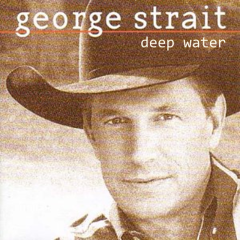
“Deep Water” is a track off country singer George Strait’s 1986 album, 7. "Deep Water" was written by Fred Rose and was first recorded and released by Bob Wills and his Texas Playboys in 1948. George Strait’s 7 LP — his seventh album — reached #1 on the Billboard Top Country Albums chart and #27 on the Billboard Top 200 Albums chart. It produced two #1 hit singles, “Nobody in His Right Mind Would’ve Left Her” and “It Ain’t Cool to Be Crazy About You.” Personnel on the LP were: George Strait (lead vocals and acoustic guitar), Curtis Young (background vocals), Eddie Bayers (drums), David Hungate (bass), Billy Joe Walker (guitar), Reggie Young (guitar), Richard Bennett (guitar), John Jarvis (piano), Johnny Gimble (fiddle and mandolin) and Paul Franklin (steel guitar).
George Strait is an American country music singer, songwriter, actor, and record producer. Many consider Strait the “King of Country Music.” He has sold more than 120 million records worldwide and has 13 multi-Platinum, 33 Platinum, and 38 Gold albums. He started his musical journey playing in a rock-and-roll cover band during his high school years in Pearsall, TX. He started singing country music in an Army-sponsored country band while stationed in Hawaii. After his stint in the Army, Strait enrolled as a student at Texas State University in San Marcos, where he formed the Ace in the Hole Band. After releasing some music on an independent Texas label, he signed his first record deal with MCA Records in Nashville in 1981. He has released 29 studio albums, three live albums, 12 compilation albums, one soundtrack album, and 102 singles. He has appeared in three motion pictures and one television show. He holds the record for most ACM and CMA Awards and is third only to Elvis Presley and The Beatles for the most Gold and Platinum albums. He was inducted into the Country Music Hall of Fame in 2006. Strait has retired from touring, giving the final concert on his The Cowboy Rides Away Tour in Arlington, TX, in June 2014. He still occasionally records and is scheduled to appear at nine stadium shows with Chris Stapleton in 2024, with the first set for May 4 in Indianapolis.