


Much like their heated competition to build new crude oil pipelines from the Permian to the Gulf Coast, midstream, logistics and trading companies are jockeying to construct the first new export terminal capable of fully loading Very Large Crude Carriers — Trafigura joined the fray earlier this week. While VLCCs are by far the most cost-efficient way to haul crude to Asia, their Godzilla-like physical dimensions restrict the number of land-based terminals they can use. And even those that can accommodate these seagoing behemoths can only load a VLCC part-way — “reverse lightering” out in deeper, open waters is required to fill the supertanker to the tippy top. So a handful of ambitious midstreamers are developing plans for offshore terminals out in deep water, miles from the Texas coast. Today, we continue our review of these proposals with a look at JupiterMLP’s plan for a terminal off Brownsville — and a new Permian pipeline to the city.
This is the second blog in this series. As we said in Part 1, U.S. crude oil exports have been rising steadily since the 40-year ban on most exports was lifted in December 2015. According to the Energy Information Administration (EIA), U.S. crude exports averaged 590 Mb/d in 2016, rose to 1.1 MMb/d in 2017, and so far in 2018 have averaged just over 1.8 MMb/d. In the week ending August 3 — the latest EIA data available — nearly 1.9 MMb/d was being sent abroad. Recently, exports hit an all-time high at an even 3.0 MMb/d exported the week ended June 22. The ratcheting up of export volumes is likely to continue — it needs to, really, to help balance a steady rise in U.S. production. As we said in Got That Swing, the three production-forecast price scenarios that we assessed in our most recent update — crude prices flat at $70/bbl or $55/bbl to 2023, or (like the forward curve) ramping down to $55/bbl over the next five years — would result in crude production growth of between 2.0 MMb/d (under the flat-at-$55 scenario) and 5.0 MMb/d (under the flat-at-$70 scenario). That’s on top of the 11 MMb/d the U.S. is already producing, which is twice the 5.5 MMb/d rate back in 2010. U.S. refineries already are operating at close to full capacity, and while at least a few refinery expansion projects are being planned, they would only be capable of absorbing a small portion of the incremental crude production we’re likely to see. Rising exports are, to put it bluntly, a market necessity.
The Crude Voyager is a weekly analysis of U.S. Gulf Coast loading activity that explains the ebbs and flows of crude loadings, destinations, and geopolitical issues impacting U.S. exports. It outlines the major paths for laden tankers hauling U.S. crude all over the world and reflects the change in tanker departures to the main regions that consume U.S. crude.
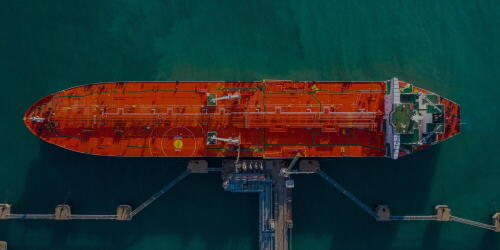
In the same way that Texas-size Ford F-Series and Chevy Silverado pickups enjoy most-favored-vehicle status in the Lone Star State, the Very Large Crude Carrier (VLCC) is preferred by many long-distance shippers. VLCCs can very economically transport about 2 MMbbl of crude oil to Asia or Europe, but their dimensions — a typical VLCC is about 1,100 feet long, with a beam (or width) of nearly 200 feet and a fully loaded draft of 72 feet — limit where they can dock. As we said in Rock the Boat, there’s still only one terminal on the Gulf Coast that can fully load a VLCC: the Louisiana Offshore Oil Port (LOOP; green diamond in Figure 1), which is located in 110-foot-deep waters 18 miles off Port Fourchon, LA. And while LOOP benefits from the 72-MMbbl crude storage, blending and distribution hub in nearby Clovelly, LA (red dot), pipeline connections to Clovelly from key Texas and Oklahoma plays to LOOP are limited (see Part 1 and Clovelly Calling? for more on that).

About the song
“Deep Water” is a track off country singer George Strait’s 1986 album, 7. "Deep Water" was written by Fred Rose and was first recorded and released by Bob Wills and his Texas Playboys in 1948. George Strait’s 7 LP — his seventh album — reached #1 on the Billboard Top Country Albums chart and #27 on the Billboard Top 200 Albums chart. It produced two #1 hit singles, “Nobody in His Right Mind Would’ve Left Her” and “It Ain’t Cool to Be Crazy About You.” Personnel on the LP were: George Strait (lead vocals and acoustic guitar), Curtis Young (background vocals), Eddie Bayers (drums), David Hungate (bass), Billy Joe Walker (guitar), Reggie Young (guitar), Richard Bennett (guitar), John Jarvis (piano), Johnny Gimble (fiddle and mandolin) and Paul Franklin (steel guitar).
George Strait is an American country music singer, songwriter, actor, and record producer. Many consider Strait the “King of Country Music.” He has sold more than 120 million records worldwide and has 13 multi-Platinum, 33 Platinum, and 38 Gold albums. He started his musical journey playing in a rock-and-roll cover band during his high school years in Pearsall, TX. He started singing country music in an Army-sponsored country band while stationed in Hawaii. After his stint in the Army, Strait enrolled as a student at Texas State University in San Marcos, where he formed the Ace in the Hole Band. After releasing some music on an independent Texas label, he signed his first record deal with MCA Records in Nashville in 1981. He has released 29 studio albums, three live albums, 12 compilation albums, one soundtrack album, and 102 singles. He has appeared in three motion pictures and one television show. He holds the record for most ACM and CMA Awards and is third only to Elvis Presley and The Beatles for the most Gold and Platinum albums. He was inducted into the Country Music Hall of Fame in 2006. Strait has retired from touring, giving the final concert on his The Cowboy Rides Away Tour in Arlington, TX, in June 2014. He still occasionally records and is scheduled to appear at nine stadium shows with Chris Stapleton in 2024, with the first set for May 4 in Indianapolis.






Comments
Very good article, but there is a missing 800 lb gorilla in the room. While the article discusses the considerable advantage of VLCCs, it completely overlooks the ULCC category, which is significantly a larger volume crude carrier. ULCCs are from 300,000 dwt to 570,000 dwt and will need at least 140 feet (35 meters minimum) draught. I worked at a STS terminal in the late 1970's and early 1980's off the outer Caymen Islands, where we always had a lee for transfer ops, and when a tanker came in that was over 500,000 dwt, we knew we had over 3 million barrels to transfer into smaller shuttles. There is a huge cost advantage for the charterers using these big fellas, and if you go off Brownsville, you get the necessary deep water. Construction of SMMB's to load offshore will be the same whether it is a VLCC or ULCC mooring bouy. Thanks