As we see it, 2023 will be another strong year for U.S. crude oil exports, driven in large part by rising domestic production. Upstream companies in the Permian and other U.S. shale plays are gradually ramping up their output and, with domestic refineries largely maxed out on how much light-sweet oil they can use, it’s safe to say that the vast majority of the incremental oil produced will end up at export terminals along the Gulf Coast. And if production continues growing (as we expect), there’s likely to be room — and a strong economic rationale — for one or more new offshore terminals to be built in the deep waters of the Gulf itself. Each of these proposed facilities would offer shippers what they want most: easy access to large volumes of oil and the ability to fully load 2-MMbbl VLCCs without any reverse lightering, which brings cheaper and cleaner export options to the market. In today’s RBN blog, we provide updates on two offshore projects still in the running: Sentinel Midstream’s Texas GulfLink and Phillips 66 and Trafigura’s Bluewater Texas.
Week after week, VLCCs dock at the Enbridge Ingleside Energy Center (EIEC) and South Texas Gateway (STG) — two state-of-the-art marine terminals in Ingleside, TX, just across the bay from Corpus Christi — where they are loaded with up to 1.25 MMbbl of crude oil and then head out to the deeper waters of the Gulf of Mexico for reverse lightering to fill their 2 MMbbl of cargo-tank capacity to the brim. Soon, when a project to deepen the ship channel to Ingleside is completed, EIEC and STG will each be able to load up to 1.6 MMbbl onto a VLCC, further reducing the need for topping off in deeper water. Because of their straight-shot pipeline connections to un-blended WTI from the Permian and favorable ship-loading economics, the two Ingleside terminals have been accounting for disproportionate shares of total U.S. export volumes. But at least four midstream developers — one of them a joint venture (JV) — are neck-deep in planning new offshore terminals that would be capable of fully loading VLCCs. Their thinking is that the ability to load a few VLCCs a week without reverse lightering will give their prospective deepwater facilities an undeniable edge.

The replay of our Fall 2026 School of Energy (September 9 & 10, Houston) is now available online!
Learn from RBN experts, participate in hands-on Excel modeling, connect with industry peers, and gain a stronger understanding of today's interconnected energy markets.
A few weeks ago, in Shake It Up, we discussed Enterprise Products Partners’ plan to build the Sea Port Oil Terminal (SPOT) in 115-feet-deep waters about 30 nautical miles off the coast of Freeport, TX. As we said then, SPOT would have two single-point moorings (SPMs) and the ability to simultaneously moor two VLCCs and load one per day. Crude would flow to SPOT on a pair of 36-inch-diameter pipelines from two Enterprise storage-and-distribution terminals: the existing ECHO Terminal southeast of Houston (8.4 MMbbl of tank storage) and the proposed Oyster Creek Terminal north of Freeport (4.8 MMbbl of planned storage capacity) in south-central Brazoria County. Enterprise has indicated that SPOT could be up and running as soon as the first half of 2026.
About the song
“River Deep, Mountain High” was written by Jeff Barry, Ellie Greenwich and Phil Spector and appears as the first song on Ike & Tina Turner’s sixth studio album of the same name. Recorded at Gold Star in Hollywood, with Phil Spector producing, it was originally released as a single on Spector’s Philles label in May 1966. It only went to #88 on the Billboard Hot 100 Singles chart, a huge disappointment to everyone involved, especially Spector, who considered the song a masterpiece and a perfect follow-up showcasing his “Wall of Sound” that had been so successful with his 1965 hit with The Righteous Brothers and “You’ve Lost That Loving Feeling.” Due to the lack of success with “River Deep-Mountain High,” Spector withdrew from the music business for two years, beginning his personal decline and problems with substance abuse and mental health.
Since its original release, the song has been inducted into the Grammy Hall of Fame, The Rock and Roll Hall of Fame’s “Hot 500 Songs that Shaped Rock and Roll” list, Rolling Stone's “Top 50 Songs,” and NME’s “500 Greatest Songs of All Time” list. It has been covered by several artists including Eric Burdon & The Animals, Deep Purple, The Supremes, The Four Tops, Erasure, and Celine Dion. Personnel on the record were: Tina Turner (lead vocals), Leon Russell, Michael Rubini (piano), Jim Horn (sax), Barney Kessell, Glen Campbell (guitar), Carol Kaye (bass), Frank Capp (percussion), Darlene Love, Fanita James, Jean King, Gracie Nitzsche, Clydie King (backing vocals), and Jack Nitzsche (strings). The track cost $22,000 ($184,000 in 2021 dollars) to produce and used 21 session musicians. Spector made Tina Turner sing the song over and over for hours before he felt like he had the perfect take. Spector said that he had invited Ike Turner to play guitar on the song, but he failed to turn up for the session.
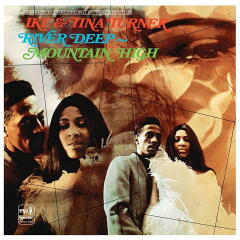
The album River Deep, Mountain High was recorded at Gold Star in Hollywood in March 1966 with Phil Spector producing. Its U.S. release was canceled by Spector after the failure of the single. It was released in the UK in September 1966 and went to #27 on the UK Singles chart. Dennis Hopper shot the album cover photo. The album was eventually released in the U.S. on A&M Records in September 1969. It went to #28 on the Billboard R&B Albums chart and #102 on the Billboard 200 Albums chart. Three singles were released from the LP.
Ike & Tina Turner were an American rock and roll/R&B duo active from 1960 to 1976. They released 22 studio albums, eight live albums, 31 compilation albums, two soundtrack albums and 70 singles. They won two Grammy Awards and were inducted into the Rock and Roll Hall of Fame in 1986.
Tina Turner (Anna Mae Bullock) was an American singer, dancer, actress and author. Referred to as the “Queen of Rock and Roll,” as a solo artist she released 10 studio albums, two live albums, six compilation albums, two soundtrack albums and 72 singles. Her career spanned over five decades. She has been featured in 15 motion pictures, including documentaries, and wrote four autobiographical books. She won 12 Grammy Awards and a Kennedy Center Honor, and was inducted into the Rock and Roll Hall of Fame as a solo artist in 2021. Tina Turner died in May 2023 at the age of 83 — her passing was the top story on the evening news.
Ike Turner (Izear Lester Turner) was an American musician, band leader, songwriter, record producer, and talent scout. In 1951, his first recording, “Rocket 88,” credited to Jackie Brenston and his Delta Cats, is a contender for the distinction of the first rock and roll record released. As a solo artist, he released 10 studio albums, two live albums, 25 compilation albums, and 30 singles. He received one Grammy Award, one Blues Music Award, and is a member of the Blues Hall of Fame. Ike Turner died in December 2007 at the age of 76.
We at RBN are saddened to learn of the recent passing of iconic legend Tina Turner. We send our sympathies and condolences to her family, friends, and fans.