LNG Canada, the newly sanctioned liquefaction/LNG export project in British Columbia, is an entirely different animal than its operational and under-construction counterparts in the U.S. The Shell-led LNG Canada project is being developed without any of the long-term offtake contracts that financed Sabine Pass, Cove Point and the projects now being built along the Louisiana and Texas coasts, and it requires the construction of a new, long-haul pipeline — Coastal GasLink. What’s also different is that the BC project’s co-owners have been developing their own gas reserves to supply the project, though they may also turn to the broader Montney and Duvernay markets for the gas they will need. Today, we conclude a two-part series with a look at how the project expects to undercut its U.S. competitors.
As we said in Part 1 of this series, the initial phase of LNG Canada that achieved final investment decisions (FIDs) by Shell and its four project partners will consist of two 7-million-tonne-per-annum (MMtpa) liquefaction trains, each demanding about 900 MMcf/d of gas. The project site (yellow triangle in Figure 1) is near the mouth of the Douglas Channel in Kitimat, a town about 400 miles up the BC coast from Vancouver. Natural gas to supply the liquefaction trains will be transported from northeastern BC via TransCanada’s planned 420-mile, 2.1-Bcf/d Coastal GasLink pipeline (dashed orange-and-black line). The LNG export project is a long-term boon to Western Canadian gas producers, but it won’t come online until at least 2023 or 2024. That’s an eternity for producers in the region’s Montney and Duvernay shale plays, who through much of 2018 have been enduring profit-crushing price discounts for their gas relative to Henry Hub. We’ve chronicled the challenges faced by these producers in a number of blogs (including Montney’s Python, Don’t Do Me Like That and On the Border); an overriding theme is that while producers in the Montney and Duvernay have competitively low production costs, they are being squeezed out of many of their traditional markets — especially the U.S. Northeast and Midwest, plus Eastern Canada — because of soaring gas output in the Marcellus/Utica.
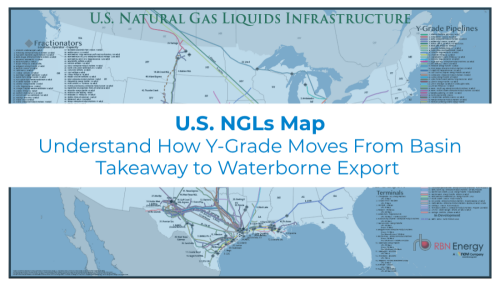
Visualize the infrastructure behind U.S. NGL movement.
The U.S. NGLs Map provides a comprehensive view of the transport, processing, and export networks moving NGLs across the U.S.
LNG Canada is a tourniquet of sorts to Western Canadian producers in that it promises to help stop the bleeding. For the first time in a long time, Montney- and Duvernay-sourced gas will be provided with access to a big new demand market, namely Asia via oceangoing LNG carriers. We first discussed the significance of the Asian market to North American gas producers and LNG exporters more than three years ago, in our “A Whole New World” series. There, we explained that Japan and South Korea are established — and very large — LNG demand centers, and are likely to remain so due to their big, energy-intensive economies; their efforts to wean themselves off coal; and their geographies, which leave them without access to pipeline gas. The real demand market to watch, though, is China. As we said recently in Masters of War, China in 2017 imported a record 38 MMtpa of LNG (the equivalent of about 5 Bcf/d), which represented an increase of more than 50% from the previous year and moved China into second place among LNG importers worldwide (only Japan imports more). And, according to a June (2018) report by the International Energy Agency (IEA), China’s LNG import volumes are expected to grow by another 60% — or 3 Bcf/d — by 2023. That growth in Chinese demand comes as the U.S. and China are locked in a trade dispute. Last month (September 2018), China put a 10% tariff on imports of U.S.-sourced LNG, complicating efforts by developers of liquefaction/LNG export projects in the U.S. to line up long-term Sales and Purchase Agreements (SPAs) with prospective Chinese buyers.
About the song
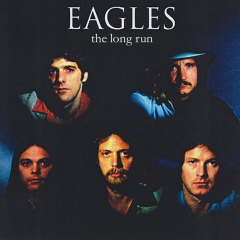
“The Long Run” was written by Don Henley and Glenn Frey and appears as the first song on side one of the Eagles’ sixth studio album of the same name. The song is about commitment in a romantic relationship, but it also addresses Henley and Frey’s response to being labeled “passe” by music critics during the disco and punk eras. The song’s style is an homage to the R&B sounds that came out of Stax Studios in Memphis in the 1960s. Released as the second single from the album in November 1979, it went to #8 on the Billboard Hot 100 Singles chart and has been certified Platinum by the Recording Industry Association of America. Personnel on the record were: Don Henley (lead vocals, drums), Glenn Frey (rhythm guitar, backing vocals), Joe Walsh (slide guitar, backing vocals), Don Felder (slide guitar, Hammond organ, backing vocals), Timothy B. Schmit (bass, backing vocals), and Joe Vitale (electric piano).
The album, The Long Run, was recorded between March 1978 and September 1979 at Criteria in Miami; Bayshore in Coconut Beach, FL; and Record Plant, One Step, Love ’n’ Comfort and Britannia in Los Angeles. Produced by Bill Szymczyk, it was released in September 1979. It went to #1 on the Billboard 200 Albums chart and has been certified 7X Platinum by the RIAA. It was the first Eagles album to feature Timothy B. Schmit on bass and the last full-length Eagles album to feature Don Felder on guitar. Three singles were released from the LP.
The Eagles are an American rock band formed in Los Angeles in 1971 by Don Henley, Glenn Frey, Bernie Leadon and Randy Meisner. All of the band members worked, recorded and toured with Linda Ronstadt before the Eagles’ career took off. They have released seven studio albums, three live albums, 10 compilation albums and 30 singles. They have sold more than 150 million records worldwide. They are members of the Rock and Roll Hall of Fame and the Vocal Group Hall of Fame, have won four CMA Awards, six Grammy Awards, and have received Kennedy Center Honors. Nine members have passed through the band since its formation. Founding member Glenn Frey died in New York City in January 2016 at 67, and founding member Randy Meisner died in Los Angeles in July 2023 at 77. The band continues to tour and will be appearing at The Sphere in Las Vegas in September and November.
"About the Song" -- written by Mickey McMahan , RBN Director of Musicology