
Crude oil may get most of the headlines, but the fuels made from it have delivered some of the market’s biggest surprises of 2026. Gasoline and diesel crack spreads have shattered previous records, with diesel’s premium over crude climbing above $100/bbl and helping propel the 3-2-1 crack spread to unprecedented heights. Those spreads reveal something that crude prices alone cannot: how much buyers are willing to pay for finished fuels relative to the oil used to produce them. That in turn provides insight into what’s driving the sky-high prices consumers are currently paying. With supply disruptions, strained trade flows and renewable-fuel compliance costs all shaping this year’s extraordinary numbers, in today’s RBN blog we’ll look at what goes into a crack spread as well as what we can learn from it and, at the end, we’ll give you the model!
A crack spread measures the difference between the value of refined products and the cost of crude oil. Its name comes from the “cracking” process in refineries, where larger hydrocarbon molecules are broken into smaller ones used in transportation fuels and other products. The individual gasoline and diesel cracks compare each product’s price with a crude benchmark. The 3-2-1 crack spread, which we first detailed in Money For Nothing, combines them, assuming three barrels of crude yield two barrels of gasoline and one barrel of diesel. That hypothetical product mix provides a convenient rule of thumb for tracking relative refining economics.
The result is a gross-margin indicator, not a measure of a refinery’s take-home profit. Refiners incur energy, labor, maintenance, transportation and renewable-fuel compliance costs. They also process different crude grades and produce a much broader slate of products, with yields that depend on their equipment and operating choices. Even the benchmark calculation can vary substantially. Different gasoline formulations, pricing locations and crude grades produce significantly different spreads. To see why that matters, let’s start with the inputs used in our daily Chart Toppers report.

The replay of our Fall 2026 School of Energy (September 9 & 10, Houston) is now available online!
Learn from RBN experts, participate in hands-on Excel modeling, connect with industry peers, and gain a stronger understanding of today's interconnected energy markets.
Start With Gasoline
Think about the choices at the pump: regular and premium gasoline have different octane ratings and prices. Wholesale markets make additional distinctions among formulations, delivery locations and timing. There is consequently more than one gasoline price, and more than one gasoline crack spread. In Chart Toppers, we use a Gulf Coast conventional gasoline price market. In our example below (using data from Friday, September 25), that price is 365 cents per gallon.
But before we compare gasoline with crude, we need to put both prices in the same units. Crude is quoted in dollars per barrel, while this gasoline benchmark is quoted in cents per gallon. With 42 gallons in a barrel, the conversion is:
365 cents/gal × 42 gal/bbl ÷ 100 = $153.30/bbl
We then subtract the crude price. With prompt WTI settling that Friday at $92.41/bbl, the gasoline crack is:
$153.30/bbl − $92.41/bbl = $60.89/bbl
A barrel of benchmark Gulf Coast gasoline was therefore worth about $61 more than a barrel of WTI, before refining and other costs. Per gallon, that difference was about $1.45.
How can gasoline prices remain elevated even when crude retreats? Finished gasoline has its own supply-and-demand balance determined in the global market, which we described recently in For the Love of Money. If gasoline becomes more valuable relative to crude, the crack can widen despite an increase in the feedstock price. A wider spread strengthens the incentive to produce gasoline, although it does not establish how much of that premium becomes refinery profit.
Add Diesel
For diesel, since we’re using a Gulf Coast gasoline price, we also use a Gulf Coast ULSD (ultra-low-sulfur diesel) benchmark. On September 25, that price was 457 cents per gallon. Applying the same conversion gives us:
457 cents/gal × 42 gal/bbl ÷ 100 = $191.94/bbl
Subtracting WTI’s $92.41/bbl settlement produces the diesel crack:
$191.94 /bbl − $92.41/bbl = $99.53/bbl
That means a barrel of benchmark Gulf Coast diesel was worth nearly $100 more than a barrel of WTI. Its premium over crude exceeded gasoline’s by roughly $39/bbl, highlighting diesel’s much stronger relative value, which we detailed in Basket Case.
This distinction matters for refining incentives. A combined crack spread can tell us that the hypothetical product barrel is valuable, but the individual cracks show where that value is concentrated. In this example, diesel offered the stronger incentive to increase production where refinery equipment and operating constraints allowed.
Bring Them Together: The 3-2-1
A refiner doesn’t make 100% gasoline or 100% diesel. It’s a mix. For that, we can combine the two products. The 3-2-1 calculation adds the value of two gasoline barrels (green-shaded row in Figure 1 below) and one diesel barrel (purple-shaded row), subtracts the cost of three crude barrels (black-shaded row) and divides the result by three. That gives us a 3-2-1 crack spread of $73.77/bbl. The result represents the theoretical value of that product mix above the crude input cost, per barrel of crude processed.
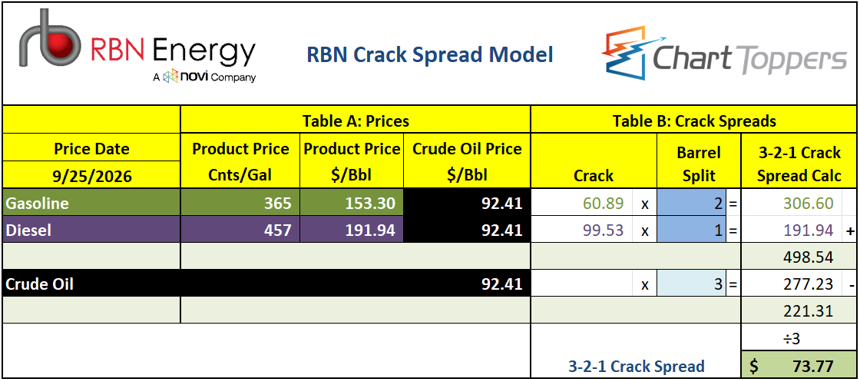
Figure 1. RBN Crack Spread Model. Source: Novi Labs

About the song
“Cracking the Code” was written by Gordy Quist and Owen Temple and appears as the eighth song on The Band of Heathens’ fifth studio album, Duende. The song addresses the irony of being genuine in a world of digital connections and social media. Personnel on the record were: Gordy Quist (vocals, guitars), Ed Jurdi (vocals, guitars, piano, percussion), Trevor Nealen (keyboards, backing vocals), Scott Davis (bass, lap steel guitar, percussion, backing vocals), Richard Millsap (drums, percussion, backing vocals), and Jim Vollentine (organ).
Duende was recorded during 2016 at The Texas Treefort in Austin; Echo Mountain in Asheville, NC; and Club Roar Studio in Nashville. The album was produced by Jim Vollentine and Gordy Quist. Released in January 2017, it went to #1 on the Americana Radio Charts. Three promotional singles and accompanying music videos were released from the LP.
The Band of Heathens is an Americana rock band formed in Austin in 2005 by songwriters Colin Brooks, Ed Jurdi and Gordy Quist. They have released nine studio albums, five live albums, a compilation album, an acoustic album of previously released songs, and 20 singles. Austin Music Awards named them “Best New Band” in 2007, and they received Gold certification from the Recording Industry Association of America for their single “Hurricane.” Fourteen members have passed through the band since its formation. They continue to record and will be on tour in the U.S. through November.
"About the Song" -- written by Mickey McMahan , RBN Director of Musicology