For a few years now, the Shale Revolution has been opening up development opportunities hardly anyone would have thought possible in the Pre-Shale Era. For example, new crude oil, natural gas and NGL pipelines from the Permian to the Gulf Coast, lots of new fractionators and steam crackers, as well as export terminals for crude, LNG, LPG, ethane and, most recently, ethylene. And here’s another. Thanks to the combination of NGL production growth and new ethylene supply — plus increasing demand for alkylate, an octane-boosting gasoline blendstock — the developer of a novel ethylene-to-alkylate project along the Houston Ship Channel has reached a Final Investment Decision (FID). Today, we discuss how the FID is driven by both supply-side and demand-side trends in the NGL and fuels markets.

As Rusty Braziel said in “The Domino Effect,” his book on the Shale Revolution, energy markets over the past few years have been characterized by an interconnected sequence of developments that have together propelled the U.S. crude oil, natural gas and NGL sectors into an extraordinary new era of abundance. Examples of the knock-on effects of the flourish caused by plentiful drill-bit hydrocarbons abound, but one that caught our eye in recent weeks is Next Wave Energy Partners’ (NWEP) FID on its planned 28-Mb/d ethylene-to-alkylate plant in Pasadena, TX. We’ll discuss the company’s project, known as Project Traveler, in detail in a moment; first we’ll look at “the row of falling dominoes” that led — almost inevitably, it now seems — to its fruition:
- Rising NGL production. Increased production of crude oil and natural gas in a number of major U.S. shale plays has resulted in higher and higher production of mixed NGLs — also known as y-grade. We have chronicled these gains in a number of RBN blogs, including Bring It On, where we noted that in 2019, produced volumes of NGLs (not counting ethane that is “rejected” into natural gas) approached 5 MMb/d — roughly double their level back in 2012 — and that by the mid-2020s, production is expected to increase by another 1 MMb/d.
- More fractionators, more steam crackers, more exports. The increasing supply of U.S.-sourced NGLs spurred the development of more fractionation capacity to separate y-grade into so-called “purity products” — ethane, propane, butane, isobutane and natural gasoline. Also, the growing supplies of NGL purity products led to the development of many new steam crackers (most of them designed to use ethane as their feedstock), and, with the U.S. now producing far more NGLs than it can consume, new marine terminal capacity is being added to handle growing volumes of LPG (propane and butane) and ethane exports. Most of this new fractionation, steam-cracker and export capacity is being added along the Gulf Coast.
- Low and relatively stable ethane prices. There can be a good bit of price volatility in the U.S. ethane market — back in September 2018, ethane prices at the Mont Belvieu ,TX, NGL storage and fractionation hub soared to north of 60 cents/gallon (c/gal) due in part to fractionation-capacity constraints. Generally speaking, though, ethane prices have been hovering within a few pennies of the 25-c/gal mark for most of the past two years, even as new steam crackers have come online and exports have risen. Our expectation is that while the next round of steam crackers will put upward pressure on prices, there is still plenty of ethane out there — much of it now being “rejected” into natural gas — and prices probably will not need to rise by more than a few c/gal to keep Gulf Coast steam crackers and export docks awash in the stuff. (Again, that doesn’t mean there won’t be at least some volatility.)
- Low and relatively stable butane prices. All of the increased y-grade production and addition of fractionation capacity can only mean one thing: more purity products. And, in the case of normal butane, this incremental supply must be exported because domestic demand is not growing. And that should mean that U.S. consumers can count on normal butane to be priced low enough to support exports.
- Rising Gulf Coast ethylene supply, and low ethylene prices. About 7.6 billion pounds per year of U.S. steam cracker capacity came online in 2018, followed by 11.2 billion pounds per year in new capacity last year; another 12.2 billion pounds per year is scheduled for start-up in the 2020-22 period. Given that ethane-consuming crackers in the Middle East and U.S. typically benefit from lower feedstock costs than their naphtha- and LPG-consuming brethren in Europe and Asia, the new U.S. plants are likely to run at high utilization rates, even if that contributes to a global ethylene-supply glut that keeps ethylene prices low. (Earlier this month, in a sign of things to come, the first cargo of ethylene was sent out of Enterprise Products Partners and Navigator Holdings’ new, 2.2-billion-pound-per-year Morgan’s Point export terminal along the Houston Ship Channel.)
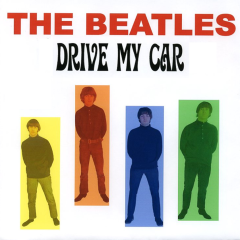
About the song
"Drive My Car" was written by Paul McCartney and John Lennon. The song was recorded at EMI Abbey Road Studios in London in October 1965, with George Martin producing. It has been suggested that the lyrics were inspired by an incident involving Beatles friend and Brian Epstein protégée Cilla Black, and her then-boyfriend, Bobby Willis. The song was the first cut on the UK version of Rubber Soul, and on the American release of Yesterday and Today. It was the first Beatles song to feature a slide guitar solo, played by Paul McCartney. Personnel on the record were: Paul McCartney (lead vocal, bass, piano, slide guitar), John Lennon (lead vocal, tambourine), George Harrison (backing vocals, lead guitar) and Ringo Starr (drums, cowbell).
Yesterday and Today was The Beatles’ 12th studio album and ninth album for Capitol Records in the U.S. It pulled together songs from the UK releases of Rubber Soul, Help, the not-yet-released Revolver, and the single of "Day Tripper"/"We Can Work It Out." The original album cover photo for the album by Robert Whitaker featured The Beatles wearing butcher smocks and draped with pieces of meat and body parts from plastic baby dolls. It has been presumed to be a reaction by The Beatles to Capitol Records in America pulling cuts culled from their UK releases, thus "butchering" the song selection and order. After a furor from U.S. retailers over the cover, Capitol pulled the album from stores and stickered over them with a new, non-offensive photo of the band. These re-stickered albums are referred to as the "butcher cover," and bring hefty prices in the collectors’ market. In 2016, an ultra-rare sealed mint stereo copy of the original cover was sold at auction for $125,000. Yesterday and Today was released in June 1966, and went to #1 on the U.S. Billboard Top 200 Albums chart. It has been certified 2x Platinum by the Recording Industry Association of America.
The Beatles were a British rock band formed in Liverpool, England, in 1960. With the line-up of John Lennon, Paul McCartney, George Harrison and Ringo Starr, The Beatles went on to change the face of rock music and pop culture during their time together. They are the best-selling music artists in history, with estimated record and digital sales of over 800 million worldwide. The band released 23 studio albums, five live albums, 53 compilation albums, 21 EPs and 63 singles. The Beatles have won one Academy Award, one Billboard Music Award, four Brit Awards, 26 Grammy Awards, 15 Ivor Novello Awards, one MTV Video Music Award and three World Music Awards. They are members of the Rock and Roll Hall of Fame, the UK Music Hall of Fame and Vocal Group Hall of Fame, and are Members of the Order of the British Empire, as appointed by Queen Elizabeth II. John Lennon died in 1980 and George Harrison in 2001. Paul McCartney and Ringo Starr continue to record and tour as solo artists.