


It would be an understatement to say that the worldwide market for liquefied natural gas (LNG) is in flux. LNG production is up and heading higher, oil—and LNG--prices are down sharply from a few months ago, and Japan and other big consumers of LNG are more interested than ever in mitigating price and supply risk. All this comes as Japan, a primary target of prospective U.S. and Canadian LNG export projects, is grappling with the need to restart dozens of idled nuclear units so it can reduce the oil and LNG imports that have hurt its trade balance since the Fukushima disaster nearly four years ago. Today we consider recent developments and how they may affect Japan and its potential LNG suppliers on the North America side of the Pacific.
Despite recent setbacks, Japan remains an undisputed economic powerhouse, the third-largest economy in the world behind the U.S. and China. But the island nation depends more than ever on imported oil and natural gas (in the form of LNG) to run its power plants and factories and to heat its businesses and homes. As we said in the First Episode of our “Spouse of the Rising Sun” series, Japan was already the world’s leading LNG importer (accounting for about one-third of all LNG imports) in March 2011, when a 9.0 earthquake triggered a tidal wave that devastated Tokyo Electric Power Co.’s six-unit Fukushima Daiichi nuclear station northeast of Tokyo. Within two months of the disaster, most of Japan’s other 48 nuclear units were offline, and by September 2013 all of them were. Given that nuclear power had been providing 30% of Japan’s electricity prior to Fukushima (with fossil-fired units providing almost all the rest), the industry-wide nuclear shutdowns forced wrenching change. Oil and LNG imports rose to fill the nuclear gap and, as we said in Episode Two, the pace of nuclear-unit restarts is likely to be slow and the heightened need for oil and LNG is likely to continue. What’s changed over the past few months though, is that a lull in LNG demand (in Japan and elsewhere in Asia) has created a supply surplus and a buyer’s market. Also, as we know all too well, the price of oil has fallen precipitously and shows no sign of a quick rebound. These changes (and rising LNG production in Papua New Guinea, Australia and—soon—in the U.S.) have given Japan the hope of reining in its fuel-import costs in general, and its LNG costs in particular.
The very liquid worldwide market for oil enables Japan and other Asian oil importers to take advantage of currently low oil prices. In addition, because the vast majority of Asian LNG contracts index LNG prices to a basket of imported oil known as the Japanese Crude Cocktail (JCC - see “Courtesy of the Red, White and Blue”), LNG-importing countries also are benefiting from much lower prices in recent months. Figure #1 shows an approximation of the JCC based on Brent prices since the start of 2014, falling from close to $20/MMBtu in July to $10/MMBtu in December. Add to that the facts that demand for LNG in Japan and South Korea this past summer and fall has been flat, and that new LNG production expected online soon will add to market supply (fully one-third of the output of Chevron’s mammoth Gorgon LNG project in Australia—set to start exporting in mid-2015—is not under long-term contract so will hit the open market) and you have yourself an LNG price-sag of major proportions. In December 2014, spot LNG prices in Asia (a better leading indicator than the JCC contract price) are below $10/MMBTU and they could fall even more by the spring of 2015 if it’s a mild winter and LNG stockpiles continue to build.
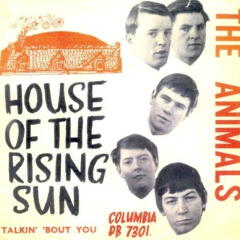
About the song
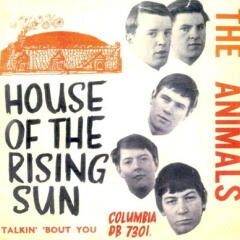
“House of the Rising Sun” is a traditional folk song recorded by British rock group, The Animals, in 1964, with arrangement credit given to Animal's keyboardist Alan Price. The lyrics tell the tale of a harsh life centered around a house of ill repute called the House of the Rising Sun in New Orleans. Rumor has it that the location for the House of the Rising Sun was 828-830 St. Louis Street in New Orleans’s French Quarter. The building is still there, and after a recent visit by Animal’s singer Eric Burdon, he stated, “The house was talking to me.” (One must keep in mind that Burden wrote the song, “A Girl Named Sandoz,” a love song to Sandoz Laboratories’ LSD-25, back in 1967, so who knows what he meant about talking houses.) The band had done an arrangement on the song and had been using it as a closer on a tour they were doing with Chuck Berry. After hearing the positive response to the song, producer Mickie Most took the band to DeLane Lea recording studio in London and recorded the tune in one take in May 1964. When the record was pressed it listed Alan Price as the arranger which led to great bitterness and strife within the band as Price got all the songwriter’s royalties on the record. It eventually led to him leaving the band in May 1965. The story went that there wasn’t enough room to list all the band members’ names on the record label, but one has to wonder why they didn‘t just list “The Animals” if that was the case. Released as single in the U.S. in June 1964, it went to #1 on the Billboard Hot 100 Singles chart and has been certified gold by the Recording Industry Association of America. Personnel on the record were: Eric Burdon (vocals), Hilton Valentine (guitar), Alan Price (Vox Continental organ), Chas Chandler (bass), and John Steel (drums, percussion).
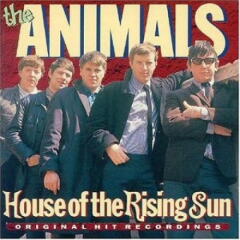
The Animals is the American debut album of the band by the same name. As “The House of the Rising Sun” was only released in a singles format in the U.K. and U.S., the album was put together by the band’s U.S. label, MGM, to include the song and promote album sales. Produced by Mickie Most, the album was released in September 1964 and went to #7 on the Billboard 200 Albums chart. Two singles were released from the LP.
The Animals are an English rock band formed in Newcastle in 1962 by Eric Burdon, Alan Price, Hilton Valentine, Chas Chandler, and John Steel. They have released 10 studio albums (including ones released with Burdon under the Eric Burdon & The Animals moniker), five EPs, six compilation albums, and 25 singles. They were inducted into the Rock and Roll Hall of Fame in 1994. In September 1966, the original band broke up, with Burden moving to California and putting together a new band called Eric Burdon & The Animals. Chas Candler went on to discover and manage Jimi Hendrix and produce future British superstars Slade. Chandler died in July 1996 and Hilton Valentine died in January 2021. Eric Burdon continues to perform live with various touring musicians as The Animals.




Comments
"Selling LNG at a solid profit," and when the LNG is regasified, the solid profit correspondingly becomes liquid!
All kidding aside, this is an excellent and informative series of articles that pulls together information from quite a variety of markets.