


The total shutdown of Japan’s nuclear power industry in the wake of the March 2011 Fukushima disaster caused a more than 20% increase in liquefied natural gas imports. In 2015, the first two of the 48 Japanese nuclear units that were taken offline post-Fukushima are expected to be restarted, but it will take several years for most of the rest to come back online—and it’s likely that many nuclear units will never return to service. How much did Fukushima change Japan’s electricity sector, and how will that nation’s fledgling nuclear reboot affect LNG imports, not just from current suppliers like Australia, Qatar and Malaysia but new and prospective suppliers in the US and Canada? Today we begin a look at the electric industry in Japan, the future of nuclear power and LNG use there, and the Japanese-led effort to change how LNG is priced.
Japan was already the world’s leading LNG importer (accounting for about one-third of all LNG imports) in March 2011, when a 9.0 earthquake triggered a tidal wave that devastated Tokyo Electric Power Co.’s six-unit Fukushima Daiichi nuclear station northeast of Tokyo. Within two months of the disaster, most of Japan’s other 48 nuclear units were offline, and by September 2013 all of them were. Given that nuclear power had been providing 30% of Japan’s electricity prior to Fukushima (with fossil-fired units providing almost all the rest), the industry-wide nuclear shutdowns forced wrenching change. Electric customers were asked to slash their power use to ease strain on the grid, and utilities took an all-hands-on-deck approach to generating electricity, maximizing their use of natural gas, coal and oil-fired units to keep the lights on. Gas and oil use to produce power rose the most in 2011 and 2012, but oil use fell in 2013, offset by a rise in lower-cost coal (see Figure #1). Note that LNG-based power generation (blue-shaded area in the bar-chart) accounts for half of the total, and that the pleas by Japan’s government and utilities to curb power use were heeded--electricity consumption in Japan (black line in chart) dropped an impressive 12% in the months after Fukushima and has remained flat since then.
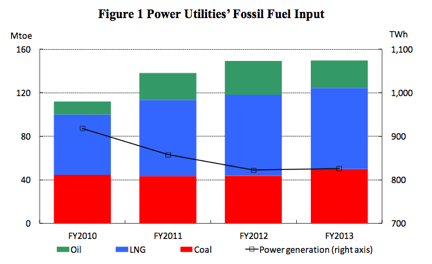
Figure #1
Source: Institute of Energy Economics, Japan (Click to Enlarge)
The increased use of fossil fuels for power generation post-Fukushima resulted in a huge uptick in LNG imports (more than 95% of Japan’s gas comes from LNG). According to the Japanese government, in 2010 the LNG equivalent of about 9 Bcf/d of natural gas was imported (with electric utilities accounting for more than 5 Bcf/d of the total). By 2013, LNG imports had soared to the equivalent of 11.5 Bcf/d (with utilities accounting for an even greater share—7.4 Bcf/d—in part because of new gas-fired plants coming online), and in the first eight months of 2014, LNG imports averaged 11.8 Bcf/d. Japan has a stellar LNG import/regasification infrastructure (30 terminals with a total gas send-out capacity of 23 Bcf/d) and can handle the flood of LNG—that wasn’t and isn’t the issue. The problems for Japan are that 1) the fossil-fired units it now depends on for almost all its power (wind, solar and other renewables provide only a sliver) can barely meet demand on days or nights with high power demand, and 2) oil and gas (particularly when it’s supplied as LNG, as it needs to be in Japan) are way more expensive than nuclear fuel (uranium).
About the song
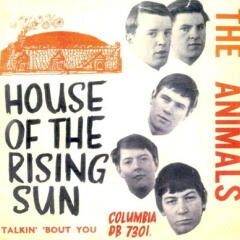
“House of the Rising Sun” is a traditional folk song recorded by British rock group, The Animals, in 1964, with arrangement credit given to Animal's keyboardist Alan Price. The lyrics tell the tale of a harsh life centered around a house of ill repute called the House of the Rising Sun in New Orleans. Rumor has it that the location for the House of the Rising Sun was 828-830 St. Louis Street in New Orleans’s French Quarter. The building is still there, and after a recent visit by Animal’s singer Eric Burdon, he stated, “The house was talking to me.” (One must keep in mind that Burden wrote the song, “A Girl Named Sandoz,” a love song to Sandoz Laboratories’ LSD-25, back in 1967, so who knows what he meant about talking houses.) The band had done an arrangement on the song and had been using it as a closer on a tour they were doing with Chuck Berry. After hearing the positive response to the song, producer Mickie Most took the band to DeLane Lea recording studio in London and recorded the tune in one take in May 1964. When the record was pressed it listed Alan Price as the arranger which led to great bitterness and strife within the band as Price got all the songwriter’s royalties on the record. It eventually led to him leaving the band in May 1965. The story went that there wasn’t enough room to list all the band members’ names on the record label, but one has to wonder why they didn‘t just list “The Animals” if that was the case. Released as single in the U.S. in June 1964, it went to #1 on the Billboard Hot 100 Singles chart and has been certified gold by the Recording Industry Association of America. Personnel on the record were: Eric Burdon (vocals), Hilton Valentine (guitar), Alan Price (Vox Continental organ), Chas Chandler (bass), and John Steel (drums, percussion).
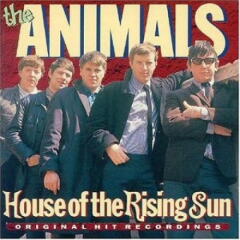
The Animals is the American debut album of the band by the same name. As “The House of the Rising Sun” was only released in a singles format in the U.K. and U.S., the album was put together by the band’s U.S. label, MGM, to include the song and promote album sales. Produced by Mickie Most, the album was released in September 1964 and went to #7 on the Billboard 200 Albums chart. Two singles were released from the LP.
The Animals are an English rock band formed in Newcastle in 1962 by Eric Burdon, Alan Price, Hilton Valentine, Chas Chandler, and John Steel. They have released 10 studio albums (including ones released with Burdon under the Eric Burdon & The Animals moniker), five EPs, six compilation albums, and 25 singles. They were inducted into the Rock and Roll Hall of Fame in 1994. In September 1966, the original band broke up, with Burden moving to California and putting together a new band called Eric Burdon & The Animals. Chas Candler went on to discover and manage Jimi Hendrix and produce future British superstars Slade. Chandler died in July 1996 and Hilton Valentine died in January 2021. Eric Burdon continues to perform live with various touring musicians as The Animals.




Comments
Thank you indeed for highlighting the topic. I am skeptical about what the government authorities (such as Abe cabinet and METI) are saying about importing LNG from the US - "cheaper than traditional LNG, linked to crude oil price." Power and gas companies that are planning to import US LNG want to diversify their LNG price exposure, as long as I understand. Diversifying price indices has a positive effect, removing their price exposure to crude oil, which could be quite volatile from time to time. The effect of power use conservation is profound - This summer, power demand declined dramatically: it was a combination of weather effect (we had a cooler than normal temperature, especially in western part of Japan) and continued power use conservation. 10 years long contraction of the Japanese economy, associated with historically strong currency=Japanese Yen, forced large manufacturers to move overseas...hence less power demand. So the recent weakness in JPY will not help boosting exports/Japanese economy as it used to be in the past but will only raise import costs (LNG, coal, foods, etc) and lead to huge current account deficit. So what lies ahead for a country with aging population - this is what we need to figure out....I look forward to your next episode. Best regards, Junzo