Last week (ending April 4) the summer 2014 natural gas storage injection season began with a whimper by adding 4 Bcf to empty tanks pummeled by the Polar Vortex. That was a slower than expected start to the Herculean task of replenishing gas stocks before next winter. A lot of factors will have to fall into place for that to happen. A too-hot summer could pull gas away from injection and into demand for power burn. Today we continue our analysis of regional power burn prospects with a look at New England demand this year.
New England is a natural gas sponge. It has no gas production of its own, and no underground storage capacity to supplement the gas pipelines that feed its gas habit from the west and north. Thanks to it’s lower use of gas this year versus the past few winters, the region was less of a drain than some others (such as the Mid-Atlantic states and the Midwest) on the nation’s natural gas reserves, which now total less than 0.9 Tcf and are badly in need of replenishing. But that could change in future because, as we said in the opening episode of Should I Store or Should I Burn, new gas-fired generation units are coming online in the U.S. each year, mostly to replace older coal units being retired because of tightening federal emissions rules. And that’s been especially true in New England where gas units now account for 54% of the region’s available generating capacity and about 50% of annual electricity production.
New England is particularly constrained when it comes to gas supply, and not just because it is the only consuming region without any underground gas storage capacity. In our Please Come to Boston series, we described how the region’s gas pipeline network remains decidedly un-robust (particularly during the winter months), and how the failure of the region’s electricity market to sufficiently incent owners of gas-fired generation to lock in long-term pipeline capacity is hampering efforts to build needed gas-delivery infrastructure. In Polar Vortex Spurs Catch-22 Workaround, we discussed efforts by New England’s governors and ISO-New England (ISO-NE)—the region’s electric-grid operator—to encourage the development of new pipeline capacity so generators and other gas consumers can benefit fully from the ample and cheap Marcellus gas being produced not so far away. As Figure #1 shows there are now more than 40 gas-fired power plants in New England, most of them connected directly to one of the six interstate gas pipelines that traverse the region (red dots in Figure #1), and the rest served through a local distribution company (LDC – pink dots in Figure #1)—or, in one case, by 250 MMb/d of imported liquefied natural gas dedicated to the 1,700-MW Mystic station near Boston (brown dot).
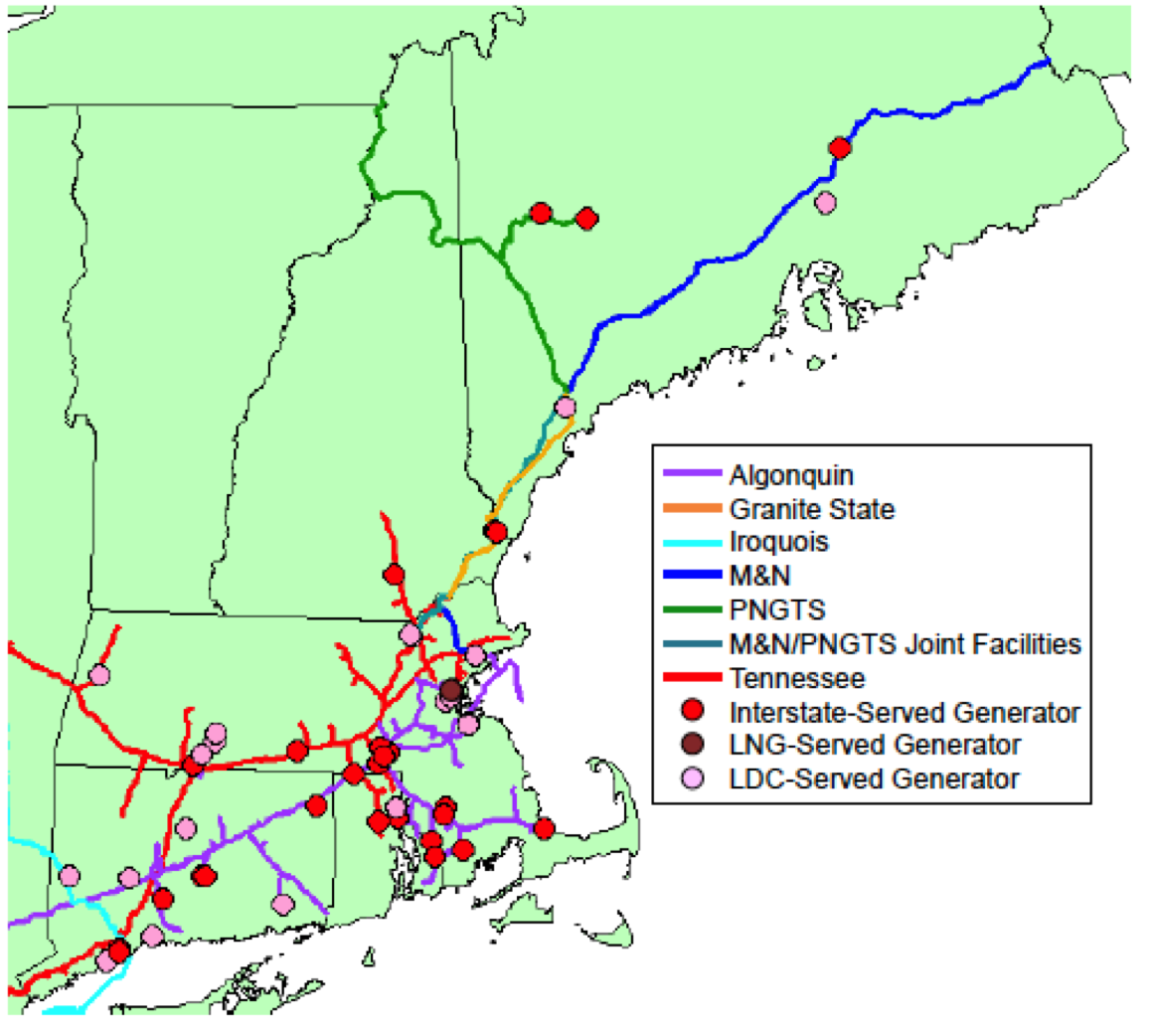
Figure #1