Sitting within or near the Marcellus/Utica shale gas play and facing tightening environmental rules that start kicking in next April, power generators in the PJM (a large region that includes the states of Pennsylvania, New Jersey, Maryland, Delaware, West Virginia and Ohio as well as parts of Virginia, North Carolina, Kentucky, Indiana, Illinois and Michigan) and New York electricity markets very likely will burn increasing amounts of natural gas the next few years. But with pressure to rebuild depleted gas inventories after this year’s Polar Vortex winter and the next wave of coal-unit retirements still months away, to what degree will generators in the region turn to gas this summer? In this episode in our gas power burn series, we provide a progress report on gas-inventory rebuilding and look at this summer’s coal-versus-gas dynamics in PJM and New York.
In the first episode of our series, Should I Store or Should I Burn—Will Power Burn Jeopardize Gas Injection Season—we recounted how the polar vortices in January and February (and colder-than-normal weather in December 2013) resulted in record draw-downs in stored natural gas. By the beginning of spring, gas inventories were well below 900 Bcf. As we see in Figure #1, while the pace of inventory rebuilding has picked up in recent weeks (119 Bcf the week ending May 30, according to the U.S. Energy Information Administration, or EIA), the inventory level (at 1.5 Tcf as of May 30) remains a hefty 33% below where it was at the same time last year (2.4 Tcf) and 37% below the five-year average for late May (2.4 Tcf).
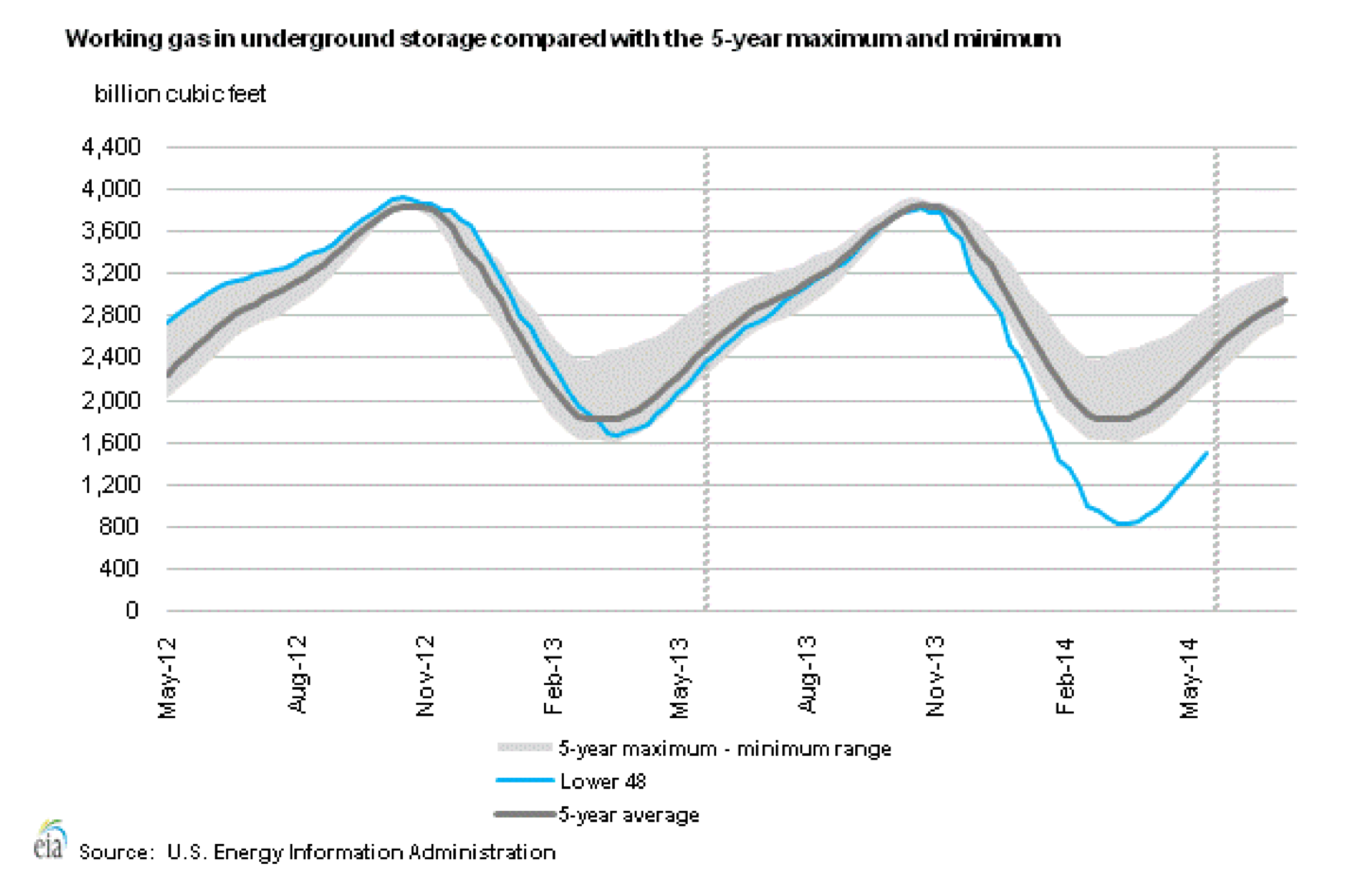
Figure #1
Source: Energy Information Administration (Click to Enlarge)

About the song
“Should I Stay or Should I Go” was written by Topper Headon, Mick Jones, Paul Simonon and Joe Strummer, and appears as the third track on side one of The Clash’s fifth studio album, Combat Rock. It was originally released as a single in May 1982, where it went to #45 on the Billboard Hot 100 Singles chart. After being featured in a Levi’s jean television commercial, the song was re-released in February 1991 and went to #1 on the U.K. singles chart and made the Top 10 on several European charts. The song borrowed heavily from the 1960s Righteous Brothers hit, “Little Latin Lupe Lu,” and featured the lead vocals of Mick Jones. The lyrics were rumored to have been written about Jones’s relationship with singer Ellen Foley. Personnel on the record were: Mick Jones (guitar, lead vocals), Joe Strummer (guitar, backing vocals), Paul Simonon (bass, backing vocals), Topper Headon (drums) and Joe Ely (backing vocals).
Combat Rock was recorded between September 1981 and April 1982 at Electric Lady Studios in New York City, Ear Studios in London, and Warnford Studio in Hampshire, England. Produced by The Clash with Glyn Johns, the album was released in May 1982. It went to #7 on the Billboard Top 200 Albums chart and has been certified 2X Platinum by the Recording Industry Association of America. Three singles were released from the LP.
The Clash was an English punk rock band formed in London in 1976 by Joe Strummer, Mick Jones, Paul Simonon and Topper Headon. Headon left the band in 1982 and Jones in 1983. The group continued with new members, but officially broke up in 1986. Ten members passed through The Clash after its inception. They released six studio albums, two live albums, nine compilation albums, two EPs, and 31 singles. The band was inducted into the Rock and Roll Hall of Fame in March 2003. Joe Strummer went on to form various solo projects, Mick Jones formed Big Audio Dynamite, and Paul Simonon formed Havana 3AM. Joe Strummer died in December 2002. In 2007, director Julien Temple released the Joe Strummer biopic Joe Strummer: The Future is Unwritten, along with a soundtrack to the film.