


Several key factors point to a gradual increase in natural gas power burn over the next few years. More gas-fired units are coming online, and more coal-units are being retired. But with gas prices trending higher this spring and summer than in the same periods last year, 2014 gas use by the electric sector may end up unchanged from 2013--unless this summer is a scorcher. The stronger pricing is good news for producers, of course, as is the very real need to replenish depleted gas stocks. Today, in the first episode of a new series on power burn demand for natural gas, we look back at 2013 and forward to prospects for 2014
The amount of gas consumed annually for power burn is a zig-zaggy thing, of course, due to factors like the strength (or weakness) of the economy, temperature, gas and coal prices, and even precipitation levels in hydro-dependent regions. After a very mild winter and with gas prices at 10 year lows (encouraging unprecedented levels of coal to gas power switching), 2012 was something of an anomaly as gas burn increased 6 Bcf/d over 2011 to 24.9 Bcf/d. In 2013 – a more normal year – natural gas consumed for power was down 2.6 Bcf/d from 2012 to 22.3 Bcf/d, in part due to higher natural gas prices and also because a milder summer reduced demand for air conditioning. Over the longer term the trend has been gradual gains in the amount of gas-fired power generated and gradual declines in the amount of power produced by coal-fired units.
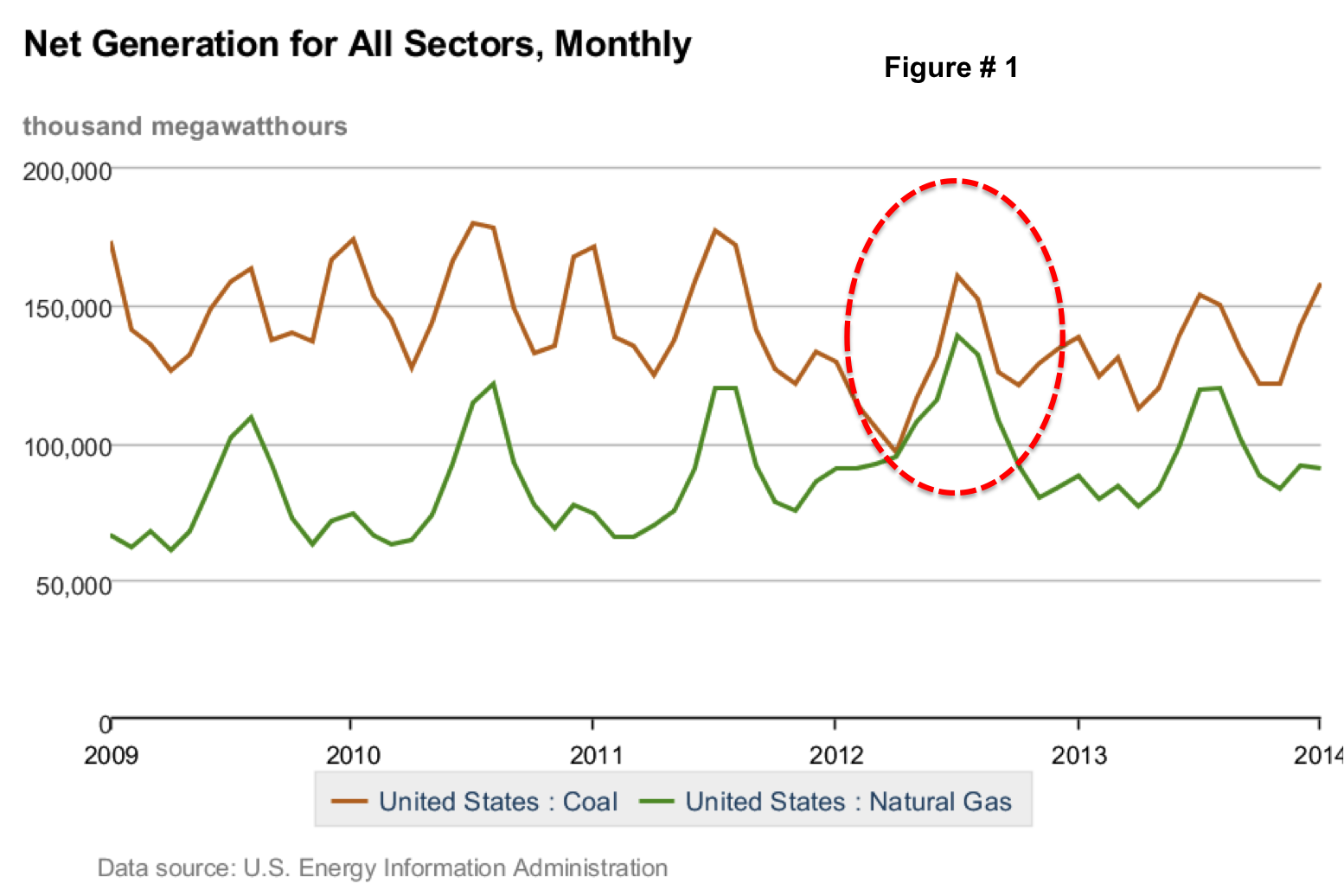
As we did in our gas power burn analysis last spring (see 2012 Natural Gas Power Burn—Was That a Wild and Crazy Year?), let us turn first to the latest data from the U.S. Energy Information Administration (EIA) and its nifty Electricity Data Browser - an application that allows users to browse through power generation statistics and select data, report types and charts interactively. Figure # 1 shows the amount of power generated (in thousand MWh) by coal (brown line) and natural gas (green line) over the past five years. You can see major peaks each summer and minor peaks each winter in both the gas and coal power generation data, with—as we said earlier—that special situation in the spring and summer of 2012 when gas prices plummeted and the electric sector (which dispatches or runs the units with the lowest costs) ramped down its coal use and ramped up its use of natural gas (red dotted circle on the chart).
The summer peaks of coal- and gas-fired generation sagged lower than previous years in 2013 with the unusually cool temperatures. But look at the trend of coal and gas generation, dismiss the anomaly of 2012, and consider two things. First, the general trend since 2009 is that the gap between coal and gas has been narrowing, with coal’s contribution falling and gas’s on the rise. Second, even with the very mild weather last summer, the output of gas-fired units in July and August of 2013 (at just under 120 million MWh each month) was almost identical to their output in those months in 2011—a typically hot, high-demand summer. So if we get back to normal summer weather in 2014, you would expect an increase in power demand generally and probably in gas-fired generation too.
But if we take the forward curve for Henry Hub natural gas as an indication of price expectations for this spring and summer, then we’ll see prices about 20% higher than they were last year—averaging $4.42/MMBtu in the April-through-October period this year, compared with $3.77/MMBtu in the same period in 2013. These higher prices will discourage coal-to-gas switching, and limit the potential for gains in spring-and-summer gas power burn. EIA forecasts a 1.3% increase in total U.S. electric output for 2014 as a whole, to 11.3 TWh, with gas’s share of output slipping slightly--to 26.9% from 27.4%--again because of that expected uptick in gas prices. It estimates gas power burn for April-through-October 2014 at 23.9 Bcf/d, about the same as last year. An unusually hot summer, though, would cause a sharper rise in generation, with both coal and gas power burn increasing.
The coal and gas data in Figure # 1 end on New Year’s Eve 2013, less than a week before we first heard the phrase “polar vortex.” EIA has estimated that the amount of power generated in the December-through-February period this past winter was 5% higher than the same period in late 2012/early 2013, primarily due to much colder weather in the Northeast, Midwest and South. The percentage of power burn from natural gas during the coldest spell in February was down slightly versus 2013, but the total amount of electricity being produced by coal and gas units alike was up because of all that Arctic air. As we will explore in later episodes of this blog series, there were real differences in wintertime gas power burn among the various regions of the U.S.
About the song
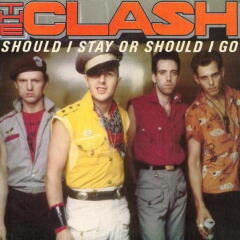
“Should I Stay or Should I Go” was written by Topper Headon, Mick Jones, Paul Simonon and Joe Strummer, and appears as the third track on side one of The Clash’s fifth studio album, Combat Rock. It was originally released as a single in May 1982, where it went to #45 on the Billboard Hot 100 Singles chart. After being featured in a Levi’s jean television commercial, the song was re-released in February 1991 and went to #1 on the U.K. singles chart and made the Top 10 on several European charts. The song borrowed heavily from the 1960s Righteous Brothers hit, “Little Latin Lupe Lu,” and featured the lead vocals of Mick Jones. The lyrics were rumored to have been written about Jones’s relationship with singer Ellen Foley. Personnel on the record were: Mick Jones (guitar, lead vocals), Joe Strummer (guitar, backing vocals), Paul Simonon (bass, backing vocals), Topper Headon (drums) and Joe Ely (backing vocals).
Combat Rock was recorded between September 1981 and April 1982 at Electric Lady Studios in New York City, Ear Studios in London, and Warnford Studio in Hampshire, England. Produced by The Clash with Glyn Johns, the album was released in May 1982. It went to #7 on the Billboard Top 200 Albums chart and has been certified 2X Platinum by the Recording Industry Association of America. Three singles were released from the LP.
The Clash was an English punk rock band formed in London in 1976 by Joe Strummer, Mick Jones, Paul Simonon and Topper Headon. Headon left the band in 1982 and Jones in 1983. The group continued with new members, but officially broke up in 1986. Ten members passed through The Clash after its inception. They released six studio albums, two live albums, nine compilation albums, two EPs, and 31 singles. The band was inducted into the Rock and Roll Hall of Fame in March 2003. Joe Strummer went on to form various solo projects, Mick Jones formed Big Audio Dynamite, and Paul Simonon formed Havana 3AM. Joe Strummer died in December 2002. In 2007, director Julien Temple released the Joe Strummer biopic Joe Strummer: The Future is Unwritten, along with a soundtrack to the film.







Comments
Housley --
Really good article. Thanks.
Just wanted to mention something that doesn't change the trend you pointed out, but might make it stronger. You said:
"Second, even with the very mild weather last summer, the output of gas-fired units in July and August of 2013 (at just under 120 million MWh each month) was almost identical to their output in those months in 2011—a typically hot, high-demand summer."
My recollection is that the summer of 2011 was a record breaker as far as being hot. I think August 2011 was the second hottest ever and July 2011 was the third hottest ever. I'm guessing that June was warm too although I don't know that one for sure.
Anyway, point being if gas burn levels were similar in Summer 2013 to 2011, they were probably pretty high compared to historic norms.