


Last month, in the U.S. Environmental Protection Agency’s (EPA) latest ruling in a long-running dispute with refiners over the Renewable Fuel Standard (RFS), EPA denied 36 petitions from refiners seeking exemptions to their obligation to blend renewables like ethanol into gasoline for the 2018 compliance year. At the core of this dispute are two contradictory premises about Renewable Identification Numbers, or RINs. One premise says the RINs system adds cost that hurts refiners’ profitability, while the other says refiners’ profitability is not affected. Can two seemingly contradictory premises be true? In today’s RBN blog, we begin an examination of the issues surrounding RINs and the degree to which the cost affects refiners’ and blenders’ bottom lines.

The Future of Fuels bi-annual report by RBN's Refined Fuels Analytics provides an in-depth analysis of the U.S. and global refinery industries, focusing on crude oil and fuel market dynamics, supply and demand, alternative fuels, refinery capacities, and price forecasts to help stakeholders navigate the evolving energy landscape.
RINs were among the first topics that RBN tackled in the blogosphere. As we said way back in 2012 in The RIN and Stimpy Show, RINs are used to monitor compliance with the federal RFS, which was created by the Energy Policy Act of 2005 and expanded and extended by the Energy Independence and Security Act of 2007. Figure 1 helps explain how RINs work. The big gray boxes represent the key players in all this, including (from the left) the renewable fuel (ethanol) producer; the refinery producing oil-based blendstock for oxygenated blending (BOB, or “unfinished” gasoline) or the importer importing BOB; the blender that mixes BOB with ethanol; and the service station where the blended gasoline (E10 in this example, a 90-10 mix of BOB and ethanol) is sold. When a gallon of ethanol (light green box to upper left) is produced for blending into BOB, a RIN — a 38-digit number — is assigned and “attached” like a virtual mattress tag to that gallon of ethanol (dark green oval to upper left).
About the song
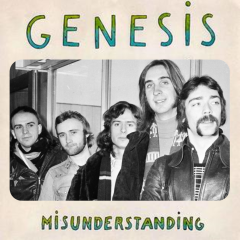
“Misunderstanding” was written by Phil Collins and appears as the fifth song on side one of Genesis’ 10th studio album, Duke. Released as a single in May 1980, the song went to #14 on the Billboard Hot 100 Singles chart. According to Collins, the song was influenced by The Beach Boys’ “Sail on Sailor,” Sly and the Family Stone’s “Hot Fun in the Summertime,” and Toto’s “Hold the Line.” Personnel on the record were: Phil Collins (lead vocals, drums, drum machine, percussion), Tony Banks (keyboards, twelve-string guitar, backing vocals), and Mike Rutherford (guitars, bass, bass pedals, backing vocals).
Duke was recorded in November and December of 1979 at Polar Studios in Stockholm, with Genesis and David Hentschel producing. Released in March 1980, the album went to #11 on the Billboard 200 Albums chart. It has been certified Platinum by the Recording Industry Association of America. Three singles were released from the LP.
Genesis is a British rock band formed in Godalming, Surrey, England, in 1967. The band was a pioneer of what was to be labeled progressive rock. Its most successful lineup consisted of Collins, Banks and Rutherford. Original lead singer Peter Gabriel left the band in 1975 to pursue a successful solo career. Genesis has released 15 studio albums, six live albums, four compilation albums, two EPs and 43 singles and have sold over 100 million records worldwide. The band was inducted into the Rock and Roll Hall of Fame in 2010. Eleven people have passed through its ranks since its inception. The band played their last concert together in March 2022, with Collins saying it would be his last Genesis tour due to health issues.




Comments
Great explanation. It must be pointed out, however, EPA's insisting RIN pass-through and rack discounts both exist is self-contradictory. Blenders can use the money refiners pay for D6 RINs either to cover increased bulk BOB prices or to discount wholesale rack E10 prices. But, they can't do both at the same time. If E10 is discounted based on the RIN price, refiners are not recapturing or passing through their D6 RIN costs. Empirical evidence (Knittel, et al) does show pass through in NYH where BOB importers must purchase RINS and imports are the marginal supply. The same paper, however, shows no pass through for LA RBOB where BOB is exported and imports do not influence market prices. It seems clear that where BOB exports dominate outside of NYH, vertically integrated refiners have their RIN costs covered by their marketing arms' even larger RIN revenues. For vertically integrated refiners, therefore, D6 RINs are essentially free and pass-through does not exist. All that is needed is for someone to gather some empirical evidence on markets outside NYH such as the Gulf Coast or elsewhere -- areas EPA has roundly ignored so far. There is a legal and economic strategy for moving the point of obligation that is yet to be tried, but space does not permit going down that path here.
Thanks for reading, and for your compliment, and for your comments! I think your comment is two steps ahead of us. In this blog, we focused on disagreement over whether the refiner’s tax gets passed through to the blender in the price of refined fuel. That's step one. Two upcoming blogs will address the two other steps in the chain which are the purchase of the renewable component and the sale of blended fuel to the consumer. As the series progresses, I will say that, if the markets for BOB and E10 are fully competitive, the RIN tax does pass through from refiner to blender, and the RIN subsidy passes through from blender to consumer, and the consumer price includes the RIN tax (passed through in the BOB component) and the RIN subsidy (passed through in the ethanol component, and sometimes called the “RIN discount”), and these two effects add to nearly a wash for E10 price. I don’t see this as self-contradictory. The blender can pass through both a higher cost of one component and a lower cost for the other at the same time. This will leave open many questions like which markets are truly competitive, whether the passthrough theory can be proven empirically, and others, which we could address in future blogs.