


Over the past few weeks, publicly traded independent refining companies reported their latest quarterly results, and nearly all lamented on a common theme: the cost of Renewable Identification Numbers (RINs) is out of control. However, the financial burden is not felt equally across the industry, as companies with integrated marketing operations (refining, blending and retailing) don’t face the same RINs-cost albatross as merchant refiners who don’t have retail operations. Today we review the escalating RIN costs that obligated parties have endured this year and explain how the degree of financial pain depends on the level of refiners’ downstream integration.
RINs have become a leading topic of conversation—and angst—in the refinery sector, and we’ve been exploring the matter in the RBN blogosphere. In our initial blog a few years ago (A Market of Contradictions: Ethanol Mandates, Motor Gasoline and the Blend Wall), we described the evolution of ethanol mandates and the limits on how much ethanol can be blended into gasoline without affecting engine performance. We followed that up with The RIN and Stimpy Show and, more recently, with a two-part series: Magical Mystery Tour - Turmoil in U.S. Gasoline Markets and the Arcane World of RINs and Magical Mystery Tour - Is a Showdown on the RFS and RINs in the Offing?
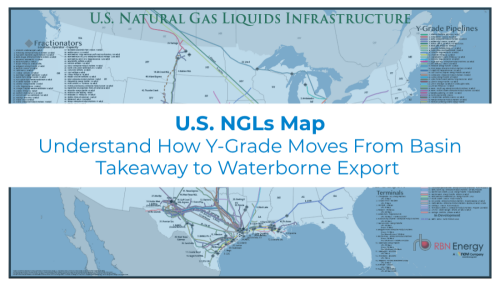
Visualize the infrastructure behind U.S. NGL movement.
The U.S. NGLs Map provides a comprehensive view of the transport, processing, and export networks moving NGLs across the U.S.
The main thing to know about RINs is that they are unique numbers assigned to batches of ethanol and other biofuels used to track compliance, and they are the “currency” of the federal government’s Renewable Fuel Standard (RFS) program. Congress created the RFS program in an effort to reduce greenhouse gas emissions and expand the nation’s renewable fuels sector, while reducing reliance on imported oil. The RFS was authorized under the Energy Policy Act of 2005 and expanded under the Energy Independence and Security Act of 2007 (commonly referred to as RFS2). In simple terms, a RIN is created when a gallon of biofuel is manufactured. Once that biofuel is blended with gasoline or diesel for sale in the U.S., the RIN becomes “detached” from the biofuel, and two things can happen: 1) it can be surrendered to the Environmental Protection Agency (EPA) by an obligated party (a refiner or importer) to demonstrate compliance with the RFS, or 2) if a non-obligated party (i.e., someone who didn’t manufacture or import the gasoline or diesel) generates the RIN, they can sell it to obligated parties who then surrender it to the EPA to meet their obligation. Therefore, refiners who produce more gasoline than they blend and sell domestically end up “short” RINs, and companies with large branded networks and smaller (or no) refining capacity that blend biofuels are “long” RINs.
In order to better understand how the cost of complying with the RFS is impacting the industry, Figure 1 shows the historical RFS compliance cost per gallon of gasoline or diesel produced. As seen from the chart, the RFS compliance cost has increased from 5.5 cents/gal on average in 2015 to 8.4 cents/gal year to date through October 2016, a gain of more than 50%. Note that most of the compliance cost is associated with corn ethanol, the most common of renewable fuels—represented by the blue bar segments in the graph—and the focus of today’s blog. It’s worth noting, though, that the cost of complying with some of the more arcane aspects of the RFS— “advanced biofuels” represented by the green, yellow and red bar segments—has been rising as the rules that mandate the use of these biofuels in gasoline and diesel ramp up.
About the song
“Money for Nothing” was written by Mark Knopfler and Sting and appears as the second song on side one of Dire Straits’ fifth studio album, Brothers in Arms. Knopfler was inspired to write the song by comments from an employee at a New York City appliance store about an MTV video playing on one of the store’s television sets: “Money for nothing and chicks for free.” Sting makes an appearance on the song, singing “I want my MTV” to the melody of The Police’s “Don’t Stand So Close to Me.” Released as the second single from the LP in June 1985, it went to #1 on the Billboard Hot 100 Singles chart. It won the band a Grammy Award in 1986 and the Video of the Year Award at the third annual MTV Video Music Awards. Personnel on the record were: Mark Knopfler (lead vocals, guitar), John Illsley (bass, backing vocals), Guy Fletcher (synthesizer, Synclavier, keyboards), Alan Clark (Hammond organ), Terry Williams (drum intro), Omar Hakim (drums), and Sting (vocals).
Brothers in Arms was recorded at AIR Studios in Montserrat between October 1984 and February 1985, and produced by Mark Knopfler and Neil Dorfsman. The album was released in May 1985 and went to #1 on the Billboard 200 Albums chart, where it stayed for nine weeks. It has been certified 9X Platinum by the Recording Industry Association of America. Five singles were released from the LP.
Dire Straits was a British rock band formed in London in 1977 by Mark Knopfler, David Knopfler, John Illsley, and Pick Withers. They were active from 1977 to 1988 and again from 1991 to 1995. Twelve members passed through the band since their formation, with Mark Knopfler always at the helm. They released six studio albums, five live albums, three compilation albums, three EPs and 31 singles and have sold more than 100 million records worldwide. Dire Straits has won four Grammy Awards, three Brit Awards and two MTV Video Music Awards and are members of the Rock and Roll Hall of Fame. Mark Knopfler continues as a solo artist and retired from touring after a final concert at Madison Square Garden in September 2019. His latest album, One Deep River, was released in April 2024.
"About the Song" -- written by Mickey McMahan , RBN Director of Musicology





Comments
You state "... some level of RIN costs are reflected in wholesale and retail fuel prices." If you consider an import wholesale transaction, comparing ex-duty cost vs. domestic refinery gate sales price results in a difference that is about equal to the current RVO equivalent price (RINS * percentages). This implies refiners are being compensated for the RINS cost and RINS are fully reflected in wholesale price. The truck rack is a different story. Competition for customers means giving some of the benefit of blending renewables away to the customer.