


After averaging more than a nickel below Henry Hub all this year, the California Border natural gas price spiked to 66 cents/MMbtu above Henry on Friday. This kind of price volatility is no surprise to anyone following the radical shifts in California energy markets, starting five years ago when the state legislature enacted its 33%-by-2020 renewable portfolio standard (RPS) law. By mid-2015, more than 14,000 MW of new solar and wind power had pulled down gas demand in California to the point that natural gas prices at the SoCal Border were averaging a negative basis to Henry Hub. Still not satisfied, last year California legislators voted to establish a 50% renewables target for 2030. On top of it all, the West Coast was coming up on a La Niña year that would bring more rain –– and hydroelectric generation –– to the Pacific Northwest and eventually into California. With all that renewable power (solar, wind and hydro), California seemed headed for an unprecedented period of low gas prices, but it did not turn out to be so simple. In today’s blog, we continue our look at California’s power and gas markets with the events and drivers that shaped late 2015 and the first six-plus months of 2016, and consider what’s to come.
In the first episode of California Sunset we discussed the events that transpired between 2011 and mid-2015 that reshaped the Golden State’s energy markets. Not long after the RPS law was passed, California shut down the nuclear generating plants at San Onofre, regulators expedited the build-out of new transmission lines to move more solar and wind power to market, and the state implemented a carbon cap-and-trade program. The market responded by building new solar projects and wind farms, which displaced the need for gas generation, especially through the middle of most days.
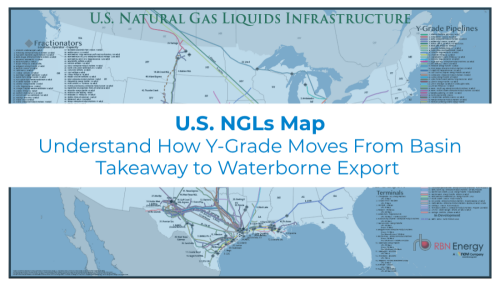
Visualize the infrastructure behind U.S. NGL movement.
The U.S. NGLs Map provides a comprehensive view of the transport, processing, and export networks moving NGLs across the U.S.
Through the fall of 2015, the West Coast was expecting a La Niña weather pattern, which favored above-normal precipitation in northern California and the Sierra Nevada mountain range along the state’s east-central regions. If this came to pass, California would have been walking into uncharted territory in 2016, with hydro generation up an average of 2,500-3,000 MW from 2015 on top of all the other increased renewables. As the rains came, though, so did the unwanted news of a valve leak at one of the natural gas storage wells at SoCal Gas’s Aliso Canyon storage facility (near Los Angeles) in early November of 2015. It quickly became known that the valve leak could not be fixed by normal protocol and that a pair of relief wells would need to be drilled so engineers could access and fix the leaky valve. To do so, they would have to drain the facility down to its minimum level. As this gas flowed out of Aliso Canyon storage and into the market, it lowered SoCal cash prices even as the gas market was already reeling from increased renewable penetration and higher hydro output. Much of this excess gas went into PG&E’s system or was pushed back into the Desert Southwest.
About the song
“California Sunset” was written by Neil Young and appears as the first song on side two of Young’s 14th studio album, Old Ways. The song is a homage to California — the Golden State — and its breathtakingly beautiful sunsets. California proved to be golden for Toronto-born Young, who, after growing up in Winnipeg, MB, left in the mid-1960s in a black 1953 Pontiac hearse named “Mortimer” in search of rock-and-roll gold in Hollywood. “California Sunset” was recorded live at a performance at The Opry in Austin for Austin City Limits in September 1984. It featured Neil Young (lead vocals, guitar), and his band, International Harvesters, with Anthony Crawford (guitar, mandolin), Ben Keith (pedal steel guitar), Spooner Oldham (piano), Tim Drummond (bass), Karl Himmel (drums), and Rufus Thibodeaux (fiddle).
Old Ways features country music tracks recorded between January 1983 and April 1985 at House of David in Nashville; The Castle in Franklin, TN; Pedernales Recording Studio in Spicewood, TX; and live at The Opry in Austin. It was produced by Neil Young, David Briggs, Ben Keith, and Elliot Mazer. It was Young’s full-on foray into country music and featured the cream of the crop of Nashville season players at the time. Willie Nelson and Waylon Jennings made appearances on the album. Released in August 1995, the LP went to #75 on the Billboard 200 Albums chart. Two singles were released from the album.
Neil Young is a Canadian-American singer, songwriter, musician, and record producer. After Winnipeg, he formed the folk-rock band Buffalo Springfield in Los Angeles in 1966 before embarking on a solo career in 1968, often backed by the band Crazy Horse. He joined Crosby, Stills, Nash & Young in 1969, drifting in and out of the band as his solo career demanded. As a solo artist, he has released 45 studio albums, 12 live albums, three compilation albums, four soundtrack albums, two EPs, and 62 singles. Young has won three Grammy Awards and one MTV Video Music Award. He is a member of the Canadian Music Hall of Fame and has been inducted into the Rock and Roll Hall of Fame twice, as a solo artist in 1995 and, in 1997, as a member of Buffalo Springfield. Young continues to record and tour and will begin a U.S. tour with Crazy Horse beginning in April.




Comments
Sorry, but that's a picture of a goose. Actually, we should probably call it a "Goose Curve" ;-)
Phil Lewis