
The U.S. and Israeli military strikes against Iran and the unsettled situation in the Middle East have pushed many topics to the background for now. But the energy-related impacts from the U.S.’s decision to remove Venezuelan President Nicolás Maduro from power early this year is one topic that won’t stay in the shadows for long. Venezuela, estimated to have the world’s largest crude oil reserves, was also a major refiner that exported products across the Western Hemisphere before it began a decadelong downturn. In today’s RBN blog, we look at the history of Venezuela’s refining sector, where things stand today, and the prospects for a turnaround.
We have written extensively about the developments in Venezuela over the past several weeks, with our analysis so far focused on crude oil production and other upstream issues. In Take Me Money and Run Venezuela, we began by detailing how the country was once a critical supplier of heavy sour crude to U.S. Gulf Coast refineries, providing more than 1 MMb/d in the late 1990s and early 2000s before Venezuelan production entered a long period of decline soon after Maduro’s predecessor, Hugo Chávez, came into power in late 1999. Today, the country produces less than 1 MMb/d of crude oil — barely one-quarter of the level it reached in the late 1990s.

The Future of Fuels bi-annual report by RBN's Refined Fuels Analytics provides an in-depth analysis of the U.S. and global refinery industries, focusing on crude oil and fuel market dynamics, supply and demand, alternative fuels, refinery capacities, and price forecasts to help stakeholders navigate the evolving energy landscape.
After our initial blog, we looked more closely at the type of crude Venezuela produces and the potential impact of more barrels hitting the global market. In Orinoco Flow, we said that most of Venezuela’s crude oil reserves are located within the 21,000-square-mile Orinoco Belt, which produces a crude that is extra-heavy (an API as low as 8-14 degrees), so thick that it’s difficult to transport and refine. In When Love Comes to Town, we looked at the differences in Venezuelan and Canadian heavy crudes, including production methods, costs and quality, and how a revival in Venezuelan production could impact the flows and prices of Canadian barrels. (As noted in our weekly Crude Billboard report, the U.S. imported 423 Mb/d of Venezuelan crude in the week ended March 13, the highest since December 2024.) We capped that series with Round and Round, where we detailed the concrete steps Venezuela could take to boost crude production in the short, medium and long term. (That analysis was included in our first Drill Down Report of 2026, which is available here.)
Today’s blog begins a new series on Venezuela, this one focused on its refining sector, export capabilities and turnaround potential. Just as we did in our initial series, let’s start with some background.
Venezuela built up the largest refining industry in Latin America during the post-WW2 era and retained that position until Brazil (a country with four times as much fuel demand) passed it in 1980, but it remained a major regional product exporter in the Caribbean (including exports to the U.S.) until well into the Chávez years. Venezuela is home to five refineries — including the Paraguaná Refining Complex, what was once the largest single-site refining facility in the world and remains the second largest by rated capacity — all of which have operated far below their full capacity in recent years.
Back in the sector’s heyday, before Chávez came to power, Venezuelan refinery throughput (see Figure 1 below) was consistently around 1 MMb/d. With its refineries operating at high rates, Venezuela emerged as a major source of refined products, with the U.S. and other Western Hemisphere countries becoming consistent importers of Venezuelan gasoline, middle distillates and other products (particularly fuel oil and asphalt). The performance of Venezuela’s refineries showed a noticeable dip in 2002 and 2003, around the time of a major strike against state-run PDVSA, but throughput mostly held steady until the early 2010s, when a sharp decline began.
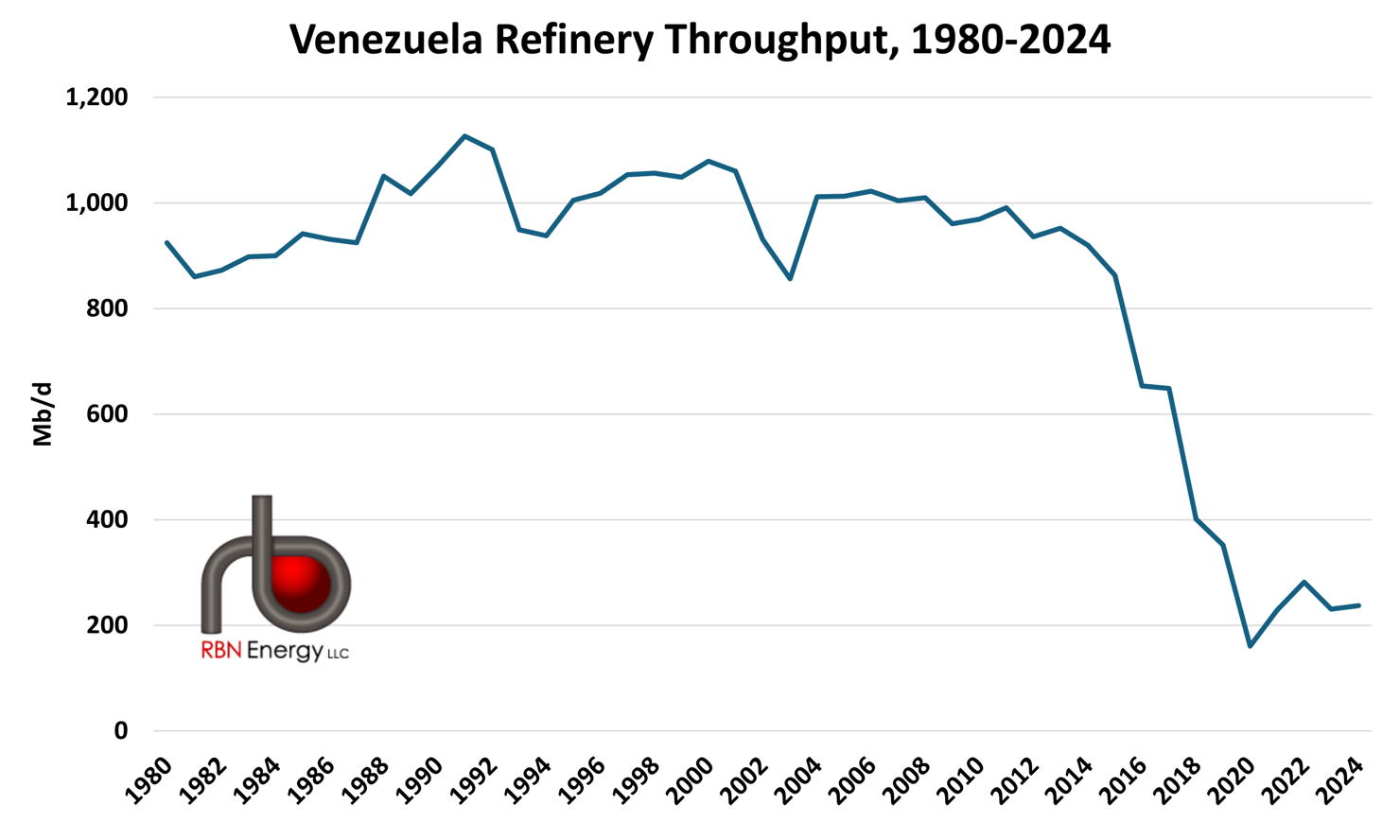
Figure 1. Venezuela Refinery Throughput, 1980-2024.
Source: 2025 Energy Institute Statistical Review of World Energy

About the song
“The Show Goes On” was written by Bruce Hornsby and appears as the first song on Side Two of his second studio album, Scenes from the Southside. The ballad is about a girl who becomes a victim of those who exploit her, and the show goes on around her in a cycle of bad decisions. The song was featured in Ron Howard’s 1991 film Backdraft, the pilot episode of the Baywatch television show, and the premiere episode of season two of the comedy-drama series The Bear. Personnel on the record were: Bruce Hornsby (lead vocals, keyboards), David Roitstein (synthesizer), George Marinelli, Peter Harris (guitar, backing vocals), Joe Puenta (bass, backing vocals), John Molo (drums) and Jeff Gerson (percussion).
Scenes from the Southside was recorded in 1987-88 at A&M Studios, Capitol Studios, Kingsound Studios, The Grey Room, Ignited Productions, and Rumbo Recorders in Los Angeles. Produced by Nel Dortsman and Bruce Hornsby, the album was released in May 1988. It went to #5 on the Billboard 200 Albums charts and has been certified Platinum by the Recording Industry Association of America. Two singles were released from the LP.
Bruce Hornsby is an American singer-songwriter and pianist. He started performing with cover bands in Virginia and got his first professional break playing in Sheena Easton’s touring band in 1984. Bruce Hornsby and The Range were signed to RCA Records and released their debut studio album, The Way It Is, in April 1986. That album went 3X Platinum and won the Grammy Award for Best New Artist in 1987. Hornsby has released 10 studio albums, four live albums, three compilation albums and 25 singles and has won five ASCAP Pop Music Awards and three Grammy Awards. He toured with the Grateful Dead from 1990 to 1992 and released a bluegrass project with Ricky Skaggs in 2007. He still records and tours. His next album, Indigo Park, will be released in April, followed by a lengthy tour of the U.S. with his band, The Noisemakers.
"About the Song" -- written by Mickey McMahan , RBN Director of Musicology