The idea of capturing the carbon dioxide emitted from power plants and industrial facilities and permanently storing it deep underground is widely viewed as one of the more promising ways to reduce greenhouse gas emissions. The catch is, how do you convince private-sector CO2 emitters to invest tens or hundreds of millions of dollars in carbon capture and sequestration projects? Enter federal government incentives — in this case the Internal Revenue Code’s carbon oxide sequestration tax credits, better known as 45Q, which at first glance would appear to offer certain industries significant financial incentives if they make these investments. However, while the credits — available for a variety of projects and uses — have been around since 2008 and were significantly expanded in 2018, they have not yet made much of an impact. In today’s RBN blog, we look at how the credits can add up for individual projects and how widely variable costs make carbon capture uneconomic for several industries.
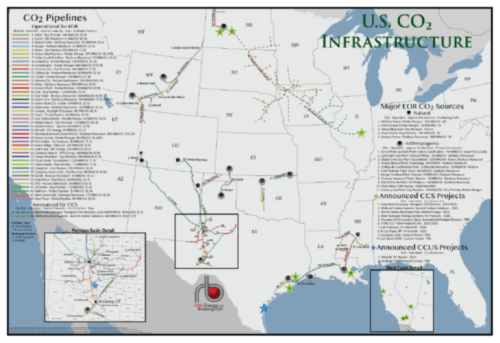
RBN Energy’s US CO₂ Infrastructure map brings together legacy Enhanced Oil Recovery (EOR) assets, as well as announced large-scale Carbon Capture and Sequestration (CCS) and Carbon Capture, Utilization and Sequestration (CCUS) projects, all in our signature concise, accurate, and intelligible style.
We took a deep dive into carbon sequestration in Part 1 of this series. Sequestration is the permanent storage of CO2 in specially designed wells deep underground with the aim of keeping that important greenhouse gas (GHG) permanently out of the atmosphere. If CO2 is captured and stored, that’s carbon capture and sequestration (CCS). If the CO2 is used for some other process before it’s stored, that’s called carbon capture, use, and sequestration (CCUS). Part 2 walked us through the extensive CO2 value chain, tracing CO2 from its initial sources of supply (either manmade or naturally occurring) through enhanced oil recovery (EOR) and onto a wide variety of end uses. In Part 3, we introduced the topic of today’s blog: the 45Q tax credit — what it is and how the credits are intended to work, along with a couple notable examples of where projects aimed at capturing CO2 along with the credits did not ultimately work out.
The 45Q rules provide a federal tax credit for disposing of qualified carbon oxide (QCO) in secure geologic storage or using it in certain approved ways. For the purposes of the tax credit, QCO is a carbon oxide — usually CO2 — that would have been released into the atmosphere if it had not been otherwise captured. That’s an important distinction because it assigns value to CO2 produced from anthropogenic (or manmade) CO2 sources, but not to CO2 that would have been mitigated regardless or that comes from naturally occurring wells — a significant source of supply for EOR as well as the wider merchant market.
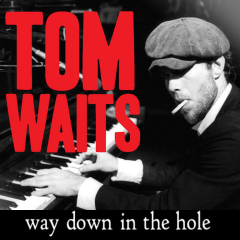
About the song
“Way Down in the Hole” was written by Tom Waits and appears as the second song on side two of Waits' 10th studio album, Franks Wild Years. The song was used as the theme song for the HBO crime drama series, The Wire. The series ran for five seasons from 2002-08. In addition to Waits’ version, a different recording of “Way Down in the Hole” was used for each season, including versions by The Blind Boys of Alabama, The Neville Brothers, DoMaJe, and Steve Earle. Personnel on the Waits record were: Tom Waits (vocals, pump organ), Marc Ribot (guitar), Greg Cohen (bass), Michael Blair (drums, percussion), Ralph Carney (sax), and Angela Brown, Leslie Holland, and Lynne Jordan (backing vocals).
Franks Wild Years was recorded during 1987 at Universal Recording in Chicago, and The Sound Factory and Sunset Sound in Hollywood. The album contains songs written for a play of the same name. Several songs from the album have appeared in television shows, movies, and stage productions. Produced by Waits, the album was released in August 1987 and went to #115 on the Billboard Top 200 Albums chart.
Tom Waits is an American songwriter, singer, musician, and actor. He began his professional career performing on the San Diego folk circuit as a teen in the late 1960s. He moved to Los Angeles in 1972, where he worked as a songwriter before securing his first record deal with Asylum Records. He has released 17 studio albums, three live albums, seven compilation albums, two soundtrack albums, and 24 singles. His songs have been covered by many artists from different genres. Waits has appeared in over two dozen motion pictures. He was inducted into the Rock and Roll Hall of Fame in 2011. His last tour was in 2008 and his last LP, Bad as Me, was released the same year. He has a featured role in the movie Licorice Pizza, which was released in the U.S. in November 2021 and received an Oscar nomination for Best Picture.