The 45Q tax credit has been the federal government’s main tool to incentivize the development of a carbon-capture industry. If the original legislation that created the credit in 2008 was intended to get things started, and the credit’s 2018 expansion designed to give the industry a further boost, the newly enacted Inflation Reduction Act (IRA) — which focuses on clean energy, despite its name — aims to propel carbon capture into the big time. In today’s RBN blog we look at changes made to the 45Q tax credit under the IRA, from the scope of the enhanced incentives to how they could boost carbon-capture opportunities for all types of projects.
As we noted in Name Game, a key element in President Biden’s 2020 campaign was a promise to reduce the use of fossil fuels and greenhouse gas (GHG) emissions and promote the development of a clean energy industry. U.S. GHG emissions have generally trended lower over the past 18 years, but not at the speed required to reach net-zero emissions by 2050 or to reduce emissions by 50%-52% (from 2005 levels) by 2030, the U.S. target under the Paris agreement. The IRA, which was signed into law by the president on August 16, includes a host of clean-energy priorities but might have its biggest impact on carbon capture, a topic we’ve written about extensively in this series.
Although carbon capture and sequestration (CCS) projects have gained significantly more attention in recent years as environmental, social and governance (ESG) concerns have risen and governments have begun to focus on ways to reach net-zero targets, the carbon-capture industry itself is still in its infancy. Most estimates put its size at about $2 billion/year, but ExxonMobil said in April that it expects the global carbon-capture industry to be a $4 trillion market by 2050 — or about 60% of the size of the overall oil and gas market, which it puts at $6.5 trillion by that date. Occidental Petroleum (Oxy), which is already invested in CO2 markets for its enhanced oil recovery (EOR) operations, has a similar outlook for the carbon-capture market, which it says could be worth $3 trillion to $5 trillion by mid-century. With the IRA now signed into law, let’s look at how it could transform the carbon-capture market, and discussions begin with the federal 45Q tax credit.
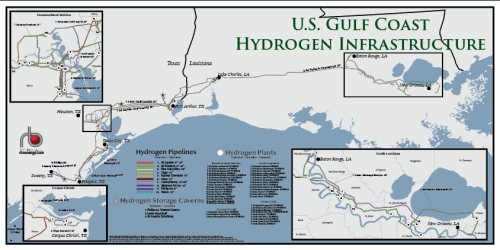
RBN’s U.S. Gulf Coast Hydrogen Infrastructure Map lays out the pipelines and merchant hydrogen plants that make up the gulf coast market, providing an unprecedented snapshot of the region’s hydrogen infrastructure network.
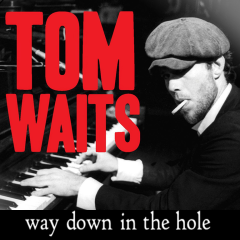
About the song
“Way Down in the Hole” was written by Tom Waits and appears as the second song on side two of Waits' 10th studio album, Franks Wild Years. The song was used as the theme song for the HBO crime drama series, The Wire. The series ran for five seasons from 2002-08. In addition to Waits’ version, a different recording of “Way Down in the Hole” was used for each season, including versions by The Blind Boys of Alabama, The Neville Brothers, DoMaJe, and Steve Earle. Personnel on the Waits record were: Tom Waits (vocals, pump organ), Marc Ribot (guitar), Greg Cohen (bass), Michael Blair (drums, percussion), Ralph Carney (sax), and Angela Brown, Leslie Holland, and Lynne Jordan (backing vocals).
Franks Wild Years was recorded during 1987 at Universal Recording in Chicago, and The Sound Factory and Sunset Sound in Hollywood. The album contains songs written for a play of the same name. Several songs from the album have appeared in television shows, movies, and stage productions. Produced by Waits, the album was released in August 1987 and went to #115 on the Billboard Top 200 Albums chart.
Tom Waits is an American songwriter, singer, musician, and actor. He began his professional career performing on the San Diego folk circuit as a teen in the late 1960s. He moved to Los Angeles in 1972, where he worked as a songwriter before securing his first record deal with Asylum Records. He has released 17 studio albums, three live albums, seven compilation albums, two soundtrack albums, and 24 singles. His songs have been covered by many artists from different genres. Waits has appeared in over two dozen motion pictures. He was inducted into the Rock and Roll Hall of Fame in 2011. His last tour was in 2008 and his last LP, Bad as Me, was released the same year. He has a featured role in the movie Licorice Pizza, which was released in the U.S. in November 2021 and received an Oscar nomination for Best Picture.