Freeport LNG is expected to be offline for an extended period following last week’s explosion and fire at the export terminal, leaving the global gas market even more undersupplied than it already was. The outage cuts U.S. export capacity by about 2 Bcf/d at a time when Europe is still taking in huge volumes of LNG to offset declines in Russian supplies and bolster storage ahead of winter. This is all happening as another large exporting nation, Australia, is facing a critical winter energy crisis of its own and South American demand is headed toward its seasonal high, straining an already tight market. Today’s RBN blog continues our series about the ongoing Freeport outage, this time looking at the impact to the global gas and LNG markets.
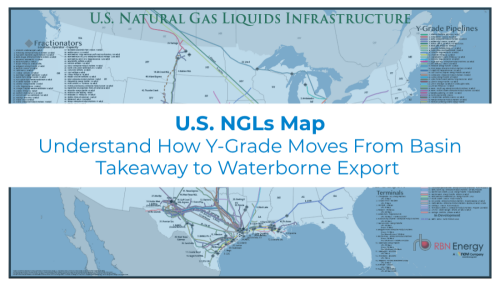
Visualize the infrastructure behind U.S. NGL movement.
The U.S. NGLs Map provides a comprehensive view of the transport, processing, and export networks moving NGLs across the U.S.
An explosion and fire occurred at the Freeport LNG export terminal on Quintana Island, TX, on June 8. Thankfully, no one was injured during the incident, but the entire terminal remains offline. Freeport said shortly after the incident that the terminal would be offline for at least three weeks. It also declared force majeure and canceled all cargoes scheduled for lifting through June 30. That timeline never really seemed all that likely, with state and federal regulators, including the Pipeline and Hazardous Materials Safety Administration (PHMSA), investigating the incident and having approval over the return to service. Freeport said in an update June 14 that a full resumption of operations and LNG output is not expected before the end of this year, but that it may be able to resume partial service after 90 days, subject to regulatory approval. Preliminary investigations of the incident have indicated that the explosion was caused by a rupture in the LNG transfer line, which led to the rapid flashing of LNG and the release of a natural gas vapor cloud, which ignited. The explosion was in a contained location near the storage tank area and none of the liquefaction trains, storage tanks or docking infrastructure were damaged in the incident.
The outage is already having a profound impact on overseas markets and in the U.S. gas market, which lost 2 Bcf/d of gas demand. In Part 1 of this series, we looked at its impact on the U.S., including how gas flows and prices changed in the immediate aftermath of the outage. Natural gas prices initially dropped with the loss of demand but rebounded somewhat as some of the more dramatic impacts were obscured by a run of hot weather. Those higher temperatures have increased domestic demand, but the outage will likely mean larger storage injections for the U.S., as there is only limited pipeline takeaway capacity out of Texas for that 2 Bcf/d of missing feedgas demand. And with the announcement of the longer-term outage, CME/NYMEX Henry Hub July futures prices fell again Tuesday, this time plunging $1.42 (16%) to close at $7.189/MMBtu. It climbed $0.231/MMBtu (5%) on Wednesday to settle at $7.420/MMBtu. The additional gas for storage, however, may not be unwelcome, considering that U.S. storage inventories are sitting near the bottom of the 5-year range and Henry Hub July futures (green line in Figure 1) were approaching $10/MMBtu prior to the incident. But for consumers of LNG, the loss of the terminal will be felt sharply, and the longer the outage lasts, the more strain it puts on global gas markets.
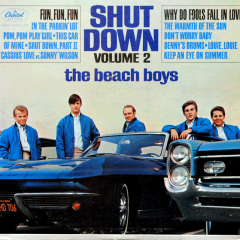
About the song
“Shut Down” was written by Brian Wilson and Roger Christian and released as the B-side of The Beach Boys’ single “Surfin’ U.S.A.” in March 1963. The Nik Venet-produced single went to #23 on the Billboard Hot 100 Singles chart. “Shut Down” also appears as the sixth cut on Side One of The Beach Boys’ second studio album, Surfin’ U.S.A., which went to went to #2 on the Billboard Top 200 Albums chart after its release, also in March 1963. Further, the song also appears as the first track on Side Two of The Beach Boys’ collection of car songs album, Little Deuce Coupe, which was released in October 1963. That album went to #4 on the Billboard Top 200 Albums chart.
“Shut Down” describes a race between a 1962 Dodge Dart and a 1963 Corvette Stingray, with the Corvette winning. Roger Christian was brought in as a lyricist with Brian Wilson because of his knowledge about cars. The Dodge is referenced in the song as having a 413 big block Max Wedge engine, with dual four-barrel carburetors. The Corvette is referred to as having a small block 327 engine, with fuel injection. Brian Wilson always owned Corvettes, including at the time this song was written ... so, Corvette for the win! Personnel on the record were: Mike Love (lead vocal, sax), Brian Wilson (backing vocals, bass), David Marks ( rhythm guitar, lead guitar during song fade), Carl Wilson (backing vocals, lead guitar) and Dennis Wilson (backing vocals, drums).
The Beach Boys are an American rock band formed in Hawthorne, CA, in 1961. The band has released 30 studio albums, eight live albums, 55 compilation albums, 23 EPs and 71 singles, and has sold over 100 million records worldwide. The Beach Boys were inducted into the Rock and Roll Hall of Fame in 1988. Their album, Pet Sounds, was inducted into the Grammy Hall of Fame in 1998, and the band was awarded a Grammy Lifetime Achievement Award in 2001. Dennis Wilson died in 1983 and Carl Wilson in 1998. Brian Wilson still records and occasionally tours as a solo artist. Mike Love, Al Jardine, and Bruce Johnston, with touring musicians, still tour as The Beach Boys.