Even as winter starts to wind down, global natural gas prices remain elevated as rising tensions between Russia and the Western world have destabilized European energy markets and pushed LNG, and U.S. LNG in particular, to center stage. From a markets perspective, the story of the past year has been high global gas prices — a strong incentive for LNG producers to push production facilities to operate at peak capacity and produce additional cargoes. The tight market has also spurred demand for new long-term sales and purchase agreements (SPAs), creating momentum for a potential new wave of LNG development. But while gas prices in Europe and Asia have been elevated all year, they have not been elevated evenly. The Asia-Europe price spread has swung dramatically from favoring Asia last spring and summer to favoring Europe this winter, and U.S. export destinations have swung with it. Last summer, almost no destination-flexible LNG produced in the U.S. was landing in Europe and now Europe is consuming U.S. LNG at record levels. In today’s RBN blog, we look at how global price spreads impact U.S. LNG export destinations and what the strength in European demand means for the future of LNG development.
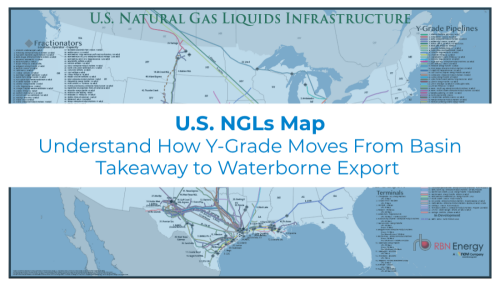
Visualize the infrastructure behind U.S. NGL movement.
The U.S. NGLs Map provides a comprehensive view of the transport, processing, and export networks moving NGLs across the U.S.
U.S. LNG production is at an all-time high, driven both by new terminals coming online and the existing fleet operating at peak capacity for an extended period this winter (see Higher and Higher). High global demand for LNG has underpinned the market for over a year now, pushing gas prices to record highs repeatedly in the second half of 2021 (see Baby, It’s Cold Outside). And while prices are down from their last ultra-peak of nearly $60/MMBtu in late December, they remain incredibly elevated compared to previous years, with increased uncertainty over Russia continuing to put upward pressure on gas prices even as winter enters its final weeks. European fundamentals have driven headlines around the global gas market all year, from record-low storage (see It’s Too Late) to soaring carbon prices (see I Won’t Back Down) to the prospect of a Russia-Ukraine armed conflict indefinitely postponing the startup of Nord Stream 2, the new pipeline from Russia to Germany which would have increased Russian piped exports to Europe. But despite the flashy headlines, summertime U.S. LNG exports to Europe were barely more than in the previous year, which was during the peak of COVID-related cargo cancellations. Even with prices having quadrupled from 2020 amid high global gas demand, Europe was consistently outbid for cargoes by other markets. Now, that’s completely flipped. Last month, more than 75% of U.S. LNG, or 75 of the 98 cargoes exported in January, landed in Europe, nearly double the volume from the previous winter. It’s an astonishing reversal, driven by the flexible nature of U.S. LNG contracts (see Just Can’t Get Enough, Part 2) and the Asia-Europe price spread.
As we’ve said, one of the most important characteristics of U.S. LNG is its destination flexibility. Contracts and government regulations allow offtakers to market to any country not under U.S. sanctions and a diverse group of offtakers hold long-term contracts for U.S. LNG. In our LNG Voyager Quarterly report, RBN tracks all long-term contracts for existing LNG terminals and projects under development. We separate offtakers into five buckets: Asian Consumers, Asian Traders, Pacific Basin LNG Producers, Portfolio Players, and European Consumers. The two consumer categories comprise utilities in their respective continents, such as South Korea’s KOGAS in Asia or Germany’s Uniper in Europe. Utilities hold just under 40% of U.S. long-term offtake agreements, split evenly between Europe and Asia. The remaining three categories, which account for more than 60% of long-term U.S. contracts, are all inherently destination flexible as they are not themselves consumers — a mix of Asian traders such as Mitsui, global portfolio players like BP and TotalEnergies, and a small number of Pacific Basin producers, like Woodside. While many of these companies have sales agreements of their own with LNG end-users, they also have diverse supply sources to serve those obligations which allow them to optimize their logistics and shipping costs. The end result is that U.S. LNG destinations can change dramatically by season, over time, and in line with global gas prices.

About the song
“Upside Down” was written by Nile Rodgers and Bernard Edwards (Chic) and appears as the first song on side one of Diana Ross’s 11th studio album, diana. Released as the first single from the album, the song went to #1 on the Billboard Hot 100, Disco, and Soul Singles charts. It has been certified Gold by the Recording Industry Association of America. Personnel on the record were: Diana Ross (lead vocals), Bernard Edwards (bass), Nile Rodgers (guitar), Tony Thompson (drums), Andy Barrett (piano), Raymond Jones (keyboards), and Alfa Anderson, Fonzi Thornton, Luci Martin, Michelle Cobbs (backing vocals).
Recorded between December 1979 and March 1980 at the Power Station in New York, diana was produced by Bernard Edwards and Nile Rodgers. Ross and her production team had a falling out over the mixes, and she and Russ Terrana rerecorded her vocals and remixed the album at Electric Lady in New York, and Motown/Hitsville USA studio in Hollywood. The album was released in May 1980 and went to #1 on the Billboard Top R&B/Hip-Hop Albums, and #2 on the Billboard 200 Albums charts. It has been certified Platinum by the RIAA. Three charting singles were released from the LP.
Diana Ross is an American singer, songwriter and actress from Detroit. Ross rose to fame as the lead vocalist for The Supremes, Motown’s most successful act in the ’60s. She left The Supremes in 1970 to embark on a solo career that continues to this day. As a solo artist, she has released 25 studio albums, five live albums, 30 compilation albums, one EP, four soundtrack albums, and 91 singles. As an actress, Ross has starred in five motion pictures and been featured in 35 television shows. She has won seven American Music Awards, one Grammy Award, one Golden Globe Award, and one Tony Award. She has been awarded a Lifetime Achievement Grammy Award, a Presidential Medal of Honor, a Kennedy Center Honor, and has a star on the Hollywood Walk of Fame. She still records and tours, and released her 25th studio album, Thank You, in November 2021.