The Permian, the world’s largest NGL-producing region, is poised for continued growth across the entire NGL value chain. The Permian is sending more liquids toward the Gulf Coast, but getting those barrels to market takes more than pipelines. Fractionators must separate them, export terminals must connect growing supplies with overseas buyers, and storage must provide a buffer. With domestic demand offering limited room to grow, can downstream infrastructure keep pace? In today’s RBN blog, we examine the projects helping turn rising Permian production into global supply.
This is the fifth blog in our series on the outlook for major U.S. producing basins, starting with the largest: the Permian. In Part 1, we discussed the major Permian gas pipeline projects scheduled to come online in 2026 and 2027, how much new capacity they will provide, and consider what the shift means for prices at the critical Waha Hub, Gulf Coast balances and the U.S. natural gas market. In Part 2, we reviewed the basin’s long-term gas pipeline projects and the challenges that could arise as that new infrastructure comes online. In Part 3, we discussed the Permian’s biggest gas producers and how they might respond to the new gas pipelines planned for the basin. And in Part 4, we detailed the surge in the basin’s NGL production, which is slated to account for more than half of U.S. output by 2035.
As a quick refresher, associated gas and NGLs are byproducts of crude oil production, so as oil output rises, the Permian’s infrastructure needs to keep up with the gas and NGLs that come along for the ride. Significantly for our topic today, that means a lot of new gas processing plants — which separate NGLs from the gas stream — need to be built, moved or expanded in the areas seeing high gas production growth. (New additions to the fleet tend to be cryogenic facilities that can extract a very high percentage of the liquids entrained in the gas stream and take in about 275-300 MMcf/d of NGL-packed associated gas.) From the tailgate of the processing plant, pipelines take the NGLs as a mixed stream called “Y-grade” to fractionation centers where the mixed product is separated into purity form before heading to downstream markets, like petrochemicals and exports.
Today, we’ll look at the downstream fractionation and export facilities.
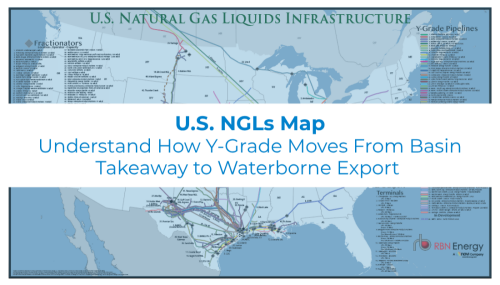
Visualize the infrastructure behind U.S. NGL movement.
The U.S. NGLs Map provides a comprehensive view of the transport, processing, and export networks moving NGLs across the U.S.
Fractionation Capacity
Gulf Coast fractionation capacity is expected to remain relatively tight over the next several years, even with planned additions. More than 1.25 MMb/d of new capacity is expected by the end of 2029, and those projects must keep pace with rising NGL supply and the additional Y-grade volumes made accessible by new Permian takeaway pipelines. At the NGL hub in Mont Belvieu, TX, Enterprise Products Partners (dark-blue bar segments in Figure 1 below) is adding 345 Mb/d by 2030, Targa Resources (orange bar segments) is constructing 450 Mb/d across three new fractionators, and Energy Transfer (green bar segments) is building 165 Mb/d of additional fractionation capacity, all between 2026 and 2030, with some of that online already. Outside of Mont Belvieu, there’s also Phillips 66’s Coastal Bend fractionator (purple bar segments) in Robstown, TX (near Corpus Christi), adding 100 Mb/d by 2029, and new MPLX fractionators (red bar segments) totaling 300 Mb/d coming online in Texas City.
About the song
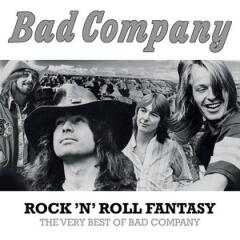
“Movin’ On” was written by Mick Ralphs and was originally recorded and released as a single by Hackensack on Island Records in November 1972; it failed to make the charts. The single was produced by Muff Winwood, the older brother of Steve Winwood, who were in the Spencer Davis Group together in the 1960s. The song talks about the chaotic, nomadic lifestyles of touring rock musicians, something that Mick Ralphs was well acquainted with as the lead guitarist for Mott the Hoople before forming Bad Company. It was recorded by Bad Company in November 1973 and released as the second single from their debut studio album, Bad Company, in January 1975. It went to #19 on the Billboard Hot 100 Singles chart. Personnel on the record were: Paul Rodgers (vocals), Mick Ralphs (guitar), Boz Burrell (bass), and Simon Kirke (drums).
Bad Company is the debut studio album by the British supergroup of the same name, formed in London in 1973. Recorded at Headley Grange in East Hampshire, England, on Ronnie Lane’s mobile studio during November 1973, it was produced by Bad Company. Led Zeppelin also used Headley Grange to record. Both bands were managed by Peter Grant and recorded on the Swan Song record label. The album was released in May 1974 and went to #1 on the Billboard 200 Albums chart. It has been certified 5X Platinum by the Recording Industry Association of America. Two singles were released from the LP.
Bad Company was an English rock band formed in London in 1973 by vocalist Paul Rodgers (Free), drummer Simon Kirke (Free), guitarist Mick Ralphs (Mott the Hoople), and bassist Boz Burrell (King Crimson). They were managed by Led Zeppelin’s manager, Peter Grant. They released 12 studio albums, five live albums, and 29 singles and have sold over 40 million records worldwide. They were inducted into the Rock and Roll Hall of Fame in 2025. The original band stayed together from 1973 until 1982. Various forms of the band with different players continued to play under the Bad Company moniker until 2023. Bassist Boz Burrell died in Marbella, Spain, in September 2006 at 60. Guitarist Mick Ralphs died in London in June 2025 at 81. Vocalist Paul Rodgers and drummer Simon Kirke continue to pursue various musical endeavors.
"About the Song" -- written by Mickey McMahan , RBN Director of Musicology