
The rapid buildout of Permian gas processing plants and other NGL-related infrastructure in Texas and southeastern New Mexico isn’t just continuing, it’s accelerating. Not just processing, but also new and expanded NGL pipelines, new fractionators in Mont Belvieu (and near Corpus Christi), and new ethane and LPG export capacity. Funny thing is, all that growth and investment is happening as crude oil-focused production in the Permian has remained flat as a pancake. In today’s RBN blog, we discuss the latest project announcements and why associated gas and NGL production in the Permian are still rising.
Crude oil prices have been elevated for three months now thanks to the Iran war, but Permian producers have resisted the temptation to ratchet up their drilling-and-completion activity. In fact, the Permian rig count is virtually unchanged from the end of last year (247 then vs. 246 as of mid-May) and so is basin oil production, at 6.6 MMb/d, according to our weekly Crude Oil Permian report. That extraordinary discipline during an extended period of WTI prices north of $90/bbl raises an important, two-part question for folks who focus on the NGL side of things: If Permian crude oil production isn’t rising in this price environment, has oil output there pretty much peaked and, if so, what does that mean for the basin’s production of associated gas and NGLs?
Spoiler alert: Even if Permian crude oil production stays flat — heck, even if it were to sag by a few hundred thousand barrels a day — the basin’s output of associated gas and NGLs will continue to increase, and at a pretty good clip. (And that’s impacting the market for NGL purity products like propane — see our recent Wind of Change blog.) As we explained a few months ago in Hold On ... I’m Coming, the mix of crude, natural gas and NGLs emerging from Permian wells has been evolving for many years now, with the general trends being (1) more gas per barrel of oil (that is, a higher gas-to-oil ratio, or GOR) and (2) more NGLs per thousand cubic feet of gas (that is, a higher gallons-per-Mcf, or GPM).
The shift toward gassier, more-NGL-packed production in the Permian has been significant. By our estimate, the overall basin’s GOR has increased from 3.4:1 in 2014 to 4.4:1 in 2025, a gain of almost 30%, and the Permian’s GPM has risen from about 4.5 to 5.2. And from everything we’ve seen and heard about where producers are drilling and what’s emerging from their newer wells, this ramp-up in GORs and GPMs has been accelerating — and that’s what we’ve got in our models.
This suggests that, even under a flat oil production scenario, the Permian’s associated gas and NGL output will keep climbing into the 2030s. RBN’s mid-case scenario for the basin, which envisions a gradual rise in crude oil production into the 2030s and sees dry gas output increasing to 28 Bcf/d in 2030 and NGL output climbing to 4.8 MMb/d. The same analysis predicts that by 2035, Permian dry gas production will rise to 32 Bcf/d and NGL output will top 5.5 MMb/d, or about 50% of the U.S. total for NGLs.
We have blogged extensively about the new and expanded natural gas pipelines out of the Permian (mostly toward the Gulf Coast but also to the Desert Southwest and maybe the Midcon). But it’s been a while since we did a roundup on planned additions to the interconnected set of “wellhead-to-water” assets that process, transport, fractionate, store and export NGLs. There’s a lot going on, so to keep things simple, we’ll tackle this company by company, starting with Targa Resources and Enterprise Products Partners.
Targa Resources is one of a select few midstream companies with a complete range of NGL-related assets, everything from gas gathering pipelines and processing plants in the Permian to NGL takeaway pipelines, fractionators and NGL storage at Mont Belvieu and NGL export facilities. Targa has 8.7 Bcf/d of gas processing capacity in the Permian, split about evenly between the Midland Basin (4.4 Bcf/d) and the Delaware Basin (4.3 Bcf/d). (Eighteen of its 21 Midland plants are actually owned by a Targa/ExxonMobil joint venture in which Targa holds a 72.8% stake.)
During its Q1 2026 earnings call on May 7, Targa said that it recently started operation of its two newest processing plants: the 275-MMcf/d Falcon II facility in the Delaware (in February) and the 275-MMcf/d East Pembrook plant in the Midland (in late March). Four additional plants, each with a capacity of 275 MMcf/d, are scheduled to come online by the end of 2027, including the East Driver plant in the Midland in Q3 2026 and — all in the Delaware — Copperhead (Q1 2027), Yeti (Q3 2027) and Yeti II (Q4 2027). The midstreamer also announced two more Delaware processing plants during its recent call. The 265-MMcf/d Roadrunner II facility and the 275-MMcf/d Copperhead II plant will both start operating in Q1 2028.
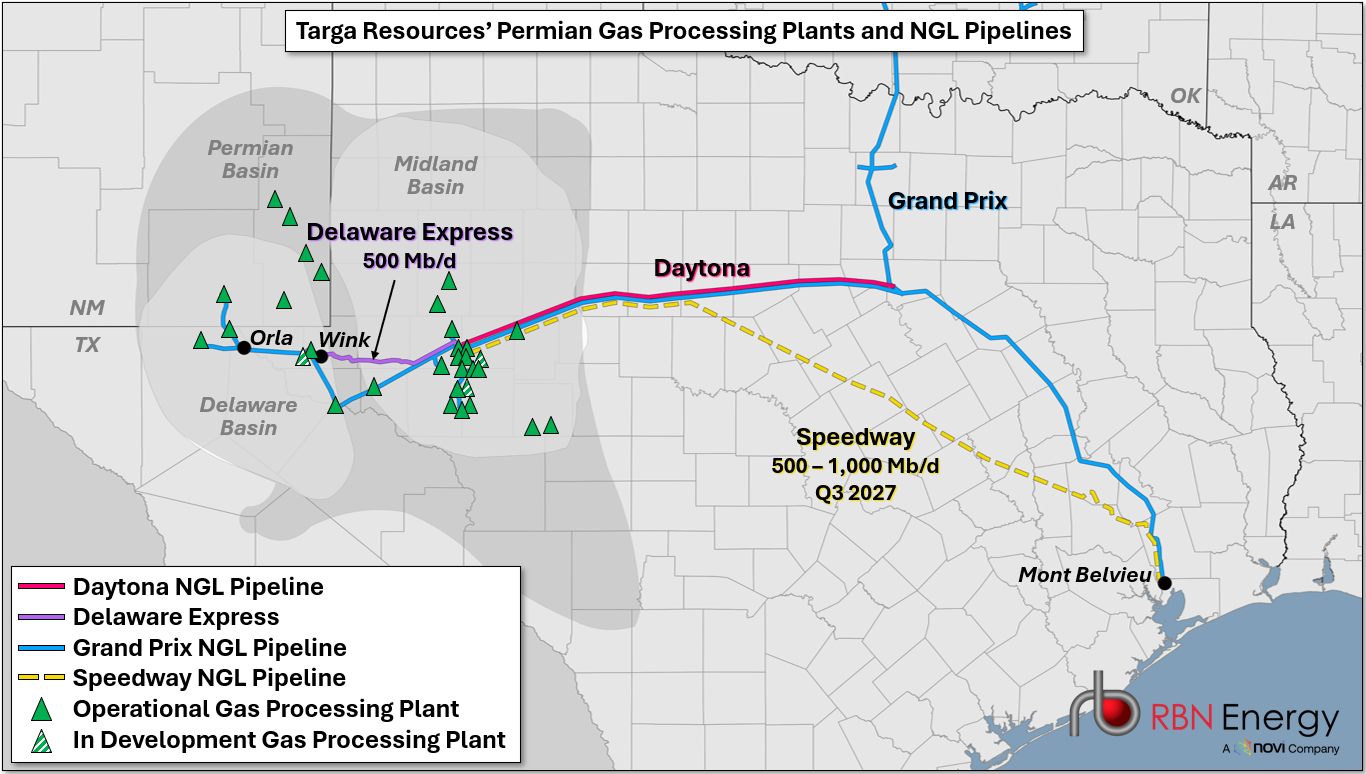
Figure 1. Targa Resources’ Permian Gas Processing Plants and NGL Pipelines. Source: Novi Labs
Seaway Freeport Crude Oil Exports Reach Multi-Year High as SPR Draws Accelerate
As discussed in the Crude Voyager Report for the week ended May 29, exports out of the U.S. Gulf Coast (USGC) averaged 5.4 MMb/d, with strength seen across a number of terminals. In the Houston region, the Seaway Freeport Terminal recorded export activity for the seventh consecutive week. While only one Aframax cargo was seen, the terminal's seven-week streak represents its longest period of uninterrupted export activity since 2023, signaling a notable increase in utilization compared with the sporadic loadings observed in recent years.
About the song
“Calling All Angels” was written by Pat Monahan, Jimmy Stafford and Scott Underwood, and appears as the first song on Train’s third studio album, My Private Nation. The song was inspired by a conversation with Monahan and his therapist, who put forth the idea that we are all made up of angels and traitors, and the lyrics follow that struggle between good and evil. Released as the first single from the album in April 2003, it went to #1 on the Billboard Adult Alternative Airplay chart and #11 on the Billboard Hot 100 Singles chart. It has been certified 2X Platinum by the Recording Industry Association of America (RIAA). The song is played at every home game of Major League Baseball’s Los Angeles Angels. Personnel on the record were: Pat Monahan (lead vocals, percussion), Jimmy Stafford (lead guitar, backing vocals), Scott Underwood (drums, percussion, keyboards), Charlie Colin (bass, backing vocals), and Rob Hotchkiss (rhythm guitar, piano).
My Private Nation was recorded in 2003 at Southern Tracks Recording in Atlanta and produced by Brendon O’Brien. Released in June 2003, it went to #6 on the Billboard 200 Albums chart and has been certified Platinum by the RIAA. Three singles were released from the LP.
Train is an American pop-rock band formed in San Francisco in 1993 by Pat Monahan, Rob Hotchkiss, Jimmy Stafford, Scott Underwood and Charlie Colin. The band has released 11 studio albums, three live albums, one compilation album, four EPs and 34 singles and have sold more than 10 million records worldwide. They have won one ASCAP Award, two Billboard Music Awards and three Grammy Awards. Sixteen members have passed through the band since its formation, with founding member Monahan the sole original member still in the group. They will begin a U.S. tour with Barenaked Ladies in July and continue through August.
"About the Song" -- written by Mickey McMahan , RBN Director of Musicology