Situated in West Texas’s Winkler County, the tiny city of Wink (population just under 1,000) might seem easy to overlook but it holds a special place in music history as the childhood home of Roy Orbison — he formed his first band, the Wink Westerners, there in 1949. But beyond its rich musical legacy, Wink in recent years has emerged as a key hub for crude oil connectivity in the prolific Permian Basin. Don’t blink or you might miss out on what’s happening in this dynamic locale, the subject of today’s RBN blog.

The replay of our Fall 2026 School of Energy (September 9 & 10, Houston) is now available online!
Learn from RBN experts, participate in hands-on Excel modeling, connect with industry peers, and gain a stronger understanding of today's interconnected energy markets.
We’ve been writing a lot about the Permian in recent weeks — it’s hard not to. In Texas Hold ’Em, we explained that producers need sufficient takeaway capacity to handle their rising volumes of crude oil and associated gas. Gas takeaway constraints are already here, and the industry is eagerly anticipating the ramp up of a new pipeline: the 2.5-Bcf/d Matterhorn Express, which will come online later this year. However, still more gas takeaway capacity will be needed to keep up with the Permian’s growth trajectory (see our Around the Bend series) and several projects are in the running to provide that. Next, in Corpus Christi Bay, we noted that the Corpus Christi crude oil market is pulling as much volume as it can from the Permian via pipelines that are running nearly at capacity. The situation is complicated by the very real possibility that one or more offshore export facilities capable of fully loading Very Large Crude Carriers (VLCCs) may be built off the Texas coast (see our deepwater crude export series). Most recently, in Houston (Means I’m One Day Closer to You), we looked at the latest Permian flows to Houston and how they could change if a deepwater port is added nearby.
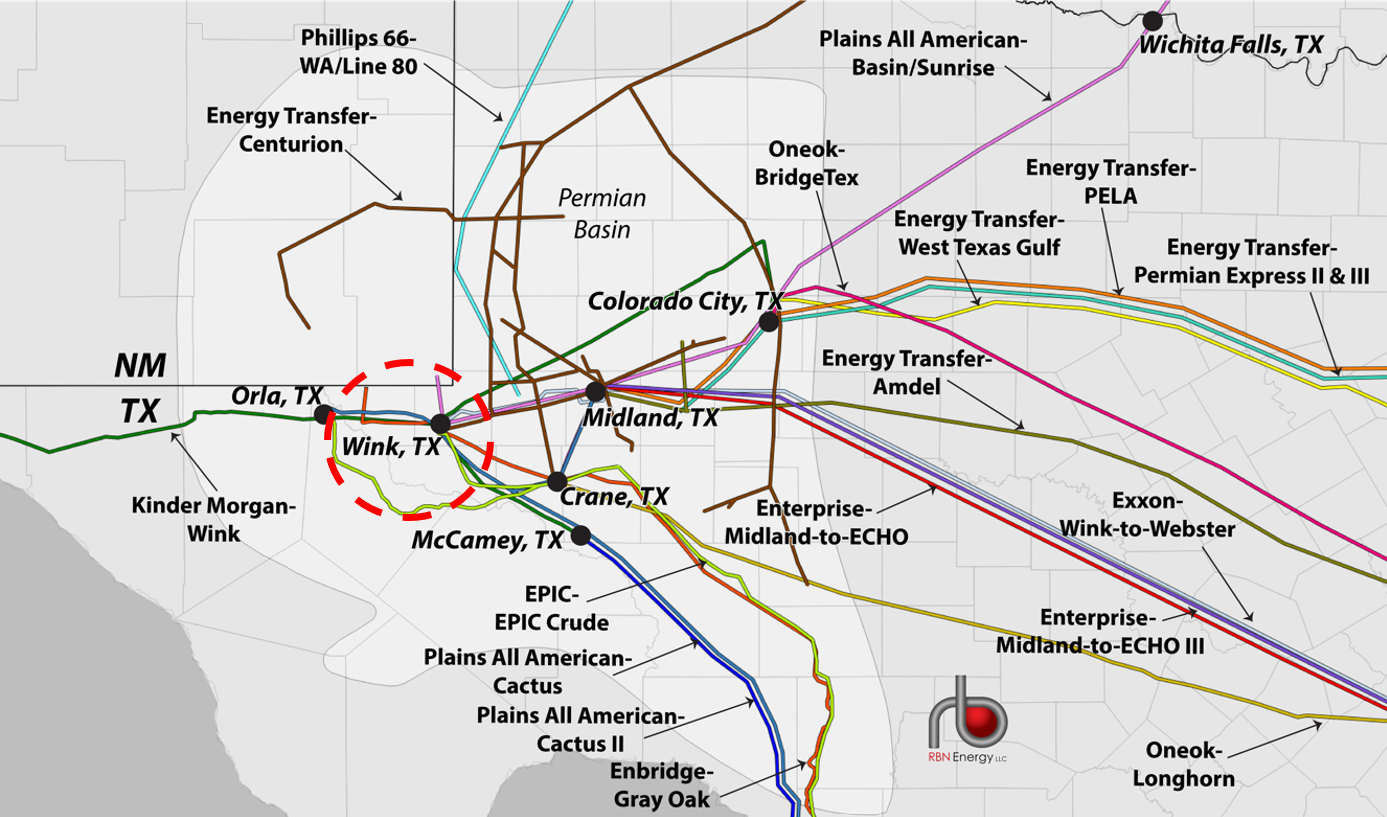
Figure 1. Permian Crude Oil Pipelines. Source: RBN Crude Oil Permian
So, where does Wink (dashed red oval in Figure 1 above) fit into the bigger picture? At the heart of Wink’s importance lies its role as a central point for the convergence of Permian oil. Much like Cushing, OK — but admittedly on a much smaller scale — Wink got its start as an oil hub a century or so ago as a hotbed of crude oil production. (See our eight-part Oklahoma Swing blog series and Drill Down Report for everything you need to know about Cushing.) In July 1926, oil was discovered at the Hendrick oil field near what is now called Wink, and by March 1929 — less than three years after “first oil” — the field was producing a then-astonishing 171 Mb/d. Rudimentary pipeline and railroad infrastructure was built to help deal with the massive volumes. The boom didn’t last: Local production declined significantly over the ensuing decades and so did Wink’s population, which had peaked at about 6,000 in 1930. But Wink’s location — and its oil-related infrastructure, bare-boned as it may have been — made it a logical crossroads for crude oil making its way from the Permian to the Gulf Coast.

About the song
“Dream Baby (How Long Must I Dream)” was written by Cindy Walker and appears as the third song on side two of Roy Orbison’s first compilation album, Roy Orbison’s Greatest Hits, released in August 1962. The song was released as a single in February 1962 and it went to #4 on the Billboard Hot 100 Singles chart. It was recorded at RCA Studio B in Nashville in January 1962 and produced by Fred Foster. The song has been covered by many artists including The Beatles, Del Shannon, Glen Campbell, Lacy J. Dalton, and Waylon Jennings. Personnel on the record were: Roy Orbison (lead vocals), Grady Martin (electric lead guitar), Fred Carter Jr. (acoustic rhythm guitar), Bob Moore (bass), Buddy Harman (drums), Boots Randolph (saxophone), and unnamed musicians on piano and background vocals.
Roy Orbison’s Greatest Hits was the third album by Orbison for Monument Records and his first hits compilation album. All the sides on the LP were recorded at RCA Studio B in Nashville between September 1959-January 1962, with Fred Foster producing. Released in August 1962, it went to #13 on the Billboard 200 Albums chart and has been certified Gold by the Recording Industry Association of America.
Roy Orbison was an American singer, songwriter and guitarist known for his unique and powerful vocal qualities. Born in Vernon in north-central Texas and growing up in Wink in West Texas, he describes his memories of Wink as “football, oil fields, oil, and sand.” The town of Wink was established in 1926 after oil was discovered there and it quickly became a boomtown in the late 1920s. Today its population is less than 1,000. While attending high school in Wink, Orbison had a band called the Wink Westerners who played honky tonks in the area and had a weekly radio show on KERB in nearby Kermit. Orbison started his recording career with Sam Phillips’ Sun Records in Memphis in the mid-fifties but had his greatest success with Monument Records in the sixties. He released 23 studio albums, four live albums, 24 compilation albums, and 92 singles. He was also a member of the supergroup the Traveling Wilburys with George Harrison, Bob Dylan, Tom Petty and Jeff Lynne. There was a resurgence of interest in Orbison’s music after his song “In Dreams” was featured in David Lynch’s 1987 hit movie, Blue Velvet. He won five Grammy Awards, a Grammy Lifetime Achievement Award, and is a member of the Rock and Roll Hall of Fame, the Songwriters Hall of Fame, and has a star on the Hollywood Walk of Fame. Orbison died in Hendersonville Tennessee in December 1988 at the age of 52.