Hundreds of miles separate the Permian Basin from the U.S. Gulf Coast, but in the Shale Era traversing that span has become increasingly important to Permian producers. Billions of dollars have been invested to expand capacity to move Permian production — crude, natural gas or NGLs — to the Gulf Coast to take advantage of surging export markets. In today’s RBN blog, we’ll focus our attention on EPIC Midstream and its EPIC Crude Pipeline, which has operated above its nameplate capacity for much of this year.
The replay of our Fall 2026 School of Energy (September 9 & 10, Houston) is now available online!
Learn from RBN experts, participate in hands-on Excel modeling, connect with industry peers, and gain a stronger understanding of today's interconnected energy markets.
Before we jump into the details, it’s helpful to understand EPIC Crude’s ownership and anchor shippers (at least those that have been made public). Initially, EPIC Crude was supported by capital commitments from funds managed by private equity group Ares Management (45%), with additional equity from Noble Midstream Partners (30%), Altus Midstream (15%, a midstream company formed between Apache and Kayne Anderson Acquisition Corp.) and Diamondback Energy (10%). Apache and Noble (the latter acquired by Chevron in 2020) were the first to commit as anchor shippers in May 2018, securing 75 Mb/d and 100 Mb/d of firm capacity, respectively. At that time, more than 500,000 acres were dedicated to the pipe, with Apache and Noble among the key contributors. Following an extended open season, Diamondback (50 Mb/d) and other unnamed parties (200 Mb/d) joined, bringing total commitments to 425 Mb/d and prompting EPIC to upsize the pipeline’s diameter from 24 to 30 inches with a 600-Mb/d capacity.
Now, Diamondback and pure-play Permian midstream company Kinetik Holdings (formed in 2022 by the merger of Altus Midstream and the corporate parent of EagleClaw Midstream) together have acquired an additional 30% equity interest in the EPIC Crude pipeline system. With the deal, the companies now each own 27.5% of EPIC Crude, an affiliate of the parent company EPIC Midstream, which will continue to own a 45% stake and remain the operator of the pipeline.
About the song
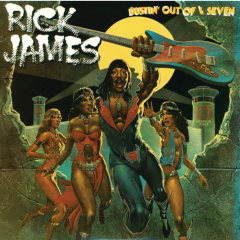
“Bustin’ Out” was written by Rick James and appears as the first song on side one of his second studio album, Bustin’ Out of L Seven. It was released as a single in January 1979 and went to #8 on the Billboard R&B and #71 on the Billboard Hot 100 Singles charts. Personnel on the record were: Rick James (lead vocals, guitar, bass, keyboards, percussion), Oscar Alston (bass), Levi Ruffin (synthesizer, percussion), Ernie Fields Jr., Michael Brecker (tenor saxophone), Fred Jackson Jr. (alto saxophone, flute), Randy Brecker (trumpet), Al Szymanski (guitar), Lanise Hughes, Lorenzo Shaw (drums, percussion), and Shondra Akeim, Maxine Waters, Clydene Jackson (backing vocals).
The album, Bustin’ Out of L Seven, was recorded in 1978 at Sigma Sound in New York City and Magic Wand in Hollywood. Produced by Rick James and Art Stewart, it was released in January 1979. It went to #2 on the Billboard R&B and #16 on the Billboard 200 Albums charts. Two singles were released from the LP.
Rick James (James Ambrose Johnson Jr.) was an American singer, songwriter, musician and record producer. Born and raised in Buffalo, NY, he moved to Toronto in his early twenties where he formed the rock band The Mynah Birds, which at one time included Neil Young. The band signed with Motown Records, but James’ career was stymied for a while after U.S. military authorities found him and convicted him of desertion. After serving several months in prison, James relocated to Los Angeles and formed a few rock and funk groups in the late 1960s and early 1970s. He signed with Motown’s Gordy Records in 1978 and immediately began putting out hit records. He released 13 studio albums, 10 compilation albums, and 41 singles. He won an American Music Award and a Grammy Award. James died in Burbank, CA, in 2004 at the age of 56. James was featured in a 2021 documentary film, Bitchin’: The Sound and Fury of Rick James.