As a piece of legislation makes its way through Congress, the name it’s given can say a lot about its overall importance and what it intends to accomplish, but also a little bit about the current political environment. Surging inflation has been one of the biggest stories of the past year and politicians of all stripes have been looking for ways to ease the pressure on consumers. Those concerns were a big reason why the Biden administration’s Build Back Better Act (BBBA), which included several climate- and energy-related measures, ultimately died in Congress late last year. The Inflation Reduction Act of 2022, which Democrats in Washington hope to pass soon, embraces the fight against inflation and includes other significant provisions, but clean energy is at the heart of the bill. In today’s RBN blog, we look at the legislation's climate and clean-energy initiatives — including a methane-reduction program, more tax credits for electric vehicles, and incentives for renewable energy and clean hydrogen — and how they would help reduce greenhouse gas (GHG) emissions.
A key element in President Biden’s 2020 campaign was a promise to reduce fossil-fuel usage and GHG emissions and to promote the development of a clean-energy industry as a way to reach net-zero emissions by 2050, a goal established by the 2015 Paris climate agreement. Biden acted as soon as he took office, revoking the border crossing permit for the Keystone XL oil pipeline and issuing an executive order to rejoin the Paris agreement on Inauguration Day. (President Trump announced plans for the U.S. to withdraw from the agreement in 2017, which became official after a three-year waiting period ended in 2020.) Days later, Biden issued another order that outlined plans to put climate concerns at the heart of U.S. foreign policy and national security.
Many of the administration’s plans to reach that net-zero target were included in the BBBA, which, among other things, boosted the 45Q federal tax credit for carbon capture and sequestration (CCS), as we discussed in Way Down in the Hole, Part 5. The wide-ranging BBBA also included major changes in taxes, health care, and several other domestic programs. It was narrowly passed by the House in November 2021 but died in the Senate a month later when Senator Joe Manchin, a Democrat from West Virginia, came out against it. With a 50-50 split in the Senate, Democrats needed every one of their votes (plus that of Vice President Harris to break a tie) to pass the measure via reconciliation, a special parliamentary procedure that allows Congress to pass certain budgetary legislation by a simple majority.
About the song
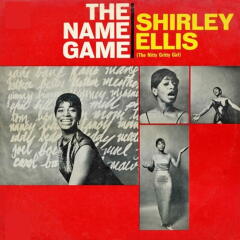
“The Name Game” was written by Shirley Ellis and Lincoln Chase. It appeared as the first song on side one of Shirley Ellis’ second studio album of the same name. Produced by Charles Calello, it was released as a single in December 1964. It went to #3 on the Billboard Hot 100 and #4 on the Billboard R&B Singles charts. The song is a rhyming game that creates variations on a person’s name. Ellis explains how to play the game through speaking and singing on the record. She said the song was based on a game she played as a child. It’s probably no coincidence that “Lincoln,” the name of the song’s co-writer, was used in the recording. Schoolkids on playgrounds everywhere in 1965 had fun and laughs using the name “Chuck” in the game, while teachers and parents were not so amused. The song has been covered by artists such as Soupy Sales, Laura Branigan, Divine, and Linda Tillery. Personnel on the record featured Shirley Ellis (vocals).
Shirley Ellis (Shirley Marie O’Garra) was an American soul music singer and songwriter. She is best known for her novelty hit records in the 1960s: “The Nitty Gritty” (1963); “The Name Game” (1964); and “The Clapping Song” (1965). “The Clapping Song” was certified Gold by the Recording Industry Association of America. Ellis started her professional career by writing two songs that The Chords recorded in the 1950s. All her solo hits were co-written with her manager, record producer and songwriting partner, Lincoln Chase. Ellis recorded for Congress, Columbia and Bell before retiring from the music industry in 1968. She released three studio albums, four compilation albums, and 14 singles. Ellis died in March 2005 in New York City at the age of 76.