It’s not the most accurately named piece of legislation, but that doesn’t mean the Inflation Reduction Act (IRA) might not have an outsized impact on everything from electric vehicles (EVs) and hydrogen production to greenhouse gas (GHG) emissions and carbon-capture projects. There’s plenty of potential for things to happen in the long run, but before then, a lot needs to get done — including the rules and regulations that will guide the IRA’s implementation. In today’s RBN blog, we look at why the IRA remains a work in progress, the critical role that rulemaking will play, and potential impediments to the law’s long-term success.
Two laws enacted during the Biden administration have dramatically increased the government funding, subsidies and tax credits available for a wide range of efforts aimed at decarbonization. The first, the Infrastructure Investment and Jobs Act (IIJA, also known as the Bipartisan Infrastructure Law), was enacted in November 2021 and includes $10 billion to advance carbon-capture technologies, $8 billion for regional clean hydrogen hubs (see The Contenders) and $1.5 billion for additional hydrogen initiatives, plus billions more for weatherization, smart power grids, nuclear and hydroelectric generation, and battery research. It was with the second major piece of legislation, August 2022’s passage of the IRA, where the Biden administration’s energy transition efforts began to pick up speed. While the name of the bill might lead one to believe that fighting inflation is its main goal — that’s just a marketable title — low-carbon energy is at its heart (see Part 1 of this series for more). It includes a host of climate and energy initiatives, many of which we’ll note below, but they all need rules and regulations, and how they are written will impact the IRA in many ways, such as how inclusive (or restrictive) the law’s provisions end up being, how easy (or difficult) it will be to qualify for federal funds, and the extent to which the law might be challenged in court.
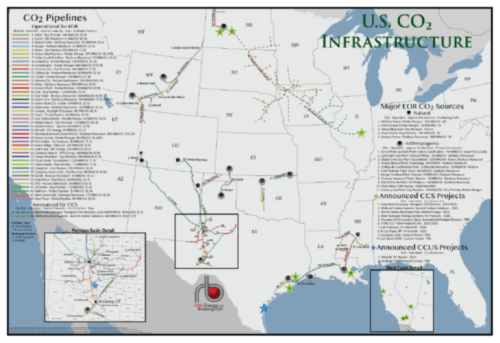
RBN Energy’s US CO₂ Infrastructure map brings together legacy Enhanced Oil Recovery (EOR) assets, as well as announced large-scale Carbon Capture and Sequestration (CCS) and Carbon Capture, Utilization and Sequestration (CCUS) projects, all in our signature concise, accurate, and intelligible style.
Federal agencies are responsible for implementing and enforcing laws passed by Congress. Those laws are not only lengthy and complex, but they often leave out important details. To meet their responsibilities, those agencies (there can be several impacted by any piece of legislation) must be able to create their own policies, procedures and rules, a process called rulemaking. In the case of the IRA, that rulemaking largely involves the Department of Energy (DOE), but other bureaucracies such as the Environmental Protection Agency (EPA), the Department of Transportation (DOT) and the Treasury Department are also affected, along with others. Those agencies must administer policy and distribute funding in a way that follows the legislative text.

About the song
“The Name Game” was written by Shirley Ellis and Lincoln Chase. It appeared as the first song on side one of Shirley Ellis’ second studio album of the same name. Produced by Charles Calello, it was released as a single in December 1964. It went to #3 on the Billboard Hot 100 and #4 on the Billboard R&B Singles charts. The song is a rhyming game that creates variations on a person’s name. Ellis explains how to play the game through speaking and singing on the record. She said the song was based on a game she played as a child. It’s probably no coincidence that “Lincoln,” the name of the song’s co-writer, was used in the recording. Schoolkids on playgrounds everywhere in 1965 had fun and laughs using the name “Chuck” in the game, while teachers and parents were not so amused. The song has been covered by artists such as Soupy Sales, Laura Branigan, Divine, and Linda Tillery. Personnel on the record featured Shirley Ellis (vocals).
Shirley Ellis (Shirley Marie O’Garra) was an American soul music singer and songwriter. She is best known for her novelty hit records in the 1960s: “The Nitty Gritty” (1963); “The Name Game” (1964); and “The Clapping Song” (1965). “The Clapping Song” was certified Gold by the Recording Industry Association of America. Ellis started her professional career by writing two songs that The Chords recorded in the 1950s. All her solo hits were co-written with her manager, record producer and songwriting partner, Lincoln Chase. Ellis recorded for Congress, Columbia and Bell before retiring from the music industry in 1968. She released three studio albums, four compilation albums, and 14 singles. Ellis died in March 2005 in New York City at the age of 76.