Russia’s invasion of Ukraine has pushed U.S. LNG into the spotlight as Europe seeks to wean itself off Russian natural gas. In the short term, U.S. LNG to Europe is constrained by liquefaction capacity on the LNG output side but also by Europe’s own import capacity and pipeline grid. Very little can be done to quickly increase global LNG production, and while many export terminals will operate at peak capacity for longer to boost output, LNG terminals take time to build, so capacity for this year and the next few years is already set. Further out, however, there is no shortage of new projects hoping to capitalize on the current clamor for LNG and reach a final investment decision (FID), and the U.S. could be headed toward its biggest year for new LNG capacity ever. In today’s RBN blog, we continue our series examining key U.S. projects, turning our lens to what is arguably the most discussed and reported-on project on our list — and one that is moving forward potentially without a formal FID — Tellurian’s Driftwood LNG.
Demand for U.S. LNG has never been higher. The global gas market has been tight for 18 months or more, leading to a huge run-up in international gas prices from historic lows of around $2/MMBtu in the summer of 2020 to record-smashing highs the past few months. Benchmark European gas prices averaged more than $30/MMBtu this past winter, or more than $10/MMBtu above the previous single-day record settlement. The highest price spikes have been caused by tensions between Europe and Russia in the months leading up to and during the invasion of Ukraine. Russia’s aggression has forced the world to reconsider its trade relations with that country and led Europe to try to wean itself off Russian natural gas, which currently accounts for as much as 40% of Europe’s gas supply. Europe’s reliance on Russian gas won’t evaporate overnight, but the European Commission (EC) is working on reducing its usage now and in the long term (see You Don’t Own Me), something the U.S. can help with. The U.S. has said in recent days that it will work with international partners to provide an additional 15 billion cubic meters (BCM; about 530 Bcf) of LNG to Europe this year. Although the plan does not specifically say where this LNG would come from, the U.S. would most likely be able to produce and send all of that. (See Baby I Got It and Help is on the Way for more on how much LNG the U.S. could send to Europe this year.)
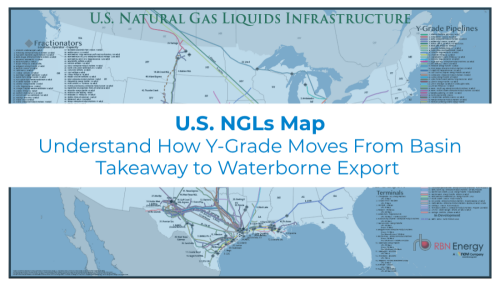
Visualize the infrastructure behind U.S. NGL movement.
The U.S. NGLs Map provides a comprehensive view of the transport, processing, and export networks moving NGLs across the U.S.
Beyond the short term, however, it certainly seems like the sky’s the limit. U.S. gas producer EQT Resources in February laid out a plan to help reduce global emissions by unleashing the power of U.S. LNG. Its plan calls for quadrupling U.S. LNG export capacity to more than 55 Bcf/d by 2030 (from the current 10.6 Bcf/d), effectively pushing coal fired-generation out of the money abroad, similar to what the U.S. experienced domestically to some degree after the Shale Revolution. While scaling up LNG production to that level would require some significant regulatory changes in the U.S., there are projects that are ready to go now. In Part 1 of this series, we looked at Venture Global’s Plaquemines LNG. At the time we published that blog it seemed that Venture Global was ready to take FID any day on the first half of the 20-MMtpa (million metric tons per annum; 2.65 Bcf/d) project. Although the FID has still not happened, Venture Global has announced two new long-term offtake agreements for the project and now 14 Mtpa (1.85 Bcf/d) of the terminal’s capacity has been secured in 20-year sales purchase agreements (SPAs). Venture Global will likely take FID on the entire 20-MMtpa (2.65 Bcf/d) project all at once — and soon. When it happens — we’re confident it’s a question of when, not if — it will be the largest amount of new LNG capacity in North America to ever reach FID at once. In Part 2, we looked at Cheniere’s Corpus Christi Stage III, another 10 MMtpa (1.32 Bcf/d) of capacity that will almost certainly get a green light this year. Both projects are being developed by companies with portfolios of other projects and are underpinned, at least in part, by long-term, traditional SPAs.
About the song
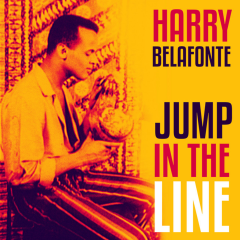
“Jump in the Line (Shake Senora)” was written by Lord Kitchener (“Kitch” was known as the “grand master of calypso” and later was a pioneer in the Soca music movement). The song appears as the seventh tune on Harry Belafonte’s 11th studio album, Jump Up Calypso, and was released as a single in November 1961. It has been covered by many artists over the years, with Belafonte’s version being featured during the end of Tim Burton’s 1988 hit comedy/horror film, Beetlejuice. Personnel on the record were: Harry Belafonte (vocals), The Trinidad Steel Band (instrumentation), Ernie Calabria, Millard Thomas (guitar), and Norman Keenan (bass).
Jump Up Calypso was recorded in 1960 and produced by Bob Bollard. Released in November 1961, the album went to #3 on the Billboard 200 Albums chart.
Harry Belafonte (Harold George Bellanfanti Jr.) is an American singer, songwriter, activist, and actor. He was born in Harlem to Jamaican parents. In the late 1940s Belafonte took acting lessons at the Dramatic Workshop of the New School in New York City alongside Marlon Brando, Sidney Portier and Tony Curtis. He received a Tony Award for his acting in the Broadway revue John Murray Anderson’s Almanac in 1954. He started his career as a singer in New York to help pay for his acting lessons. The first time he sang in front of an audience he was backed up by the Charlie Parker band. His breakthrough album in 1956, Calypso, became the first LP to sell a million copies within a year. It contained his most famous song, “The Banana Boat Song,” with its call and response lyric: “Day-O.” Belafonte has released 30 studio albums, eight live albums, three compilation albums and 20 singles. He has appeared in 35 films and documentaries, and 25 television shows. He has been a longtime humanitarian and political activist, and has won three Grammy Awards, one Emmy Award and one Tony Award. He has received a Kennedy Center Honor, a National Medal of Arts and a Grammy Lifetime Achievement Award, and has a star on the Hollywood Walk of Fame. At the age of 95, he is still active in film, music, and political activism.