


The fallout from Putin’s full-scale invasion of Ukraine has been multifold, with the human tragedy front and center. But it’s also reverberated across world economies as governments move to sanction Russia and corporations cut their ties with it. In a bid to minimize the impact on energy supplies and prices, the U.S. and its European allies have been grappling with how best to wean themselves from Russian crude oil and natural gas. That was relatively easy for the U.S. — the Russian import ban announced earlier this week by President Biden is likely to have only minor side effects. But the challenges for Europe are far greater due to its significant dependence on Russian supplies. If you’re stateside and trying to make sense of the market implications of all that — and trying to wrap your head around Europe’s energy infrastructure (and its approach to discussing energy volumes) — you’re not alone. In today’s RBN blog, we begin a look at what the European response could mean for the global LNG market.
Let’s start with the flurry of recent announcements, with the U.S., UK and European Union all moving to cut or curtail Russian oil and gas imports. The Biden administration on March 8 announced an immediate ban on Russian energy supplies into U.S. ports, including crude oil, LNG and coal. In concert with the U.S., the UK followed with its own plan — to ban all imports of oil and refined products from Russia but take a more phased approach, with the goal to end them by the end of 2022, given its heavier dependence on Russian oil. The UK’s plan does not include natural gas or LNG. On the natural gas side, however, the European Commission (EC), which represents the 27 countries in the European Union (EU), on March 8 announced plans to reduce imports from Russia — which make up 40% of Europe’s gas supply — by two-thirds by the end of this year. The plan echoed and built on elements of a plan outlined by the International Energy Agency (IEA) last week for the EU to reduce Russian gas imports by more than one-third within a year.
We recently dissected the impacts of a potential (now real) ban on Russian oil to the U.S. — in particular, the implications for U.S. refineries — in We’re Not Gonna Take It. Banning Russian supplies is a much bigger deal for Europe, however, especially when it comes to its natural gas requirements. So, we now turn our attention to the European gas situation, putting the EC/EU’s plan in the context of the continent’s gas market landscape, what the curtailments could look like and implications for the global LNG market, including exports from the U.S., given its increasing role as marginal LNG supplier in global LNG trade.
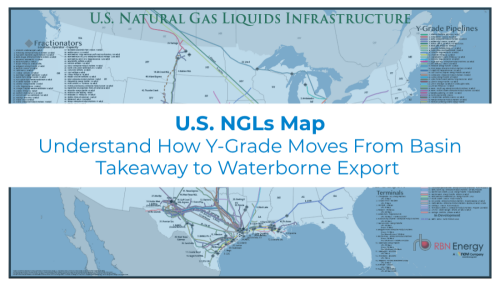
Visualize the infrastructure behind U.S. NGL movement.
The U.S. NGLs Map provides a comprehensive view of the transport, processing, and export networks moving NGLs across the U.S.
About the song
“You Don't Own Me” was written by John Madara and David White. It appears as the first song on side two of Lesley Gore’s second studio album, Lesley Gore Sings of Mixed-Up Hearts. Released as a single in December 1963, it went to #2 on the Billboard Hot 100 Singles chart. It remained at #2 for three consecutive weeks, until The Beatles arrived with “I Want to Hold Your Hand,” taking over the #2 spot. The song was recorded when Gore was 17 and is a pretty heady mix for a teenager to sing an anthem that celebrates defiance over authority. It was inducted into the Grammy Hall of Fame in 2016. The song has been certified Gold by the Recording Industry Association of America (RIAA). Recorded in September 1963, the tune features Lesley Gore on vocals, accompanied by session musicians selected by producer Quincy Jones. It would be Gore’s last Top 10 single.
Lesley Gore Sings of Mixed-Up Hearts was the follow-up to Gore's debut album, I'll Cry If I Want To. The Quincy Jones-produced LP contained three charting hit singles: “She's a Fool,” “You Don't Own Me,” and “Sunshine, Lollipops, and Rainbows.” It was released in November 1963 and went to #125 on the Billboard Top 200 Albums chart.
Lesley Gore (Lesley Sue Goldstein) was an American singer, songwriter and actress. Brooklyn-born Gore recorded her first hit record, “It's My Party,” with producer Quincy Jones when she was 16. It went to #1 on the Billboard Hot 100 Singles chart and has been certified Gold by the RIAA. She released 13 studio albums, six compilation albums, and 37 singles. In the sixties Gore acted on the television series, The Donna Reed Show, Batman, Malibu U, and Dream Girl of ’67. In the eighties she appeared on All My Children, and in the nineties on Murphy Brown. She composed songs with her brother Michael for the soundtrack album for the film Fame and wrote music for the 1996 film Grace of My Heart. In 2003, she hosted several episodes of the PBS series In the Life. Gore died in Manhattan in February 2015.




Comments
What I have rarely seen mentioned is quickly ramping up Europe’s natural gas production. Because of environmental pressures many older gas field were prematurely abandoned (Groningen, etc.). Similarly, newer fields in the North Sea have been capped. Time to give the petroleum industry some free rein to quickly jack up production. The economics are certainly attractive!
Just a quick note on your map: the GALSI pipeline linking Algeria with Italy via Sardinia has not been built.