It’s true. A lot of folks harbor serious doubts about whether “green,” “blue,” or “pink” hydrogen (H2) can ever be produced efficiently and cheaply enough — and in sufficient volumes — to justify blending hydrogen with natural gas, let alone using H2 as an outright replacement for gas. At the same time, though, a growing number of electric utilities and independent power producers — generally cautious groups — are planning new, large-scale power plants that will be capable of hydrogen/natgas co-firing from the get-go, and can be converted with relative ease to 100% H2 later on. Can hydrogen really make sense as a generation fuel? In today’s RBN blog, we begin a series on the prospects for environmentally friendly hydrogen — and ammonia, an H2 carrier — in the power generation sector.

We get it. There’s a growing chorus of skepticism — even cynicism —regarding hydrogen as a “fuel of the future” or “energy storage pathway.” Since we started blogging about hydrogen back in 2020, we’ve tried our best to keep it real — that is, to point out the many economic and other challenges associated with making H2 more of a mainstream fuel. Producing low-carbon hydrogen is expensive, energy intensive, and material intensive, and the entire value chain — upstream, midstream, and downstream — will require huge sums of money and a long time to achieve significant development to even put a dent in conventional energy sources. But while it’s debatable whether the benefits will outweigh the costs, even opponents would do well to recognize the growing interest in hydrogen from a wide range of industry players, including industrial giants like Air Products & Chemicals that are investing billions of dollars in massive green and blue hydrogen projects in the U.S. and abroad. And it’s hard to ignore the big bet that the federal government is putting on H2. As we’ve been tracking in our weekly Hydrogen Billboard report, the bipartisan infrastructure bill that President Biden signed into law in November 2021 allocates $8 billion to establish four regional H2 hubs. (Proposals are due in May, and the hubs will be selected within a year.
The reality is that while hydrogen has a long way to go, its potential as a long-term solution means that energy companies planning for the future need to pay attention. The number of companies and amount of money directed toward hydrogen development is substantial — not just from ambitious start-ups but from what you might call “the establishment.” Recent evidence of this has been coming in spades from the U.S. electric power sector, where investor-owned utilities like Entergy Texas, publicly owned municipal utility groups like Intermountain Power Agency (in Utah), and IPPs like Danskammer Energy (in New York), EmberClear (in Ohio), and Balico LLC (in Virginia) are planning large combined-cycle power plants designed to be capable of burning up to a 70/30 blend of natural gas and green, blue, or pink hydrogen when they start up, and up to 100% with later retrofits, if and when that makes economic sense. [A quick reminder: Green hydrogen comes from water run through an electrolyzer powered by renewable energy; blue H2 is produced from natural gas via steam methane reforming (SMR), with at least part of the resulting carbon dioxide (CO2) being captured and sequestered; and pink H2 comes from water run through an electrolyzer powered by nuclear power. See You Can Make It If You Try for more.]
About the song
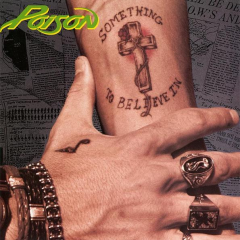
“Something to Believe In” was written by Bret Michaels, C.C. DeVille, Bobby Dall, and Rikki Rockett (Poison). The power ballad appears as the 11th song on Poison's third studio album, Flesh & Blood, and was the second single released from the LP in September 1990. It went to #4 on the Billboard Hot 100 Singles chart and has been certified Gold by the Recording Industry Association of America (RIAA). Personnel on the record were: Bret Michaels (lead, backing vocals, acoustic guitar), C.C. DeVille (lead, rhythm electric guitars, backing vocals), Bobby Dall (bass, backing vocals), Rikki Rockett (drums, backing vocals), and John Webster (piano).
Flesh & Blood was recorded at Little Mountain Sound Studios in Vancouver, BC, in 1989-90. Produced by Bruce Fairbairn and Mike Fraser, the album was released in June 1990. It went to #2 on the Billboard 200 Albums chart and has been certified 3x Platinum by the RIAA. Five singles were released from the LP.
Poison is an American glam metal band formed in Mechanicsburg, PA, in 1983. Although the band has had four guitarists through its history, the core of the group — Bret Michaels, C.C. DeVille, Bobby Dall, and Rikki Rockett — has remained. Poison has released seven studio albums, four live albums, seven compilation albums, and 30 singles and has sold over 50 million records worldwide. The band continues to record and tour and will be resuming its stadium tour with Mötley Crüe, Def Leppard, and Joan Jett in June 2022.