Up in Canada, there is finally a regulatory timeline for reviewing Enbridge’s long-standing proposal to revamp how it allocates space — and charges for service — on the company’s 2.9-MMb/d Mainline. But the plan to convert the largest crude oil pipeline system out of Western Canada from one whose space is 100% uncommitted and allocated every month to one with 90% of its capacity locked in via long-term contracts remains controversial, especially among producers. Plus, the world has changed in the past few months. Oil sands and other production in Alberta and its provincial neighbors is off sharply in response to pandemic-related demand destruction and low oil prices, and the always-full Mainline has been running at well under 90% of its capacity lately. Further, the Trans Mountain Expansion and Keystone XL projects — competitors to the Mainline in a way — have progressed this year, making shippers wonder whether to lock in capacity on the Mainline if TMX and KXL’s completion may be imminent. Today, we begin a short series on the prospective shift to a contract-carriage approach on the primary conduit for heavy and light crudes from Western Canada to U.S. crude hubs and refineries.

Canadian crude output is rising, requiring new export routes. As traditional pathways face constraints, the U.S. Rockies—especially the Guernsey, WY hub—are emerging as key corridors for moving Canadian heavy crude to downstream markets, including the Gulf Coast.
Last year, in a four-part blog series on Enbridge’s Mainline recontracting plan — then still under development — we said that the midstream company’s largest crude oil pipeline system (orange lines in Figure 1) accounts for a staggering 70% of Western Canada’s total export-related pipeline capacity. The system’s parallel Lines 1, 2, 3, 4 and 67 transport a variety of heavy and light crudes from Edmonton and Hardisty, AB, to Clearbrook, MN, and Superior, WI. From there, other Mainline pipes move crude to Flanagan in north-central Illinois (Line 61), the Chicago area (Lines 6, 14 and 64), Michigan (Lines 5 and 78) and Ontario (Lines 5, 78, 7, 10 and 11).
About the song
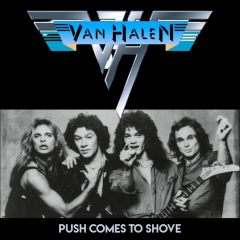
"Push Comes to Shove" was written by Eddie Van Halen, Alex Van Halen, Michael Anthony and David Lee Roth. It appears as the second song on side two of Van Halen's fourth studio album, Fair Warning. It is interesting to note that the song, released by Van Halen in 1981, was followed by a song with the same title from Aerosmith in 1982, and Jackyl in 1994. Personnel on the Van Halen record were: David Lee Roth (lead vocals), Eddie Van Halen (guitar, synthesizers, backing vocals), Michael Anthony (bass, backing vocals), and Alex Van Halen (drums).
Fair Warning was recorded in March and early April 1981 at Sunset Sound in Hollywood, CA, with Ted Templeman producing. The album cover art was taken from a detail from Canadian artist William Kurelek's painting, “The Maze.” The album was released in April 1981, and went to #5 on the Billboard Top 200 Albums Chart. It has been certified 2x Platinum by the Recording Industry Association of America.
Van Halen is an American rock band formed in Pasadena, CA, in 1972. The band has had eight members pass through its ranks — only the Van Halen brothers have remained in the band since its formation. Van Halen has sold more than 80 million records worldwide. The group has released 12 studio albums, two live albums, two compilation albums and 56 singles. Van Halen has won one American Music Award, one Grammy Award and four MTV Video Music Awards. The band has been on hiatus since 2015, and its future is unknown at this time.