Enbridge’s proposal to have crude oil shippers on its now fully uncommitted Mainline sign long-term contracts for as much as 90% of the 2.9-MMb/d pipeline network’s capacity is a big deal — and controversial. Refiners and integrated producer/refiners generally support the plan, which is now up for consideration by the Canada Energy Regulator, while Western Canadian producers with no refining operations of their own — and, for many, no history of shipping on the Mainline — mostly oppose it. What’s driving their contrasting views? It’s complicated, of course, but what it really comes down to is that everyone wants to avoid what they see as a bad outcome. Refiners and “integrateds” fear that if the current month-to-month approach to pipeline space allocation remains in place, cost-of-service-based tariffs on Mainline will soar when new takeaway capacity is built on the Trans Mountain and Keystone systems and fewer barrels flow on Mainline. Producers, in turn, are wary of making multi-year, take-or-pay commitments to Enbridge if they’ll soon have other takeaway options, and are equally concerned that they’d be left in the lurch if they don’t commit to Mainline and the Trans Mountain Expansion and Keystone XL projects don’t get built. Today, we consider both sides of this important debate.

Crude Oil Permian provides detailed analysis of the fundamental drivers impacting the Permian Basin crude oil market including weekly data, analysis and market intelligence updates of: Permian crude oil supply and demand, pipeline outflows and capacity, prices, and infrastructure updates.
Enbridge’s Mainline accounts for a staggering 70% of Western Canada’s total export-related pipeline capacity, something we discussed during our recent Studio Sessions webinar, “Alberta Bound” (see below for replay information). The network’s parallel Lines 1, 2, 3, 4 and 67 transport a variety of heavy and light crudes from the Western Canadian Sedimentary Basin (WCSB) via receipt points at Edmonton and Hardisty, AB, to Clearbrook, MN, and Superior, WI. From there, other Mainline pipes move crude to Flanagan in north-central Illinois (Line 61), the Chicago area (Lines 6, 14), Michigan (Lines 5 and 78) and Ontario (Lines 5, 78, 7, 10 and 11). As shown in Figure 1, of the 2.7 MMb/d of what Enbridge refers to as “core” refinery demand in the U.S. Midwest and Eastern Canada (yellow bar), 2.2 MMb/d is connected to the Enbridge network; many of these refineries are complex facilities configured to process heavy crudes from Alberta. Of that demand served by Enbridge, 1.9 MMb/d is in the Midwest (gray bar to left) and another 0.3 MMb/d is located in Ontario and Quebec (gray bar in middle). The balance of the crude used to meet core refinery needs in the Midwest and Eastern Canada is delivered by non-Enbridge pipes and by water (gray bar to right). Crude that flows through the Mainline also can continue on to more distant destinations on other Enbridge-owned pipes — to Cushing, OK, and the Gulf Coast, for example.
About the song
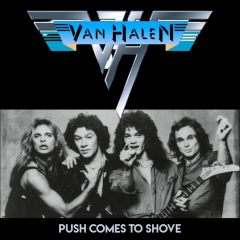
"Push Comes to Shove" was written by Eddie Van Halen, Alex Van Halen, Michael Anthony and David Lee Roth. It appears as the second song on side two of Van Halen's fourth studio album, Fair Warning. It is interesting to note that the song, released by Van Halen in 1981, was followed by a song with the same title from Aerosmith in 1982, and Jackyl in 1994. Personnel on the Van Halen record were: David Lee Roth (lead vocals), Eddie Van Halen (guitar, synthesizers, backing vocals), Michael Anthony (bass, backing vocals), and Alex Van Halen (drums).
Fair Warning was recorded in March and early April 1981 at Sunset Sound in Hollywood, CA, with Ted Templeman producing. The album cover art was taken from a detail from Canadian artist William Kurelek's painting, “The Maze.” The album was released in April 1981, and went to #5 on the Billboard Top 200 Albums Chart. It has been certified 2x Platinum by the Recording Industry Association of America.
Van Halen is an American rock band formed in Pasadena, CA, in 1972. The band has had eight members pass through its ranks — only the Van Halen brothers have remained in the band since its formation. Van Halen has sold more than 80 million records worldwide. The group has released 12 studio albums, two live albums, two compilation albums and 56 singles. Van Halen has won one American Music Award, one Grammy Award and four MTV Video Music Awards. The band has been on hiatus since 2015, and its future is unknown at this time.