It took a while, but Enbridge and shippers on its 3.2-MMb/d Mainline system have finally reached an agreement in principle on a new tolling agreement that will lower per-barrel rates on the mammoth crude oil pipeline network between Western Canada and the U.S. Midwest — and also help ensure that Enbridge will earn a healthy rate of return on its largest asset. Assuming the Mainline Tolling Agreement (MTA) is approved by Canadian regulators later this year (and that’s seems to be a safe bet), the new rate structure should also help the Mainline system retain the vast majority of its crude volumes, even as it faces new competition from the Trans Mountain Expansion (TMX) project, which will provide 590 Mb/d of additional pipeline capacity from Edmonton, AB, to the British Columbia (BC) coast starting sometime next year. In today’s RBN blog, we discuss the MTA and what it means for Enbridge, shippers and TMX.

Join industry leaders in Calgary on October 29 for market insights, technical presentations, Duvernay inventory analysis, an expert panel, and networking focused on the next chapter of Canadian energy.
Some may disagree, but we’d argue that Enbridge’s Mainline system (orange lines in Figure 1) is among North America’s most underappreciated midstream assets. Largely under the radar, its platoon of pipelines (Lines 1, 2, 3, 4, 5, 6, 7, 11, 14, 61, 62, 64, 65, 67 and 78 and 93) reliably transports more than 3 MMb/d of heavy, medium and light crude oil (and some NGLs) from the Western Canadian Sedimentary Basin to terminals in Minnesota, Wisconsin, Illinois, Indiana, Michigan and Ontario. From there — on other pipelines, many of them also owned by Enbridge — the crude flows to other terminals and refineries across a broad swath of real estate between Quebec and the Gulf Coast.
For example, from Flanagan, IL, crude can continue on either the Flanagan South or Spearhead pipelines (parallel dark pink and light pink lines; both owned by Enbridge) to the Cushing, OK, crude hub, and from Cushing to Freeport, TX, on Enbridge and Enterprise Products Partners’ jointly owned Seaway pipeline system (dark blue line). Also from Flanagan, crude can flow south on Enbridge’s Southern Access Extension Pipeline (light blue line) to the Patoka crude hub in south-central Illinois –– Patoka being the northern terminus of the recently reversed Capline pipeline (yellow line). And, crude can flow east to Montreal on Enbridge’s Line 9 (red line).
About the song
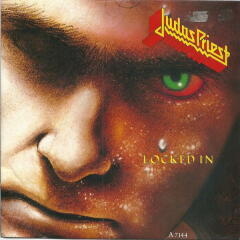
“Locked In” was written by K.K. Downing, Glenn Tipton, and Rob Halford. It appears as the second song on side one of Judas Priest’s 10th studio album, Turbo. Released as a single in May 1986, the video of the song received heavy rotation on MTV. Personnel on the record were: Rob Halford (vocals), K.K. Downing (guitar, guitar synthesizer), Glenn Tipton (guitar, guitar synthesizer), Ian Hill (bass), and Dave Holland (drums).
Turbo was recorded between June 1985 and February 1986 at Compass Point in Nassau (the Bahamas), and Record Plant in Los Angeles. Produced by Tom Allom, it was released in March 1986 and went to #17 on the Billboard 200 Albums chart and has been certified Platinum by the Recording Industry Association of America. Turbo was somewhat controversial among Priest fans due to its heavy use of guitar synthesizers, a real departure from its twin lead guitar attack of the past. The band also ditched their trademark black leather and studs wardrobe for the Turbo tour, replacing it with a more glam look. The guitar synthesizers left after this tour and the black leather and studs returned for the following tour and haven't left since. Judas Priest, after all, invented this look. Three singles were released from the LP.
Judas Priest is an English heavy metal band formed in Birmingham in 1969. With record sales of over 50 million worldwide, they are one of the most popular heavy metal acts ever. The band has released 18 studio albums, six live albums, seven compilation albums, and 29 singles. They have won one Grammy Award and were inducted into the Rock and Roll Hall of Fame for Musical Excellence in 2022. Twenty people have passed through the ranks of Judas Priest since the band’s formation. Founding members Rob Halford and Ian Hill — along with Scott Travis, Richie Faulkner, and Andy Sneap — still record and tour as Judas Priest. They completed a European tour in the spring of 2023, and have scheduled dates for a Metal Masters Tour in Europe beginning in March 2024 with Saxon and Uriah Heep.