The U.S. outlook for low-carbon hydrogen was bright and sunny just a year or two ago, with billions in federal funding and policy support, but to no one’s surprise, things have darkened considerably this year. Several clean-energy initiatives have faced resistance from Republicans in Washington, with the budget reconciliation bill currently making its way through Congress on track to produce the most significant changes yet. In today’s RBN blog, we’ll look at how the bill could dramatically scale back the 45V tax credit for hydrogen production and deal a mighty blow to dozens of projects under development.
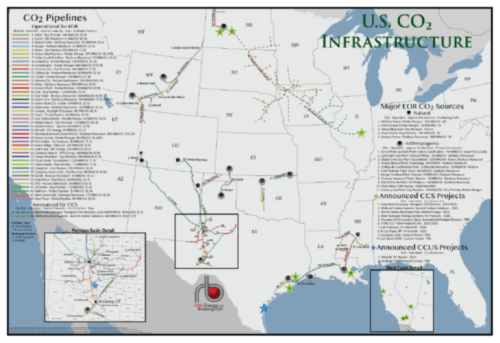
RBN Energy’s US CO₂ Infrastructure map brings together legacy Enhanced Oil Recovery (EOR) assets, as well as announced large-scale Carbon Capture and Sequestration (CCS) and Carbon Capture, Utilization and Sequestration (CCUS) projects, all in our signature concise, accurate, and intelligible style.
Hydrogen was a priority for the Biden administration, which viewed it as a crucial piece of its long-term decarbonization strategy. Those efforts included billions in funding under the 2021 Infrastructure Investment and Jobs Act (IIJA) and the 2022 Inflation Reduction Act (IRA). The IRA, widely seen at the time as a game-changer regarding incentives for clean energy, included provisions on everything from methane emissions and electric vehicles (EVs) to carbon capture and sequestration (CCS) and alternative fuels, but one of the most significant elements was the inclusion of the 45V tax credit. As part of an effort to reduce spending, fund a package of tax cuts and refocus U.S. energy priorities, the Trump administration and Congress have zeroed in on the IRA’s tax credits as the reconciliation bill has come together over the first few months of this year.
By way of review, let’s take a quick look at what 45V was designed to do. As defined by the IRA, clean hydrogen is produced in a way that results in a lifecycle greenhouse gas (GHG) emissions rate of not more than 4 kg of carbon dioxide equivalent per kilogram of hydrogen (CO2e/kg). (Conventional gray hydrogen, which accounts for nearly all the production today, typically generates 10-14 CO2e/kg of GHG emissions.) Under 45V, credits worth up to $3/kg would be available (left axis in Figure 1 below) based on the rate of lifecycle GHG emissions during a clean hydrogen facility’s first 10 years of operation. The production tax credit (PTC) includes a base rate (blue bars) and a bonus rate (orange bars), the latter of which is 5X the base rate for producers meeting prevailing wage and apprenticeship requirements. We should note that only very expensive green hydrogen, produced by running water through an electrolyzer powered by renewable sources, would qualify for the most lucrative credit (Tier 1). In contrast, blue hydrogen (produced by running natural gas through a steam methane reformer and capturing and sequestering most of the resulting carbon dioxide, or CO2) would be relegated to the lower credit amounts due to its higher carbon intensity (CI) rates. The emissions ranges for each tier of the tax credit are shown by the black arrows and the right axis.
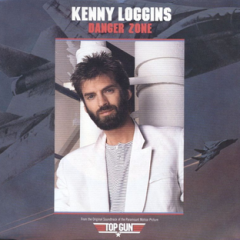
About the song
“Danger Zone” was written by Giorgio Moroder with lyrics by Tom Whitlock. It was the first track on the bestselling soundtrack album for the motion picture Top Gun. Sung by Kenny Loggins and produced by Giorgio Moroder, the song was released as a single in May 1986 and went to #2 on the Billboard Hot 100 Singles chart. Personnel on the record were: Kenny Loggins (vocals, rhythm guitar), Dann Huff (lead guitar), Tom Scott (sax), Giorgio Moroder (synthesizers, sequencer, drum machine) and Tom Whitlock (synthesizer).
The album Top Gun was recorded during 1986 at various studios, with different artists and producers. The album’s production was overseen by Don Simpson and Jerry Bruckheimer. Kenny Loggins, Cheap Trick, Berlin, Teena Marie, Miami Sound Machine, Loverboy, Larry Greene, Marietta, Harold Faltermeyer and Steve Stevens were the featured artists on the LP. Released in May 1986, the album went to #1 on the Billboard Top 200 Albums chart and has been certified 9x Platinum by the Recording Industry Association of America. It was the best-selling soundtrack album of 1986. Six singles were released from the LP.
Kenny Loggins is an American singer, songwriter and guitarist. His early songs were recorded by the Nitty Gritty Dirt band, which led to the founding of the rock duo Loggins and Messina in the ’70s. The duo released seven studio albums, three live albums, four compilation albums, and 10 charted singles. They have sold more than 6 million records worldwide. As a solo artist, Loggins has released 14 studio albums, two live albums, two compilation albums and 31 singles. He is also a member, along with Gary Burr and Georgia Middleman, of the country trio Blue Sky Riders. The trio has released two studio albums. Loggins continues to record and play an occasional live performance. He will be appearing July 25-27 at the Newport Folk Festival in Newport, RI.