Over the past few weeks, many U.S. refiners reported even-stronger-than-expected first-quarter results, and it’s likely their good fortune will continue. Why? Despite the skyrocketing price of crude oil — refiners’ primary feedstock — the prices of the gasoline and diesel they produce have risen even more. And it’s that now-yawning gap between crude oil and refined-products prices that’s been driving refining margins — and refiners’ profits — to near-historic levels. Refining margins, like the character and capabilities of thoroughbreds like “Rich Strike” in Saturday’s amazing Kentucky Derby, are unique to each refinery because of their different sizes, equipment and crude slates (among other things), but there’s a tried-and-true way to estimate the refining sector’s general profitability, as we discuss in today’s blog on U.S. refiners’ sky-high crack spreads.

The Future of Fuels bi-annual report by RBN's Refined Fuels Analytics provides an in-depth analysis of the U.S. and global refinery industries, focusing on crude oil and fuel market dynamics, supply and demand, alternative fuels, refinery capacities, and price forecasts to help stakeholders navigate the evolving energy landscape.
It’s been quite an earnings season for many U.S. refiners. One after another, they’ve reported first-quarter results that exceeded even Wall Street’s energy-boom-time expectations. And in each case, as you might have guessed, the improved results were fueled by sharply higher refining margins — namely, the money refiners make on each barrel of crude oil they process into gasoline, diesel, jet fuel and other products. Valero Energy and Phillips 66, for example, both said that their refining margins in the first quarter were more than double those of a year earlier, when COVID was still weighing heavily on fuel demand. PBF Energy’s margins more than tripled.
For many years now, we’ve blogged about the crack spread, which you might call a rule-of-thumb approach to estimating the profitability of the refining sector by comparing the price of crude to the prices of gasoline and diesel, the two largest outputs of a typical refinery. And there are at least a few approaches to compute the crack spread.
A common approach is to use the 3-2-1 crack spread, which represents the operation of a hypothetical refinery that makes twice as much gasoline as diesel from three barrels of crude. In other words, a 3-2-1 crack spread is the difference between the cost of three barrels of crude and the sum of two barrels of gasoline plus one barrel of diesel. We often use the 3-2-1 crack spread (and track it in RBN Spotcheck) because, back in the good ol’ days, a typical refinery produced about twice as much gasoline as diesel. But we also look at the 2-1-1 crack spread — the difference between the cost of two barrels of crude and the sum of one barrel of gasoline and one barrel of diesel — because that one-to-one gasoline-to-diesel output ratio is often a little closer to reality these days. (Or if you’re looking for more sophisticated regional margins across various grades, we’ve got those in our Refinery Billboard.)
About the song
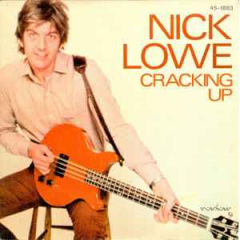
“Cracking Up” was written by Nick Lowe and appears as the second song on side one of Lowe’s second studio album, Labour of Lust. The song was released as a single on Radar Records in the UK in May 1979. Tom Petty and the Heartbreakers recorded a version of it in 1985, and it’s included on their Playback compilation box set released in November 1995. Personnel on the Nick Lowe record were: Nick Lowe (lead vocals bass), Dave Edmunds (guitar, backing vocals), Billy Bremner (guitar, backing vocals), and Terry Williams (drums).
Labour of Lust was recorded in 1978-79 at Eden Studio in London and Love in Helsinki and released in June 1979. Produced by Nick Lowe, the album includes all the personnel from the band Rockpile. The American version of the album has slightly different tracks than the UK version. (Yep Roc Records has recently reissued the album with all tracks from the U.S. and UK versions.) The album went to #32 on the Billboard 200 Albums chart. One single, “Cruel to be Kind,” was released from the LP. It went to #12 on the Billboard Hot 100 Singles chart.
Nick Lowe is a British singer, songwriter, musician, and producer. He started his professional career in 1967 with his high school friend, Brinsley Schwarz, whose band would become one of the kingpins of the British pub rock scene in the early to mid-1970s. Lowe wrote two of his best-selling songs while with Brinsley Schwarz: “(What’s So Funny ’Bout) Peace, Love, and Understanding” and “Cruel to be Kind,” co-written with Schwarz bandmate Ian Gomm. In 1975, Lowe started playing with Dave Edmunds, Billy Bremner, and Terry Williams in the band Rockpile. In August 1976, Lowe released “So It Goes,” the first single on the UK punk rock label Stiff Records. Stiff was funded by a small loan from fellow pub rocker Lee Brilleaux from the band Dr. Feelgood. Lowe has produced records for The Damned, Elvis Costello, The Pretenders, Dr. Feelgood, Wreckless Eric, Mickey Jupp, Carlene Carter, and the Fabulous Thunderbirds. As a solo artist, he has released 14 studio albums, three live albums, six compilation albums, three EPs and 23 singles. He released six albums with Brinsley Schwarz, one album with Rockpile, and one album with Little Village. He continues to record, produce and tour.