


U.S. diesel inventories are at their lowest level for May since 2000 and East Coast stocks recently hit their lowest mark for any week or month since the EIA started tracking them in 1990. Crack spreads for diesel — and, more recently, for gasoline — have gone parabolic, giving refiners the strongest financial signal ever to produce more diesel and gasoline as we enter the summer travel season. More jet fuel too. The problem is, U.S. refineries already are running flat-out. And Europe? It’s facing big cuts in crude oil and refined-products imports from Russia as well as much higher prices for — and possible shortages of — oil and natural gas, the latter being the primary fuel for operating refinery hydrocrackers, which upgrade low-quality heavy gas-oils into high-quality diesel, gasoline and jet. It’s a mess, and not easily fixable, as we discuss in today’s RBN blog.
U.S. and global energy markets have always had challenges to deal with — nothing so far-reaching, multifaceted and interdependent can run as reliably and smoothly as a Swiss watch, whose gears and springs operate within a glass-and-gold vacuum. But it would be hard to find a time when energy markets are in as much disarray as they are today. The COVID pandemic, a precipitous economic slowdown (and partial rebound), a nascent energy transition, Russia’s war on Ukraine, and China’s big-city lockdowns, among other things, have combined to wreak havoc, with the most significant effect being supply/demand imbalances that have propelled prices for crude oil and refined products (and natural gas) sharply higher.

The Future of Fuels bi-annual report by RBN's Refined Fuels Analytics provides an in-depth analysis of the U.S. and global refinery industries, focusing on crude oil and fuel market dynamics, supply and demand, alternative fuels, refinery capacities, and price forecasts to help stakeholders navigate the evolving energy landscape.
Markets generally fix themselves. We’ve all heard this economic truism: “The cure for high prices is high prices.” While that may generally be true — when widget demand and prices soar, producers ramp up production to take advantage of the situation, and increased supply brings prices back to earth — the truism doesn’t always hold up, especially in the short term, particularly when things get complicated. And things are very complicated today. Demand for crude oil from Russia, a leading producer, is off sharply — the U.S., its allies and others won’t touch the stuff, leaving Russia’s reduced output to be sold at a discount to those who will. Oil production in the rest of the world is up only marginally, however, partly because many countries can’t increase their production much and partly because those that can have learned that ramping up production quickly can cause prices to plummet.
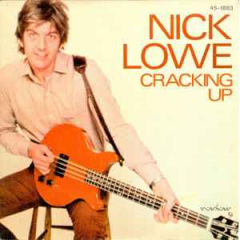
About the song
“Cracking Up” was written by Nick Lowe and appears as the second song on side one of Lowe’s second studio album, Labour of Lust. The song was released as a single on Radar Records in the UK in May 1979. Tom Petty and the Heartbreakers recorded a version of it in 1985, and it’s included on their Playback compilation box set released in November 1995. Personnel on the Nick Lowe record were: Nick Lowe (lead vocals bass), Dave Edmunds (guitar, backing vocals), Billy Bremner (guitar, backing vocals), and Terry Williams (drums).
Labour of Lust was recorded in 1978-79 at Eden Studio in London and Love in Helsinki and released in June 1979. Produced by Nick Lowe, the album includes all the personnel from the band Rockpile. The American version of the album has slightly different tracks than the UK version. (Yep Roc Records has recently reissued the album with all tracks from the U.S. and UK versions.) The album went to #32 on the Billboard 200 Albums chart. One single, “Cruel to be Kind,” was released from the LP. It went to #12 on the Billboard Hot 100 Singles chart.
Nick Lowe is a British singer, songwriter, musician, and producer. He started his professional career in 1967 with his high school friend, Brinsley Schwarz, whose band would become one of the kingpins of the British pub rock scene in the early to mid-1970s. Lowe wrote two of his best-selling songs while with Brinsley Schwarz: “(What’s So Funny ’Bout) Peace, Love, and Understanding” and “Cruel to be Kind,” co-written with Schwarz bandmate Ian Gomm. In 1975, Lowe started playing with Dave Edmunds, Billy Bremner, and Terry Williams in the band Rockpile. In August 1976, Lowe released “So It Goes,” the first single on the UK punk rock label Stiff Records. Stiff was funded by a small loan from fellow pub rocker Lee Brilleaux from the band Dr. Feelgood. Lowe has produced records for The Damned, Elvis Costello, The Pretenders, Dr. Feelgood, Wreckless Eric, Mickey Jupp, Carlene Carter, and the Fabulous Thunderbirds. As a solo artist, he has released 14 studio albums, three live albums, six compilation albums, three EPs and 23 singles. He released six albums with Brinsley Schwarz, one album with Rockpile, and one album with Little Village. He continues to record, produce and tour.






Comments
Shouldn't high cracks drive refining investment, any signs of that happening?
In reply to what are the prospects for new and/or refining additions? by Andrew Wittmann
Refiners are always working to streamline and debottleneck their facilities to maximize yields, but so far there's been no sign of new, major refinery investments. In our view, they are unlikely given the significant investments that would be needed, the long lead time, the potential for crack spreads to shrink, and ESG-related issues.