


We’ve spent a lot of time this year looking at the global move to decarbonize and explaining why there isn’t going to be a straight line leading directly to abundant carbon-free power and a net-zero world. That might be the way a lot of people would like to see it go, but that’s not the reality we’re now facing. All sorts of obstacles have popped up, indicating that the energy industry’s trilemma of availability, reliability and affordability not only clash with each other on occasion, they can also conflict with economic and environmental priorities. Nowhere is that more evident than in the U.S., where small-scale battles over the clean-energy transition are playing out all over the map. In today’s RBN blog, we discuss highlights from our newly released Drill Down Report on the ways the nation’s clean-energy push is playing out at the state level.

Although renewable sources of power generation are nothing new, efforts to develop more low-carbon sources and reduce greenhouse gas (GHG) emissions have been significantly boosted by two developments in recent years:
- On a global level, many countries have cited concerns about the long-term impacts of climate change as the justification for extremely ambitious aspirations to decarbonize the world economy and reach net-zero GHG emissions by 2050, a goal established by the 2015 Paris climate agreement.
- In the U.S., energy policy shifted dramatically after President Biden took office in January 2021. A key element in Biden’s 2020 campaign was a promise to reduce fossil-fuel usage and GHG emissions and to promote the development of a clean-energy industry as a way to reach net-zero goals.
With a focus on the changes that need to happen in the short term to make any long-term goals viable, Biden set out some ambitious 2030 targets: at least 80% of U.S. power generated by renewable sources, a reduction in GHG emissions by 50%-52% (from 2005) levels, and a faster pace of electric vehicle (EV) adoption so they make up at least 50% of new-vehicle sales. More importantly, the Biden administration successfully steered the passage of two significant pieces of clean-energy legislation: the Infrastructure Investment and Jobs Act (IIJA, better known as the Bipartisan Infrastructure Law) and the Inflation Reduction Act (IRA). Among other things, the IIJA established billions of dollars in funding for a series of regional direct air capture (DAC) and clean hydrogen hubs. The IRA, widely seen as a game-changer when it comes to incentives around clean energy, includes provisions on everything from methane emissions and EVs to carbon capture and sequestration (CCS) and alternative fuels.
The administration’s targets and the enactment of the IIJA and IRA provide a 50,000-foot idealized view of what the transition to an economy with reduced reliance on fossil fuels could look like, but it’s at the state level that the real changes will be felt. Nowhere is that more apparent than Hawaii, the focus of Section 2 in our new Drill Down Report, where an envisaged transition from fossil fuels for power generation has long been a priority for environmental and economic reasons. The state’s boldest move so far may be the September 2022 retirement of Hawaii’s last remaining coal-fired power plant, the 180-MW Barbers Point facility on Oahu. The plant had long been the biggest source of power for the island, meeting about 16% of peak electric demand. While coal plants have been closing across the U.S. over the past decade, largely due to low natural gas prices but also due to tightening environmental regulations, the situation in Hawaii is unique. According to the State Energy Office, the closure of Barbers Point represented the first time a state has retired a large coal unit without transitioning first to a “bridge” fuel such as natural gas.
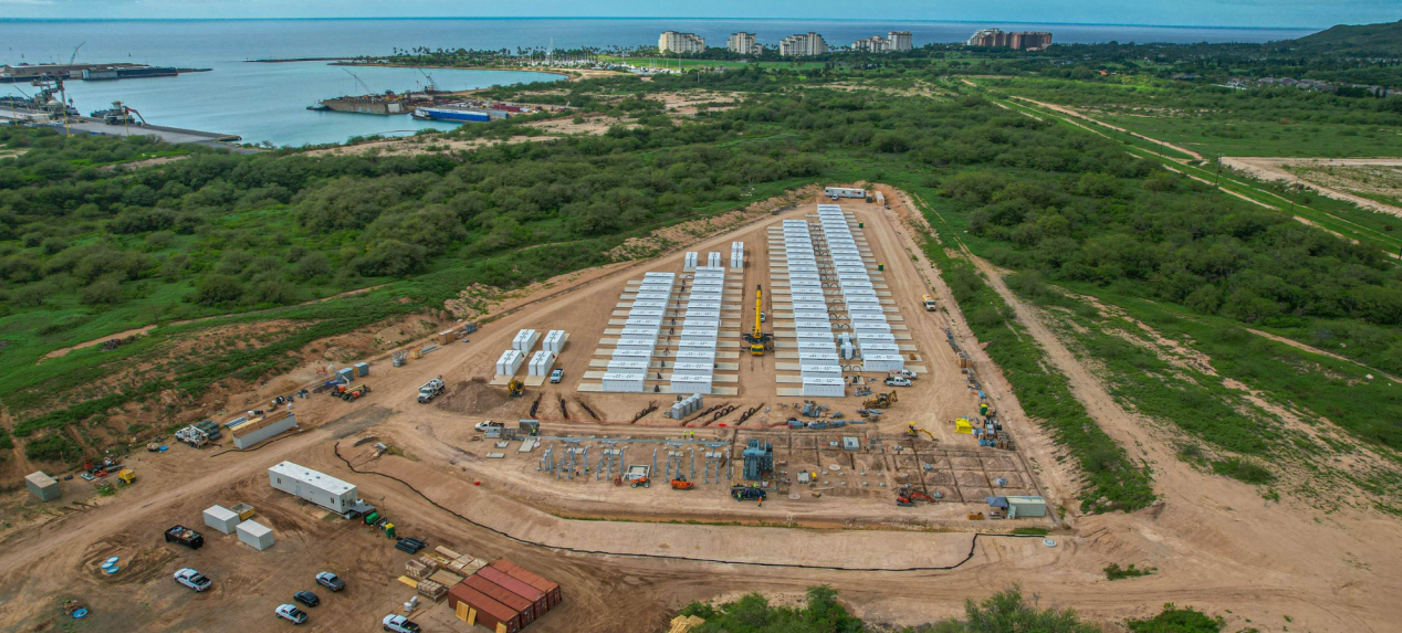
Construction at the Kapolei Energy Storage Facility on Oahu. Source: Plus Power

About the song
“Love is a Battlefield” was written by Holly Knight and Mike Chapman and appears as the fourth song on side two of Pat Benatar’s first live album, Live from Earth. It is one of two studio recordings that are on the album, both produced by Benatar’s guitarist and future husband, Neil Giraldo, with Peter Coleman at MCA/Whitney Studios in Glendale, CA. Released as a single in September 1983, it went to #1 on the Billboard Mainstream Rock and #4 on the Billboard Hot 100 Singles charts. It has been certified gold by the Recording Industry Association of America (RIAA). The video for the song features one of the funniest choreographed dance scenes outside of Billy Squire’s video for “Rock Me Tonight.” It also was one of the first music videos to feature outside dialog in it, which was quickly followed in December 1983 by the Michael Jackson “Thriller” video/mini-movie, directed by Animal House director John Landis. In a case of six degrees of separation, dialog appears again in the April 1984 music video for Twisted Sister’s “We’re Not Gonna Take It,” which features dialog from actor Mark Metcalf reinterpreting his Neidermeyer character from Animal House. Benatar’s video was nominated for an MTV Video Music Award and the song won her a Grammy Award for Best Female Rock Vocal Performance. Personnel on the record were: Pat Benatar (vocals), Neil Giraldo (guitar, sequencing, drum programs), Charlie Giordano (keyboards), Roger Capps (bass), and Myron Grumbacher (drums).
Live from Earth was recorded in 1982-83 on Benatar’s Get Nervous tour in France and California and produced by Neil Geraldo. Released in October 1983, the album went to #1 on the Billboard Rock and #13 on the Billboard 200 Albums charts and has been certified platinum by the RIAA. Two singles were released from the LP.
Pat Benatar is an American rock singer and songwriter. She signed to Chrysalis Records in 1978 and released her debut album, In the Heat of the Night, in August 1979. She has released 11 studio albums, 12 live albums, 27 compilation albums, and 40 singles. She has sold more than 35 million records worldwide. She has won three American Music Awards, four Grammy Awards, and was inducted into the Rock and Roll Hal of Fame in November 2022. She still records and tours with her husband, Neil Giraldo.







Comments
The engineering requirement that modern power grids require a large percentage of 24/7 reliable dispatchable power cannot be legislated away. California is reluctantly facing this reality. This state has 40 million people and a huge economy that would be fifth largest in the world requires huge amounts of energy and electric power. For the past two decades, the state has required about 300 terawatt-hours per year. (1 terawatt-hour is a billion kilowatt-hours.) Natural gas is the dominant energy source for in-state electricity generation. However, California also imports about 1/3 of its annual electricity consumption. California imports the greatest amount of power of any state. Unfortunately for the environment, a significant fraction of California electricity imports are from coal-fired power plants, which produce both air and water pollution. Despite large investments, many California grid-scale batteries were exhausted on September 6, 2022 during the huge heat storm from August through September. California's power grid was beginning to black out.
California also determined they need dispatchable nuclear power. California SB 846 was enacted on September 2, 2022. The CPUC will likely approve a five-year extension for the operation of Diablo Canyon nuclear Power Plant (DCPP) on December 14, 2023. For a summary, see this December 5, 2023 OpEd, https://santamariatimes.com/opinion/guest/news-to-be-thankful-for-the-diablo-canyon-extension-guest-commentary/article_6abfddc3-d1fa-50db-85ae-2af46cbde933.html To learn about the legal advocacy for DCPP extended operations by an independent nonprofit, Californians for Green Nuclear Power, please see https://cgnp.org/sb-846-update/