It has become abundantly clear over the past couple of years that energy transition isn’t going to be a straight line leading directly to abundant carbon-free power and a net-zero world. All sorts of obstacles have popped up, indicating that the energy industry’s trilemma of availability, reliability and affordability not only clash with each other, they can also conflict with environmental priorities. The challenge is being felt now in Hawaii, where a commitment to expanding energy production from renewable sources and tamping down the use of fossil fuels while also keeping prices under control and reducing pollution is turning out to be no easy feat. In today’s RBN blog, we look at Hawaii’s recent efforts to phase out coal- and oil-fired power generation, why that’s turned out to be easier said than done, and what it all means for environmental performance and energy prices.
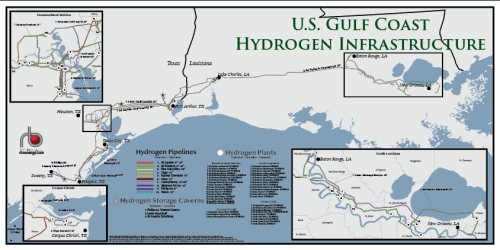
RBN’s U.S. Gulf Coast Hydrogen Infrastructure Map lays out the pipelines and merchant hydrogen plants that make up the gulf coast market, providing an unprecedented snapshot of the region’s hydrogen infrastructure network.
In many ways, Hawaii exemplifies both the ambitions and pitfalls in today’s energy landscape. The sharp contrast between the state’s environmental bounty and its energy needs is vividly exemplified at a spot called Kahe Point on the west side of Oahu, the most populous of the Hawaiian islands. Nicknamed “Electric Beach,” (yellow star in Figure 1) the area’s abundant sea life — including reef fish, sea turtles, eagle rays and even pods of spinner dolphins — attracts scores of divers and snorkelers, but much of that underwater beauty is a result of the warm water that flows from the cooling pipes that extend from a nearby power plant, which runs on fuel oil. So why does a state with such a strong environmental drive perpetuate the plant on the otherwise pristine coastline?
Let’s start with a look at where things currently stand in the Aloha State, where a transition from fossil fuels for power generation has long been a priority for environmental and economic reasons. In many ways, the energy landscape there remains a state of extremes. Even though Hawaii has the third-lowest energy consumption per capita of any state, according to Energy Information Administration (EIA) data, it uses almost seven times more energy than it produces, a result of its small size and lack of resources. (It has no oil, gas or coal reserves. Renewables are responsible for about 15% of utility-scale power generation, with imported oil responsible for nearly all the rest.) Solar power (including rooftop panels) meets about 17% of the state’s overall electricity needs, which puts it 10th overall in that category, but petroleum-based products account for about 80% of the state’s total energy consumption (including transportation), which is the highest in the U.S. And then there’s the bottom-line number that resonates with residential consumers, businesses and politicians alike: the highest electricity prices among the 50 states.
About the song
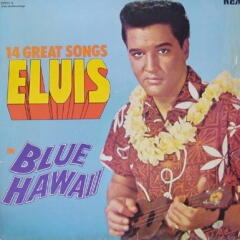
“Can’t Help Falling in Love” was written by Hugo Peretti, Luigi Creatore and George David Weiss. It appears as the fifth song on side one of Elvis Presley’s fourth soundtrack album, Blue Hawaii. The melody of the song originated in the French love song “Plaisir d’amour,” composed in 1784 by Jean-Paul-Egide Martini. “Can’t Help Falling in Love” was featured in Presley’s 1961 feature film, Blue Hawaii. Released as a single in November 1961, it went to #2 on the Billboard Hot 100 Singles chart and has been certified Platinum by the Recording Industry Association of America. The song was featured as the finale at Elvis’ concert appearances in the 1960s and ’70s. Elvis sang it in the live segment of his 1968 NBC television special and as the closing number for his 1973 live global telecast, Aloha from Hawaii. It was the last song he performed live at his final concert at Market Square Arena in Indianapolis in June 1977. Personnel on the record were: Elvis Presley (lead vocals), The Jordanaires (backing vocals), Scotty Moore, Hank Garland (electric guitar), Tiny Timbrell (acoustic guitar), Floyd Cramer (piano), Dudley Brooks (celeste), Bob Moore (acoustic bass), Hal Blaine (drums, percussion), and Alvino Rey (pedal steel guitar).
Blue Hawaii was recorded at Radio Recorders in Hollywood in March 1961 with Steve Sholes handling production duties. The soundtrack album was released in October 1961 and went to #1 on the Billboard 200 Albums chart. It has been certified 3x Platinum by the RIAA. Due to the success of this soundtrack album and its predecessor, G.I. Blues, Elvis and his manager Tom Parker would focus on Elvis’ film career and soundtrack albums for the next eight years. Two singles were released from the LP.
Elvis Presley was an American rock and roll singer and actor. Dubbed “The King,” he is regarded as an iconic cultural figure of the 20th century and one of the early pioneers that helped put rock and roll on the map. His professional career began in 1954 when he started making records for Sam Phillips’ Sun Records in Memphis. He released 23 studio albums, eight live albums, 13 compilation albums, 18 soundtrack albums, 19 EPs, and 117 singles. He has sold more than 500 million records worldwide. He starred in thirty-three motion pictures. Elvis won three Grammy Awards, a Grammy Lifetime Achievement Award, and is a member of the Rock and Roll Hall of Fame. He has a star on the Hollywood Walk of Fame, and was posthumously awarded the Presidential Medal of Freedom in 2018. Elvis Presley died at his Graceland home in Memphis in August 1977 at the age of 42.