Tariffs have served as a cornerstone of President Trump’s economic vision. In the campaign, he said he could impose tariffs as high as 25% on all imported goods from Canada — including crude oil — and he could deliver on that promise at any time. This has raised concerns, especially for Canadian producers and U.S. refiners, who depend on the efficient and economical movement of barrels between the trading partners. In today’s RBN blog, we look at how much Canadian crude oil flows to the U.S., how those imports could be affected by tariffs, and how Canadian producers and U.S. refiners would share the financial impact.
President Trump’s initial wave of executive orders (EOs) included some directly aimed at U.S. energy and trade policy (see Brand New Day). One of his first EOs directed federal agencies to investigate trade practices, including the U.S.-Mexico-Canada Agreement (USMCA), which replaced the North American Free Trade Agreement (NAFTA) and was signed by Trump in 2020. The president had indicated during the campaign that he could institute a tariff of up to 25% on all imported goods from Canada and Mexico on Day 1 of his administration in response to what he has called the failure of both countries to curb the flow of people and drugs across the border. The tariffs haven’t happened yet, but White House buzz this week suggested they could go into effect as soon as Saturday, February 1.
While the tariffs could be in place soon, it’s not a done deal and things could change quickly. For instance, in his first week in office, President Trump threatened 25% tariffs on Colombia if the country didn’t accept U.S. flights carrying deported migrants. Ten hours after that threat, Colombian President Gustavo Petro agreed to accept the flights and Trump changed his mind on the tariffs. However, Trump has said for months that he has his sights set on Canada and Mexico, and it is unclear if he can reach deals with those countries that could prevent the tariffs. Our focus today is on Canada, as the impact of tariffs on Mexico would be less severe for U.S. refiners. Mexico has long planned to lower its exports to the U.S. and send more of its oil to its new refinery, Dos Bocas (see Here, I Go Again).
Oh, Canada
When it comes to U.S. energy markets, the largest impact of Trump’s tariffs would be on Canadian crude oil imports. As we discussed in Why Can’t We Be Friends?, Canada (pink layer in Figure 1 below) supplied an average 4.2 MMb/d to the U.S. in the first 10 months of 2024, or 62% of total U.S. imports, with imports from other non-OPEC countries (tan layer) and from OPEC (blue layer) in distant second and third place at 1.5 MMb/d and 1 MMb/d, respectively. Most of those Canadian imports flowed to U.S. refineries in PADD 2 (Midwest), many of which are configured specifically to process large volumes of heavy Canadian crude. Smaller amounts were piped to refineries in PADD 4 (Rockies) and PADD 5 (West Coast) and to refineries and export docks in PADD 3 (Gulf Coast).
These refineries are configured to process heavy, sour crude blends such as Western Canadian Select (WCS), the highest-volume crude imported from Canada into the U.S. A 25% tariff would impact the cost of crude oil for these refineries. But the tariff would also impact the price that Canadian producers could get for their crude.
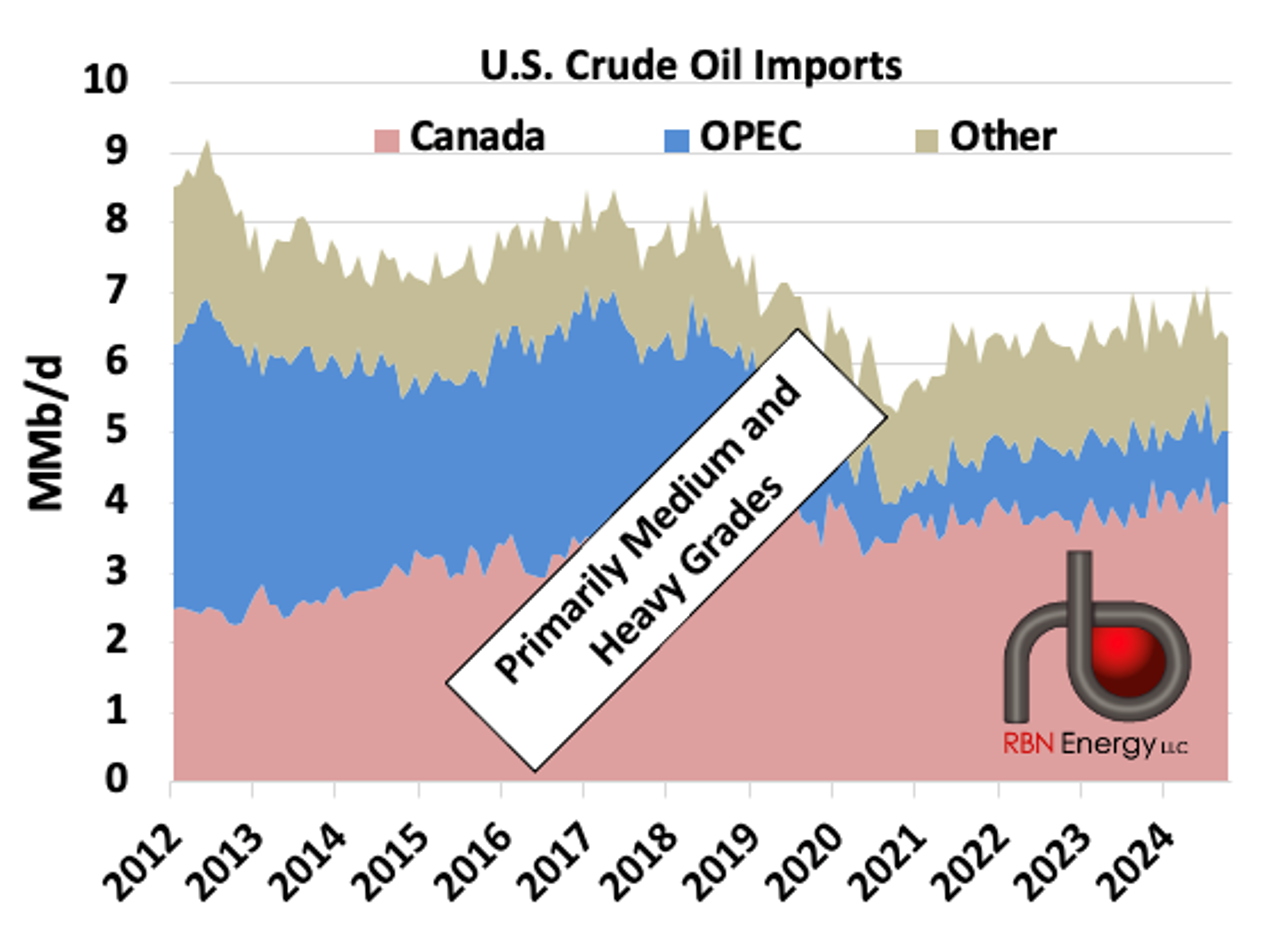
Figure 1. U.S. Crude Oil Imports by Source. Source: RBN Note: Data for 2024 is for January Through October.

About the song
“Everybody Hurts” was written by Bill Berry, Peter Buck, Mike Mills and Michael Stipe. It appears as the fourth song on side one of R.E.M.’s eighth studio album, Automatic for the People. R.E.M. guitarist Peter Buck has said of the song, “It was aimed at teenagers, the idea that high school is a portal to hell seems pretty realistic to me.” It has gone on to be known as a melancholy look at comfort during loss and pain. Released as a single in April 1993, it went to #29 on the Billboard Hot 100 Singles chart. A video of the song directed by Jake Scott featured the band and a crowd of people stuck in a traffic jam as subtitles of their thoughts flashed across the screen. At the end everyone leaves their cars and walks, then disappear. The video received heavy rotation on MTV at the time. Personnel on the record were: Michael Stipe (lead vocals), Peter Buck (guitars), Mike Mills (bass, keyboards, backing vocals), Bill Berry (drums, percussion, backing vocals), John Paul Jones (orchestral arrangements), Denise Berginson-Smith, Lonnie Ottzen, Patti Gouvas, Sandy Salzinger, Sou-Chun Su, Jody Taylor (violin), Reid Harris, Paul Murphy, Heidi Nitchie (viola), Kathleen Lee, Daniel Laufer, Elizabeth Proctor Murphy (cello), Deborah Workman (oboe), and George Hanson (conductor).
Automatic for the People was recorded between June 1991 and July 1992 at Bearsville in Woodstock, NY; Criteria in Miami; John Keane in Athens, GA; Kingsway in New Orleans; and Bosstown in Atlanta. Produced by Scott Litt and R.E.M., it was released in October 1992 and went to #2 on the Billboard 200 Albums chart. It has been certified 4x Platinum by the Recording Industry Association of America. Six singles were released from the LP.
R.E.M. was an American alternative rock band formed in Athens, GA, in 1980 by drummer Bill Berry, guitarist Peter Buck, bassist Mike Mills, and vocalist Michael Stipe when they were students at the University of Georgia. They released their first single, “Radio Free Europe,” in 1981. They released 15 studio albums, five live albums, one soundtrack album, 16 compilation albums, six EPs and 63 singles. They have sold more than 90 million records worldwide. R.E.M. has won four BMI Awards, two Billboard Music Awards, three Brit Awards, three Grammy Awards, and 12 MTV Video Music Awards, and was inducted into the Rock and Roll Hall of Fame in March 2007. The band broke up amicably in 2011 with all four members going on to do successful solo projects.