President-elect Trump’s plan to impose a 25% tariff on all imported goods from Canada and Mexico — including crude oil — has raised concern among U.S. refiners, many of which depend heavily on those imports and would face serious challenges in replacing them. The question is, given that dependence and the incoming administration’s pledge to reduce energy costs, will refiners — and oil producers in Canada and Mexico — succeed in their efforts to exempt crude oil from the tariff plan? In today’s RBN blog, we discuss the degree to which U.S. refineries incorporate Canada- and Mexico-sourced oil in their crude slates, the potentially devastating impacts of a tariff on Canadian crude in particular, and the odds for and against U.S. tariffs on oil imports from its neighbors.
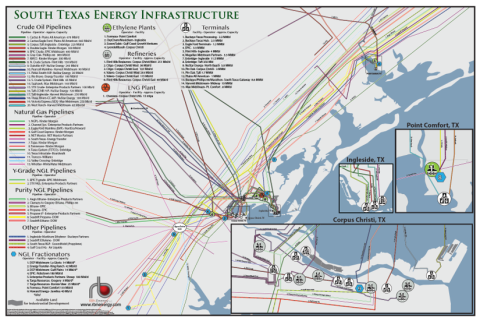
RBN Energy’s South Texas Energy Infrastructure Map brings together all the pieces of the critical and complex puzzle of the greater Corpus Christi region. Spanning from Point Comfort, TX to Corpus Christ, TX and south of the Agua Dulce natural gas hub, the map details the processing, transportation and export facilities in RBN Energy’s classic clear, concise and easy to comprehend style.
It’s been a busy few weeks for the Trump 2.0 transition team. Just days after his reelection on November 5, the once and future president put forward Doug Burgum, governor of North Dakota (#3 among the states in U.S. oil production) as his Interior Secretary and Chris Wright, founder and CEO of Liberty Energy (a leading hydraulic fracturing and proppant sand logistics company) as his Energy Secretary designee. Both are viewed as strong advocates of expanded U.S. energy production. But on November 25, President-elect Trump said that on January 20, 2025 — his first day in office — he would impose a 25% tariff on all imported goods from Canada and Mexico, including crude oil and natural gas. The incoming president added that he would keep the tariffs in place until the U.S.’s neighbors to the north and south stopped the flow of illegal drugs (especially fentanyl) and illegal immigrants.
Canada
The potential impact of a big bump-up in the delivered cost of imported Canadian crude in particular is enormous. From 2009 to 2023 — a 15-year period during which production soared in both U.S. shale plays and the Alberta oil sands — U.S. imports of Canadian crude doubled, from just over 1.9 MMb/d to nearly 3.9 MMb/d, according to the Energy Information Administration (EIA). As shown by the dark-red bar segments in Figure 1 below, the vast majority of Canadian imports have flowed to refineries in PADD 2 (Midwest), a number of which have upgraded their operations to enable the refining of favorably priced, harder-to-process, heavy (low-API) crude oils like those produced in the oil sands. Smaller volumes of Canadian crude are either piped, railed or transported by marine vessels to refineries in PADDs 1 (East Coast), 3 (Gulf Coast), 4 (Rockies) and 5 (West Coast). While refineries in PADD 4 are also highly dependent on crude imports from Canada, most crude imports into PADDs 1, 3 & 5 are from other sources (gray bar segments).
U.S. Imports of Crude Oil by Origin in 2023 (in MMb/d)
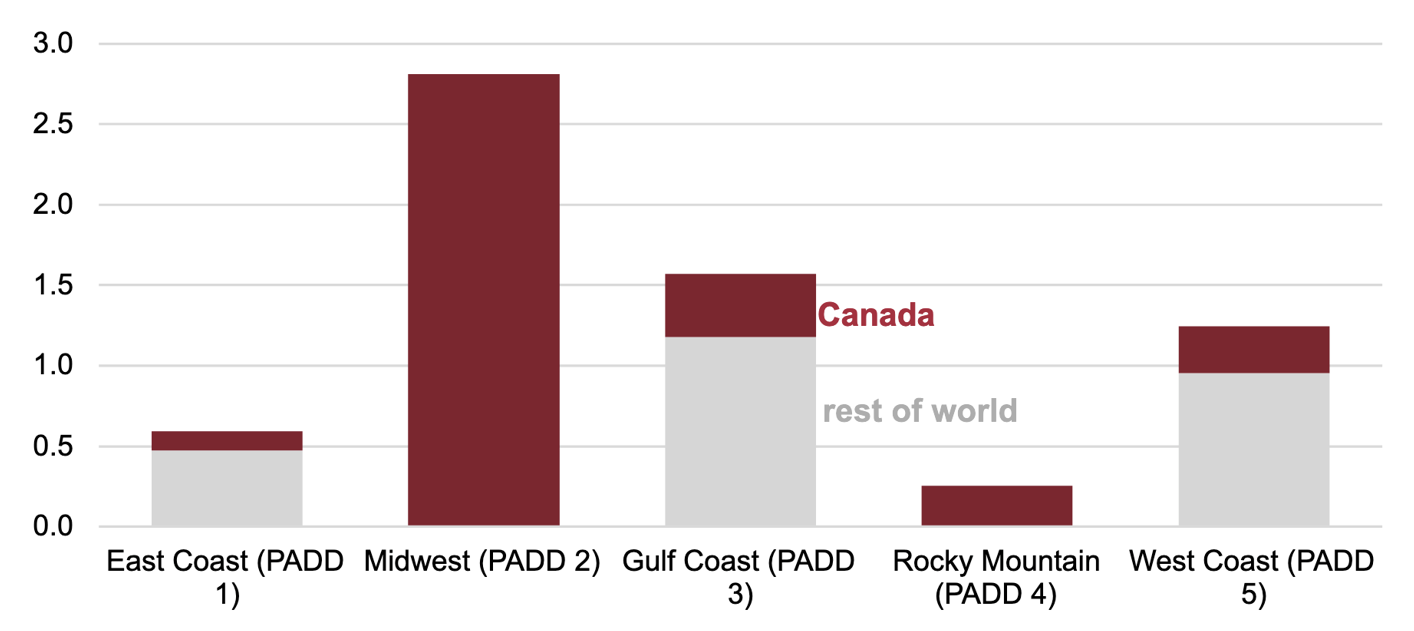
Figure 1. U.S. Imports of Crude Oil by Origin in 2023 (in MMb/d). Source: EIA
About the song
“Why Can’t We Be Friends?” is a hit single by the funk band War off their 1975 album of the same name. The song, written by the group, rose to #6 on the U.S. Billboard Hot 100 and #9 on the U.S. Billboard R&B chart. The personnel on the recording are: Papa Dee Allen (percussion and vocals), Harold Ray Brown (drums and vocals), B.B. Dickerson (bass and vocals), Lonnie Jordan (keyboards and vocals), Charles Miller (sax and vocals), Lee Oskar (harmonica and vocals), and Howard E. Scott (lead vocals and guitar).
“Why Can't We Be Friends?” has been used in a number of television shows, movies, and commercials over the years. It was played in outer space when NASA beamed it to the linking of Soviet cosmonauts and U.S. astronauts for the Apollo-Soyuz Project. The Why Can’t We Be Friends? album also included the hit “Low Rider.”
War started as a world music R&B unit from Long Beach, CA. The group was discovered by producer Jerry Goldstein and singer Eric Burdon (The Animals) while playing at the Rag Doll nightclub in North Hollywood, CA, in 1969. Goldstein signed them to a management/production deal, and Burdon used them as his backup band for two albums. The first, Eric Burdon Declares War, yielded the big hit, “Spill the Wine.” Eric Burdon and War have the distinction as being the last band that played with Jimi Hendrix, as Hendrix joined them at their gig at Ronnie Scott’s club in London for a rousing jam on the song “Tobacco Road” the night before he passed away. War went off on their own in 1971 and released their first album (entitled War) the same year. The group’s most successful album was their fifth LP, The World Is a Ghetto, which went to #1 on the U.S. Billboard Album & R&B charts and yielded the hit singles “The Cisco Kid” and “The World Is a Ghetto.” The LP was listed as Billboard’s #1 album of 1973.
War has released 18 studio albums (Including the two with Eric Burdon), three live albums, seven compilation albums and 60 singles during their career so far. Lonnie Jordon, the only member from the original band, still tours with other musicians under the War name.