



The vast potential for permanently storing carbon dioxide underground by using it for enhanced oil recovery can only be realized if produced or captured CO2 can be economically transported long distances via pipeline. And the only way that can happen is if the CO2 is compressed into a “supercritical” or “dense-phase” fluid — a state that is somewhat compressible like a gas but flows and can be pumped like a liquid. When CO2 is in a supercritical state, much more of it can economically flow through a pipeline to the producing field. And when it gets there, the dense-phase CO2 can be injected into an oil production zone, where it has the unique ability to flow through permeable rock formations, bond with and “swell” trapped oil molecules, and free the oil to move to the production well, then up to the surface. Given that CO2-based EOR is destined to become a much more significant activity in the energy industry, it’s time for a fun-filled review of the thermodynamics of fluids as it relates to the transportation of CO2 and its use in the production of crude oil. (Wait! Don’t leave! This will be easy to follow! We promise!) Today, we continue our series on the rapidly evolving CO2 market and why it matters to crude oil producers.
As we said in Part 1 of this blog series, CO2 sequestration is the permanent storage of CO2 deep below ground in rock formations, oil and gas reservoirs, coal seams, etc. If the CO2 is captured and stored, and that’s all, the process is called CCS (Carbon Capture and Storage). On the other hand, if the CO2 is used for some other process before it’s stored, it is called CCUS (Carbon Capture, Use, and Storage). EOR is a form of CCUS, and a very economic one at that. In EOR, CO2 is pumped into the production zone of an otherwise depleted oil field, then mixes with and frees the oil that has been left behind. Some of the CO2 used in this process stays underground, permanently trapped in the reservoir. The rest of the CO2 comes out of the ground mixed with the oil, then is separated and recycled back into the field — a process that goes on until all the original CO2 used is trapped beneath the surface.
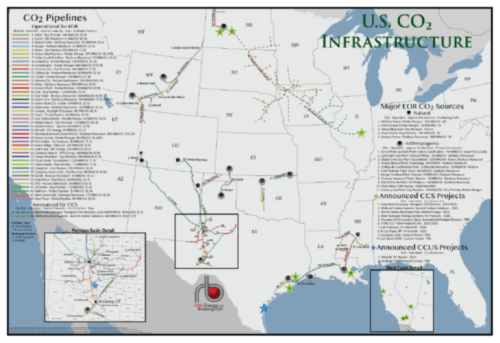
RBN Energy’s US CO₂ Infrastructure map brings together legacy Enhanced Oil Recovery (EOR) assets, as well as announced large-scale Carbon Capture and Sequestration (CCS) and Carbon Capture, Utilization and Sequestration (CCUS) projects, all in our signature concise, accurate, and intelligible style.
We also pointed out the paradox that while the CO2 stored underground in the U.S. through EOR accounts for most of the CO2 sequestered globally, much of the CO2 used for EOR is tapped from natural CO2 reservoirs and piped to oil fields. In other words, it’s taken out of the ground to be put back in the ground, with no net impact on U.S. CO2 emissions. Switch to man-made or “anthropogenic” CO2 (a.k.a. A-CO2) as the source, though, and expanded use of EOR could have a game-changing impact. In Part 2, we did deep dives both into how the CO2/EOR process works, and the economics driving the use of the process. In Part 3, we shifted our focus to CO2 sourcing and the CO2 pipeline networks that have been developed to transport both produced and captured CO2 to oil fields for EOR, as well as to other sequestration sites.

About the song
"The Air That I Breathe" was written by Albert Hammond and Mike Hazlewood. It originally appeared as the 10th cut on Albert Hammond's 1972 debut album, It Never Rains in Southern California. The album went to #77 on the Billboard Top 200 Albums chart. Three singles were released from the LP.
The Hollies recorded the song in 1973, and it appears as the fifth song on side one of The Hollies' 14th studio album, Hollies. Recorded at EMI Studio in London in 1973, it was released as a single in the U.S. in March 1974 and went to #6 on the Billboard Hot 100 Singles chart. Personnel on the record were: Allan Clarke (lead vocals), Tony Hicks (lead guitar, backing vocals), Terry Sylvester (rhythm guitar, backing vocals), Bobby Elliott (drums), Bernie Calvert (bass, keyboards), and Chris Gunning (orchestral arrangements). In 1992, Radiohead had a hit with "Creep," a song with a similar chord progression and melodic content as "The Air That I Breathe." The publisher of the older song sued Radiohead and a settlement was reached under which songwriters Hammond and Hazlewood were given co-writing credits and a portion of the royalties. Many artists have covered "The Air That I Breathe" over the years, including Simply Red, K.D. Lang, Olivia Newton-John, and The Mavericks.
The LP Hollies was produced by The Hollies and Ron Richards. Released in March 1974, it went to #28 on the Billboard Top 200 Albums chart.
The Hollies are a British rock band formed in 1962 in Manchester, England, by Allan Clarke and Graham Nash. They, along with The Rolling Stones, are among the few UK rock groups from the early '60s that have never disbanded. The Hollies have released 21 studio albums, 22 compilation albums, seven EPs, and 67 singles. The band was inducted into the Rock and Roll Hall of Fame in 2010. Nineteen members have passed through the band's ranks since its formation. Original member Tony Hicks and longtime member Bobby Elliott lead a touring version of The Hollies today.






Comments
Great blog today. But you did not comment on an obvious question. What happens when the high pressure super-critical CO2 cools to about 82F, while in the pipe. Yes, it converts to the liquid phase. But, does this harm anything, make it harder to pump, etc? As you know, the pipeline is often buried in the ground, where the temperature is below 82F, so this is a likely occurence, especially if the pipeline shuts off flow for a period of time. Any issues if this happens?
With Supercritical temps north of 90F, are most long-haul CO2 pipes insulated?