


Significantly reducing greenhouse gas emissions is an all-hands-on-deck kind of thing. More wind power? More solar? Electric vehicles? Yes, yes, and yes. Another great way to slash GHGs is to use man-made or “anthropogenic” carbon dioxide for enhanced oil recovery. EOR is an extraordinarily efficient way to permanently store CO2 deep underground. And today, the economics for EOR are being turned on their head — in a good way. For decades, the acquisition of CO2 has been a significant cost for EOR operators, requiring volumes to be produced from natural geological formations and then to be pumped to the oil fields where the CO2 is used. But things are changing. Now companies are planning to spend big bucks to capture and dispose of their CO2, meaning they may be paying someone to get rid of it. And if they pay, that flips CO2 from an operator cost to a revenue stream. The implications are profound, with operators historically motivated to use CO2 as efficiently as possible set to morph their operations to use as much CO2 as can be safely sequestered. In today’s blog, we continue our series on CO2-based EOR by looking at the coming transition in CO2/EOR economics.
This is Part 6 of our deep-dive blog series into CO2, which accounts for over 70% of all GHGs and is therefore the #1 target in global efforts to reduce emissions. Our goal is not to debate the politics around CO2 or the climate impact of CO2 emissions, but instead to develop a solid understanding of the science involved, to separate the reality from the hype, and to quantify what investments are really being made to reduce CO2 emissions, focusing primarily on CO2 sequestration, especially via EOR.

Canadian crude output is rising, requiring new export routes. As traditional pathways face constraints, the U.S. Rockies—especially the Guernsey, WY hub—are emerging as key corridors for moving Canadian heavy crude to downstream markets, including the Gulf Coast.
As we said in Part 1, CO2 sequestration is the permanent storage of CO2 deep below ground in rock formations, oil and gas reservoirs, coal seams, etc. If the CO2 is captured and stored, and that’s all, the process is called CCS (Carbon Capture and Storage). If the CO2 is used for some other process before it’s stored, it is called CCUS (Carbon Capture, Use, and Storage). As it turns out, EOR is a very economic form of CCUS. In EOR, CO2 is pumped into the production zone of an otherwise depleted oil field, where it mixes with and frees the oil that has been left behind. Some of the CO2 used in this closed loop process stays underground, permanently trapped in the reservoir. The rest of the CO2 comes out of the ground mixed with the oil. It is then separated and recycled back into the field — a process that goes on until all the original CO2 used is trapped beneath the surface. We’ll get back to recycled CO2 in a minute.
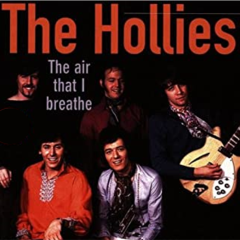
About the song
"The Air That I Breathe" was written by Albert Hammond and Mike Hazlewood. It originally appeared as the 10th cut on Albert Hammond's 1972 debut album, It Never Rains in Southern California. The album went to #77 on the Billboard Top 200 Albums chart. Three singles were released from the LP.
The Hollies recorded the song in 1973, and it appears as the fifth song on side one of The Hollies' 14th studio album, Hollies. Recorded at EMI Studio in London in 1973, it was released as a single in the U.S. in March 1974 and went to #6 on the Billboard Hot 100 Singles chart. Personnel on the record were: Allan Clarke (lead vocals), Tony Hicks (lead guitar, backing vocals), Terry Sylvester (rhythm guitar, backing vocals), Bobby Elliott (drums), Bernie Calvert (bass, keyboards), and Chris Gunning (orchestral arrangements). In 1992, Radiohead had a hit with "Creep," a song with a similar chord progression and melodic content as "The Air That I Breathe." The publisher of the older song sued Radiohead and a settlement was reached under which songwriters Hammond and Hazlewood were given co-writing credits and a portion of the royalties. Many artists have covered "The Air That I Breathe" over the years, including Simply Red, K.D. Lang, Olivia Newton-John, and The Mavericks.
The LP Hollies was produced by The Hollies and Ron Richards. Released in March 1974, it went to #28 on the Billboard Top 200 Albums chart.
The Hollies are a British rock band formed in 1962 in Manchester, England, by Allan Clarke and Graham Nash. They, along with The Rolling Stones, are among the few UK rock groups from the early '60s that have never disbanded. The Hollies have released 21 studio albums, 22 compilation albums, seven EPs, and 67 singles. The band was inducted into the Rock and Roll Hall of Fame in 2010. Nineteen members have passed through the band's ranks since its formation. Original member Tony Hicks and longtime member Bobby Elliott lead a touring version of The Hollies today.





Comments