There’s a fresh breeze blowing through the energy patch. Oil and gas companies seem to have turned a corner and are piling on the climate change bandwagon. They’re talking green, walking green, and many are in hot pursuit of government subsidies and tax breaks that are here today, with expectations that more incentives are on the way. Carbon dioxide is their primary target — it’s by far the most prevalent greenhouse gas and technologies already exist for permanently depositing captured CO2 deep underground. In fact, the U.S. is #1 in the world at this, accounting for about 80% of all the CO2 being stored globally. But it may surprise you to learn that much of the CO2 being squirreled away for eternity isn’t captured from industrial processes or exhaust. Instead, a lot of it comes from CO2 reservoirs in Colorado and New Mexico, tapped on purpose to bring vast volumes of CO2 to the surface. Why? So that CO2 can be put right back into the ground. Sound crazy? Well, it’s not. In the blog series we begin today, we explore the rapidly evolving CO2 market and the huge opportunities that await those with the ambition to pursue them.

Crude Oil TradeView provides up-to-date data and insights into the behavior of differentials for 33 crude assessments across North America. Each week, it also walks you through the reasoning of why differentials widen, narrow, flip (premium vs. discount), or blow out.
There are two ways to reduce CO2 emissions: produce less CO2 (Method 1) or make existing or newly produced CO2 go away (Method 2). Both approaches are important. For example, regarding Method 1, generating more power from renewable sources like wind and solar means you can ratchet down the need for fossil-fired power, reducing CO2 production in the process. Similarly, the shift to electric vehicles like the new Lightning version of Ford’s F-150 pickup will produce less CO2 than internal combustion engines do today. As we all know, these and many more Method 1 initiatives are in the works.
On the flip side, it’s going to be very costly to use Method 1 to reduce CO2 production from some sources — think processes like steelmaking, petrochemical crackers, cement plants, and ethanol production. These industries are not going away, but they inherently produce a lot of CO2. Generally speaking, it will make more sense to make the CO2 generated by these industries disappear than to remake their processes from the ground up. That’s where Method 2 comes in. Let those plants go ahead and generate CO2 but then capture and sequester it. That’s just a fancy word that means to store it away — permanently. There are many ways to do that, including planting trees to absorb CO2 out of the air through photosynthesis. But practically speaking, the only viable way to sequester a meaningful fraction of the humongous volumes of CO2 being emitted is to pump it into geological formations deep under the surface. (By the way, in the next blog in this series, we’ll put some real numbers around that measure of mass quantities — take it on faith for now that “humongous” applies.)
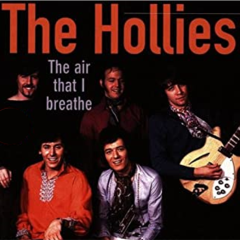
About the song
"The Air That I Breathe" was written by Albert Hammond and Mike Hazlewood. It originally appeared as the 10th cut on Albert Hammond's 1972 debut album, It Never Rains in Southern California. The album went to #77 on the Billboard Top 200 Albums chart. Three singles were released from the LP.
The Hollies recorded the song in 1973, and it appears as the fifth song on side one of The Hollies' 14th studio album, Hollies. Recorded at EMI Studio in London in 1973, it was released as a single in the U.S. in March 1974 and went to #6 on the Billboard Hot 100 Singles chart. Personnel on the record were: Allan Clarke (lead vocals), Tony Hicks (lead guitar, backing vocals), Terry Sylvester (rhythm guitar, backing vocals), Bobby Elliott (drums), Bernie Calvert (bass, keyboards), and Chris Gunning (orchestral arrangements). In 1992, Radiohead had a hit with "Creep," a song with a similar chord progression and melodic content as "The Air That I Breathe." The publisher of the older song sued Radiohead and a settlement was reached under which songwriters Hammond and Hazlewood were given co-writing credits and a portion of the royalties. Many artists have covered "The Air That I Breathe" over the years, including Simply Red, K.D. Lang, Olivia Newton-John, and The Mavericks.
The LP Hollies was produced by The Hollies and Ron Richards. Released in March 1974, it went to #28 on the Billboard Top 200 Albums chart.
The Hollies are a British rock band formed in 1962 in Manchester, England, by Allan Clarke and Graham Nash. They, along with The Rolling Stones, are among the few UK rock groups from the early '60s that have never disbanded. The Hollies have released 21 studio albums, 22 compilation albums, seven EPs, and 67 singles. The band was inducted into the Rock and Roll Hall of Fame in 2010. Nineteen members have passed through the band's ranks since its formation. Original member Tony Hicks and longtime member Bobby Elliott lead a touring version of The Hollies today.