


You might think that surplus gas storage space from a massive overbuild in the 2000s and a noteworthy 119 Bcf of already-sanctioned salt cavern projects along the Gulf Coast would be more than enough to meet the increasing needs of LNG exporters, power generators and others in the region. But gas storage customers have indicated that they will need still more capacity by the early 2030s and, in response, another 212 Bcf of salt cavern storage capacity is nearing final investment decisions (FIDs) by their developers. In today’s RBN blog, we’ll highlight elements of our new Drill Down Report on the ongoing gas storage boom in Texas, Louisiana and Mississippi.
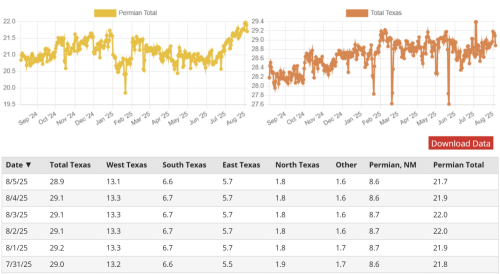
The NATGAS Production Tracker - Texas provides a DAILY update of natural gas production in Texas the New Mexico side of the Permian Basin. Quickly and easily view today’s supplies in the Lone Star state and download the full historical table when you need it.
Just a few years ago, gas storage capacity along the Gulf Coast was widely available at low cost, but that has all changed. The operators of existing and planned LNG export terminals have locked up most of the old storage surplus and much of the incremental storage capacity on the drawing boards. More storage is needed, and the scale is enormous.
There are several drivers behind this ongoing, multibillion-dollar buildout, chief among them (1) the proliferation of new and expanded LNG export terminals along the Gulf Coast and (2) terminal operators’ need for a place to quickly store large volumes of gas in the event of a liquefaction plant outage. This is key: Without nearby storage capacity to serve as an at-the-ready buffer for gas supply, terminals could expose themselves to major financial losses, either by not having the gas they need to operate or, even more ominously, by being forced to dump billions of cubic feet of gas into the market during an outage event. In essence, gas storage serves as relatively low-cost insurance.

About the song
“Green Light” was written by Ella Yelich-O'Connor (Lorde), Jack Antonoff and Joel Little, and appears as the first song on Lorde’s second studio album, Melodrama. The up-tempo dance tune explores the liberating process of moving on from a failed relationship. Lorde wrote the song after her long-term relationship with New Zealand fashion photographer James Lowe ended. Released as a single in March 2017, it went to #19 on the Billboard Hot 100 Singles chart and has been certified 2X Platinum by the Recording Industry Association of America (RIAA). The song was a major point of reference for the teenagers in the Tony Award-nominated Broadway play John Proctor Is the Villain, written by Kimberley Bellflower. Personnel on the record were: Lorde (vocals), Jack Antonoff (keyboards, programming), and Frank Dukes, Kuk Harrell, Laura Sisk, John Haynes, and Seron Ghenea (programming, production).
Melodrama was recorded between 2015 and 2017 at Electric Lady, Rough Customer, and Jungle City in New York City, and Westlake and Conway in Los Angeles. It was produced by Lorde, Jack Antonoff, Frank Dukes, Malay, Joel Little and Andrew Wyatt. Released in June 2017, it went to #1 on the Billboard 200 Albums chart and has been certified Platinum by the RIAA. Three singles were released from the LP.
Lorde (Ella Marija Lani Yelich-O’Connor) is a New Zealand singer-songwriter known for her introspective alternative pop songs. At 16, she released her debut EP, The Love Club EP, in November 2012. Her debut single from the EP, “Royals,” went to #1 on the Billboard Hot 100 Singles chart and won two Grammy Awards. Lorde has released four studio albums, a soundtrack album, four EPs and 16 singles. and has sold over 18 million records worldwide. She has won two Billboard Music Awards, two Brit Awards, two Grammy Awards, one MTV Video Music Award and three World Music Awards. She continues to record and tour. Her last studio album, Virgin, was released in June 2025, and was supported by the Ultrasound World Tour, which concluded in September in Esch-sur-Alzette, Luxembourg.
"About the Song" -- written by Mickey McMahan , RBN Director of Musicology