Leading international shipping associations and many of the large shipowners they represent are pressing the International Maritime Organization (IMO) to take a much more aggressive approach to decarbonizing their industry, and calling for a $100/metric ton fee on carbon dioxide emissions from ships to spur investment in no-carbon propulsion systems. In effect, shipowners—themselves under pressure from their large, ESG-minded customers, are telling the IMO that its goals of reducing global shipping’s carbon intensity by 40% by 2030 and total greenhouse gas emissions by 50% by 2050 are far too timid. They are insisting that the IMO set the industry on a course to quickly ramp down its carbon dioxide emissions in the 2020s and achieve net-zero CO2 emissions by mid-century. If the shipowners prevail, it could result in the phase-out of hydrocarbon-based bunker fuel in favor of low-carbon alternatives like ammonia, hydrogen, and electric batteries. In today’s RBN blog, we begin a review of the big changes ahead for global bunker fuel and what they mean for oil and gas producers and refiners.
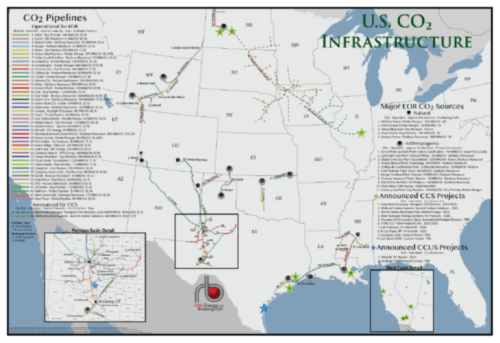
RBN Energy’s US CO₂ Infrastructure map brings together legacy Enhanced Oil Recovery (EOR) assets, as well as announced large-scale Carbon Capture and Sequestration (CCS) and Carbon Capture, Utilization and Sequestration (CCUS) projects, all in our signature concise, accurate, and intelligible style.
It was only two years ago that international shipowners were making final preparations for the January 1, 2020, implementation of IMO 2020, a long-anticipated rule by the IMO — a specialized agency of the United Nations — that mandated a nearly 90% reduction in sulfur dioxide (SO2) emissions by the 50,000-plus tankers, dry bulkers, container ships, tankers, cruise ships, and other commercial vessels plying international waters. As we said in our blog, All Around The World, just days before the new rule took effect, there was a lot of concern that, despite the efforts by refineries to produce more ultra-low-sulfur bunker fuel, there might be major shortages and price spikes. There weren’t, and within a few weeks of implementation day it became clear that IMO 2020 was the least of the world’s problems.
Now, with the COVID-19 pandemic seemingly on the wane and the global economy rebounding, the shipping industry’s immediate focus is on returning things to normal, mostly by reducing the backlogs of large container ships waiting to dock and unload at major ports around the world. At the same time, however, many leading shipping companies have been setting ambitious ESG-related goals for themselves, and urging the industry as a whole to step up its game on the climate front. Global shipping accounts for an estimated 2.5% to 3% of total greenhouse gas (GHG) emissions. The IMO, which sets emissions and other rules for global shipowners, in 2018 laid out an “initial strategy” of cutting ships’ CO2 emissions by 40% from their 2008 levels by 2030; cutting total GHGs by 50% (again from their 2008 levels) by 2050; and setting a goal of eliminating or fully offsetting GHG emissions by the end of the century. More specifically, the three-year-old plan calls for improving the efficiency of ship engines, reducing vessel operating speed (to improve their “miles-per-gallon” and thereby reduce their CO2 emissions per mile), and encouraging the use of alternative fuels (LNG, LPG, methanol, hydrogen, ammonia, and biofuels).
About the song
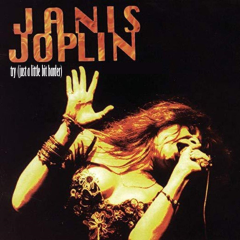
“Try (Just a Little Bit Harder)” was written by Jerry Ragovoy and Chip Taylor. The song appears as the first cut on side one of Janis Joplin's debut solo album, I Got Dem Ol' Kozmic Blues Again Mama! The tune was first recorded by soul artist Lorraine Ellison and appeared on her 1966 album, Stay With Me. “Try” was released as a single by Joplin, backed with “One Good Man” in early 1970, but failed to make the Billboard charts. Personnel on the record were: Janis Joplin (lead vocals, acoustic guitar), Sam Andrews (electric guitar, backing vocals), Brad Campbell (bass), Richard Kermode and Gabriel Mekler (keyboards), Maury Baker and Lonnie Castille (drums), Terry Clements (tenor sax), Snooky Flowers (baritone sax, backing vocals), and Luis Gasca (trumpet).
I Got Dem Ol' Kozmic Blues Again Mama! was recorded at Columbia Records Studios in New York City in June 1969. Produced by Gabriel Mekler, the album was released in September 1969. It went to #5 on the Billboard Top 200 Albums chart, and has been certified Platinum by the Recording Industry Association of America. It was the first album Joplin recorded after leaving her band, Big Brother and the Holding Company, and would be the only solo LP released during her lifetime. Three singles were released from the LP.
Janis Joplin was an American singer and songwriter. Joplin got her first professional big break after appearing with Big Brother and the Holding Company at the Monterey Pop Festival in 1967. She released four studio albums, seven live albums, 14 compilation albums, and 13 singles. She has a Grammy Lifetime Achievement Award and is a member of the Rock and Roll Hall of Fame. Joplin died in October 1970 at the age of 27.