


The international shipping industry’s push to significantly reduce its carbon footprint over the next three decades is raising an obvious question: Is there a zero- or low-carbon bunker fuel that meets all of the industry’s basic criteria — things like availability, safety, and relative economy, not to mention sufficient on-board energy to transport massive, city-block-sized vessels thousands of miles at a clip. There is no clear answer yet, but there is a lot of talk about ammonia, or more specifically ammonia produced in a way that either generates no carbon dioxide (CO2) or that captures and sequesters much of the CO2 that is generated during production. But several major challenges must be met before “green” and “blue” ammonia can lay claim to even a small slice of the bunkers market, as we discuss in today’s RBN blog.
This is the third blog in our series on efforts to reduce emissions of CO2 and other greenhouse gases (GHG) in the shipping industry, which accounts for about 3% of global GHG emissions. In Part 1, we looked at the push by leading international shipping associations and many large shipowners (particularly the large container operators) to have the International Maritime Organization (IMO) ratchet up the industry’s decarbonization goals. In effect, shipowners — themselves under pressure from their large, ESG-minded customers, shareholders, and lenders — are telling the IMO that its goals of reducing global shipping’s carbon intensity (CI) by 40% from its 2008 level by 2030 and total GHG emissions by 50% by 2050 are too timid. They want the IMO to set a more aggressive CI-reduction target for 2030 as well as a goal of eliminating or fully offsetting GHG emissions by mid-century.
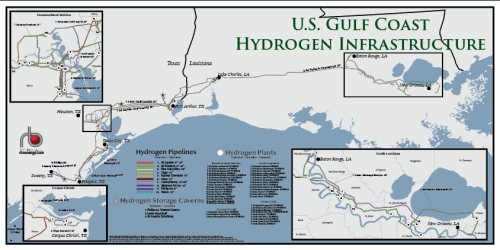
RBN’s U.S. Gulf Coast Hydrogen Infrastructure Map lays out the pipelines and merchant hydrogen plants that make up the gulf coast market, providing an unprecedented snapshot of the region’s hydrogen infrastructure network.
In Part 2, we discussed the fact that new container ships, bulk carriers, and tankers are major, long-term investments (expected life of 20-25 years), and that shipowners only want to commit to building new vessels if they know that their propulsion systems and fuel tanks make sense in the long run (while power plants can be retrofitted, it’s better to do correctly when building new). With that in mind, we looked at the prospects for LNG as a lower-carbon shipping fuel for the near/medium term — and the potential for some of that to eventually be supplanted by zero-carbon bio-LNG (a.k.a. biomethane) and synthetic LNG. (Very small volumes of bio-LNG and synthetic LNG are already being used.) There is at least some concern, however, that use of LNG of any type for as bunker fuel may result in small amounts of methane (CH4) — a potent GHG — to be released into the atmosphere during its production, transportation, and injection into an engine. This is because methane has a near/mid-term GHG impact roughly 75 times that of CO2.

About the song
“Try (Just a Little Bit Harder)” was written by Jerry Ragovoy and Chip Taylor. The song appears as the first cut on side one of Janis Joplin's debut solo album, I Got Dem Ol' Kozmic Blues Again Mama! The tune was first recorded by soul artist Lorraine Ellison and appeared on her 1966 album, Stay With Me. “Try” was released as a single by Joplin, backed with “One Good Man” in early 1970, but failed to make the Billboard charts. Personnel on the record were: Janis Joplin (lead vocals, acoustic guitar), Sam Andrews (electric guitar, backing vocals), Brad Campbell (bass), Richard Kermode and Gabriel Mekler (keyboards), Maury Baker and Lonnie Castille (drums), Terry Clements (tenor sax), Snooky Flowers (baritone sax, backing vocals), and Luis Gasca (trumpet).
I Got Dem Ol' Kozmic Blues Again Mama! was recorded at Columbia Records Studios in New York City in June 1969. Produced by Gabriel Mekler, the album was released in September 1969. It went to #5 on the Billboard Top 200 Albums chart, and has been certified Platinum by the Recording Industry Association of America. It was the first album Joplin recorded after leaving her band, Big Brother and the Holding Company, and would be the only solo LP released during her lifetime. Three singles were released from the LP.
Janis Joplin was an American singer and songwriter. Joplin got her first professional big break after appearing with Big Brother and the Holding Company at the Monterey Pop Festival in 1967. She released four studio albums, seven live albums, 14 compilation albums, and 13 singles. She has a Grammy Lifetime Achievement Award and is a member of the Rock and Roll Hall of Fame. Joplin died in October 1970 at the age of 27.







Comments
In the 3rd paragraph, you mention that "methane has a GHG impact roughly 75 times that of CO2." The EPA has stated that methane has a 25x higher global warming potential over a 100-year period (https://www.epa.gov/ghgemissions/overview-greenhouse-gases). Can you clarify the difference or is this a correction?
In reply to Clarification Request by Clayton Siegerist
We should have clarified the time period we were discussing. Below is from a previous blog where we addressed the issue:
To compare the atmospheric warming effect of various GHGs, the Environmental Protection Agency (EPA) uses a measure called the Global Warming Potential or GWP. It defines GWP as a measure of how much energy the emissions of 1 Metric Tonne (MT) of a gas will absorb over a given period of time, relative to the emissions of 1 MT of CO2. So, by definition, CO2 has a GWP of 1. The bigger the GWP value, the more that gas warms the earth compared to CO2 over that time-period, which is usually 100 years. Based on that measure, methane, the primary constituent of natural gas, has a GWP estimated at somewhere between 25 and 36 times that of CO2. However, methane emissions are neutralized after a decade or two in the atmosphere, meaning that their up-front GWP is much higher, more like 86 times that of CO2 if normalized to a 20-year timeline.
"And there’s this, too (no small matter): ammonia-fueled engines still need to be developed, as do ammonia-fueled vessels."
You're right it's no small matter, but at least it is feasible. Producing green ammonia from renewable power at industrial scale is not. At least not below a cost of 3x-5x of conventional ammonia and seas of windmills and solar panels. And it's not going to be fixed by better technology; there are impassable thermodynamic contraints we are already up against.
The only possibility is with nuclear power, but the cost will still be at least 2x.
It will become plain enough after blowing through a trillion dollars or so.